ITDP India

Promoting sustainable and equitable transportation worldwide

  • Contact
  • Who We Are
    • Our Approach
    • ITDP India’s 2024
    • Contact Us
    • Career Opportunities
  • What We Do
    • Healthy Streets
    • Public Transport
    • Electric Mobility
    • Transit Oriented Development
    • Low Emission Zones
    • Inclusive Mobility
    • Traffic Reduction
  • Where We Work
    • NATIONAL
    • MAHARASHTRA
      • Pune
      • Pimpri Chinchwad
      • Nashik
    • TAMIL NADU
      • Chennai
      • Coimbatore
    • JHARKHAND
      • Ranchi
    • Agra
    • Ahmedabad
  • Blogs
  • Resources
  • National Challenges
    • India Cycles4Change Challenge
    • Streets for People Challenge
    • Transport4All Challenge
  • Urbanlogue
    • Urbanlogue Webinars – Series One
    • Urbanlogue Webinars – Series Two
    • Urbanlogue Webinars – Series Three
    • Urbanlogue Webinars – Series Four
  • Press

Capacity Development Shapes Tamil Nadu Towns for Urban Tomorrow

14th December 2018 by admin

Tamil Nadu is urbanising and based on recent trends, the state is expected to be the most urbanised by 2030. With 11 Tamil Nadu cities being part of the Smart City Mission, it reflects the aspiration and potential that smaller townships hold to become urban centres. This is where capacity building and development exercises help bridge their aspirations with realistic and sustainable solutions.

At this point, many municipalities are growing faster than their projected trajectory, which has begun disrupting the established planning layout. To counter this spurt of growth, municipal officials on most occasions resort to quick fixes or knee-jerk solutions which in the future can further accelerate their woes.  

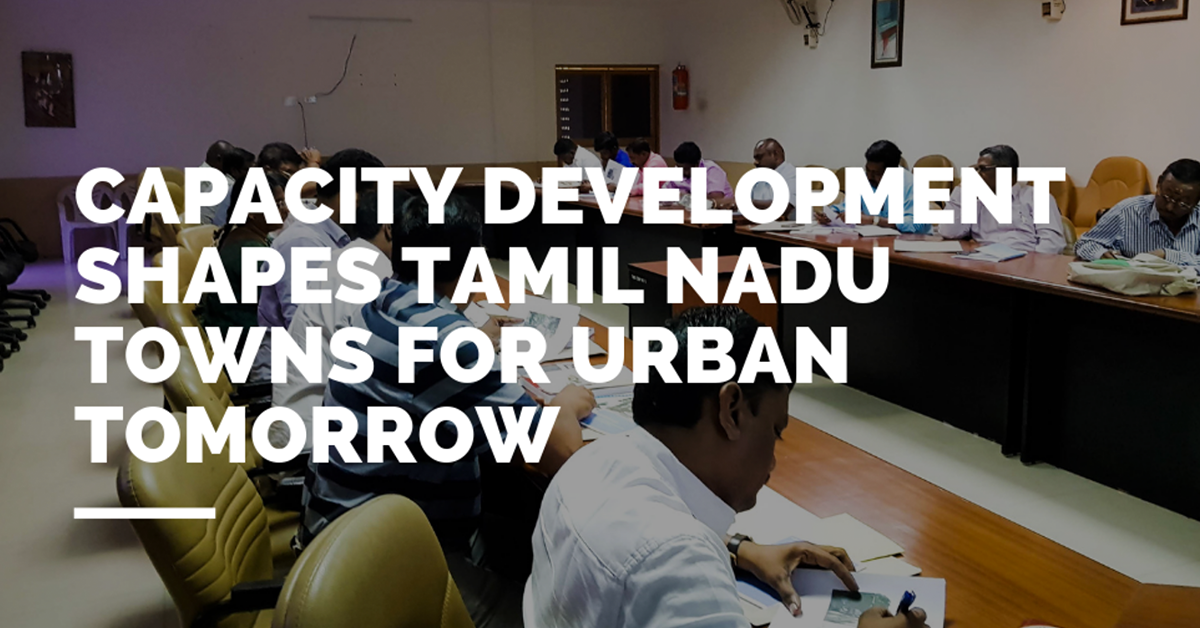
Taking notice of this worrying development, the Commissionerate of Municipal Administration (CMA), in partnership with the Tamil Nadu Institute of Urban Studies (TNIUS) and the ITDP India Programme, commissioned the capacity building programme on urban planning. The program was structured to help prepare town planners and panchayat officials to create streets and public spaces which meet the standards of upcoming smart cities.

Shifting from streets for vehicles, to streets for all

In the midst of modernisation, a key component of civic planning that is often overlooked is equitable street design. To help towns and municipalities reimagine and structure streets, beyond just accommodating the rampant vehicle population, the India Programme was brought on board to share its expertise in creating complete streets which adhere to every road users need.

As part of the course, the India Programme designed and conducted capacity development sessions for over 240 town planners from about 100 municipalities that was spread across three months.


In absence of such interventions, town planners tend to sway to the tune of vehicle-centric planning; this at the expense of safe footpaths and cycling facilities. While carriageways only get broader and footpaths narrower! Hence, such developmental workshops help officials realise the need for equality and accessibility while laying out streets. Emphasis was put on creating and improving infrastructure for pedestrians and cyclists—who account as the primary occupants of Indian urban roads.

Making sense of Complete Streets

‘What are Complete Streets?’ When asked to express their understanding of the concept, the responses from officials varied from ‘streets that are planned for better vehicular passage’ to it being ‘foreign/alien’ to them.

So, what are Complete Streets?

Complete Streets are street layouts that cater to all user groups—regardless of their age, gender, ability, or mode of transportation. They are designed with wide and continuous footpaths, safe pedestrian crossings, separate cycle tracks (where applicable), bus stops designed to enhance convenience, designated on-street parking, organised street vending, and properly-scaled carriageways. These streets are designed to offer the best of convenience and comfort based on local needs and offer spaces for relaxation, play, and interaction.

Understanding the essence of Complete Streets

Since motor vehicles have been dominating every square inch of our urban infrastructure and design plans, the sessions began with a bit of a reality check. Participants, including town planning inspectors, executive officers, and town planning officers, were introduced to general facts such as modal share, infrastructure inadequacies, misconceptions regarding road infrastructure planning, etc.

This turned out to be an important step in the process, as it helped expose the misbelief that motor vehicles transport more people than any other transportation mode. Walking and cycling accounts for 40-50% of the total modal share, and just a quarter of urban trips are on personal motor vehicles.


To further quash the fallacy, officials were shown multiple images of vehicle-centric design plans which were riddled with flaws—unusable or absent footpaths, rampant on-street parking encroachments, haphazard pedestrian crossings, etc. On realising the potential threat such single-pronged plan would generate, more officials realised why streets need to designed for all users than just vehicles.

Providing the tools for change

Understanding the flaw is just one part of the solution, the next step required acceptance and gumption to resolve it. Hence, the following session looked to tackle the incessant argument claiming, ‘Our town streets aren’t like cities, they are too small to adopt such measures.’

By sensitising officials to multiple examples of Indian streets, each reclaimed and refurbished according to best practices, many of the skeptics were won over by the effectiveness of the Complete Street programme. For example, the redesign of JM Road and DP Road in Pune; which has been lauded across the country, even winning the Housing and Urban Development Corporation Award and the Volvo Mobility Award 2017.

Further on, the basic components of Complete Streets were broken down and each element was interactively explained to officials.

To further enable their understanding of the concept, ITDP’s resources—such as Footpath Fix and Footpath Design for designing and constructing standardised footpaths and Parking Basics and Park it Right for creating means for a parking management system—were discussed and later shared with the participants for further reference.  

At the pace towns are developing in Tamil Nadu, 2030 does not seem like a distant future. Therefore, such capacity development sessions go a long way to instil concepts of sustainable and equitable mobility culture right at the grassroot levels. In essence, preparing these townships to meet their aspirations and ensure it is done for the people and not vehicles.

Written by Rohit James

Edited by Kashmira Medhora Dubash

Filed Under: Uncategorised Tagged With: Capacity Development, Community engagement, Sustainable Transport, Sustainable Transport Policy, Tamil Nadu, Walking and Cycling

Pune inspires Tamil Nadu cities to reclaim streets for people

pune cycle sharing

6th April 2018 by admin

“Smart cities are equivalent to glamorous buildings where policies and guidelines form a strong foundation”, Mr. Kunal Kumar, IAS, Commissioner of Pune Municipal Corporation. Over the years, our streets have been reduced to battlefields as people try to grapple with traffic congestion, lack of footpaths, and air pollution. One city that has taken bold, applaudable measures to rectify this chaos is Pune. Pune has been and continues to be an inspiration for many Indian cities that strive to reclaim streets for its people.

To explore Pune’s accomplishments, ITDP organised and facilitated a study tour for Tamil Nadu city officials – Corporation Commissioners of Erode, Madurai, Salem, Tiruppur, and Vellore, accompanied by engineers from the office of the Commissionerate of Municipal Administration. The study tour was conducted in collaboration with Pune Smart City Development Corporation Ltd. (also known as PSCDCL) and Pune Municipal Corporation, in February. The one-day programme aimed to sensitise participants on the best practises of designing complete streets – streets with quality footpaths, segregated cycle tracks, safe pedestrian crossing and managed parking.

Delegates interacting with PSCDCL team at the Smart City Operations Centre

Delegates interacting with PSCDCL team at the Smart City Operations Centre

The delegates visited the Smart City Operations Centre that seamlessly integrates management and monitoring of the smart city operations. To the extent, “this system also oversees the energy consumed by streetlights in the city and alerts us when any light stops working”, explained Mr. Manojit Bose,Chief Knowledge Officer, PSCDCL. The team from Tamil Nadu marvelled at the Centre’s resourcefulness at data collection and efficiency in maintaining the city’s public infrastructure.

This was followed by a roundtable discussion, facilitated by Mr Kunal Kumar, Commissioner, Pune Municipal Corporation. Mr Kumar highlighted three guiding principles for a smart city: adopt policies that guide it’s existing and future transportation requirements, leverage multiple sources of funding, and build internal capacity. Pune has launched a two-year programme with Singapore Land Transport Authority to enable 120 engineers from five departments in Pune and Pimpri-Chinchwad to acquire the knowledge and skills required for the projects.

Mr. Kunal Kumar interacts with the Tamil Nadu team and shares his recommendations for the success of the smart city projects.

Mr. Kunal Kumar interacts with the Tamil Nadu team and shares his recommendations for the success of the smart city projects.

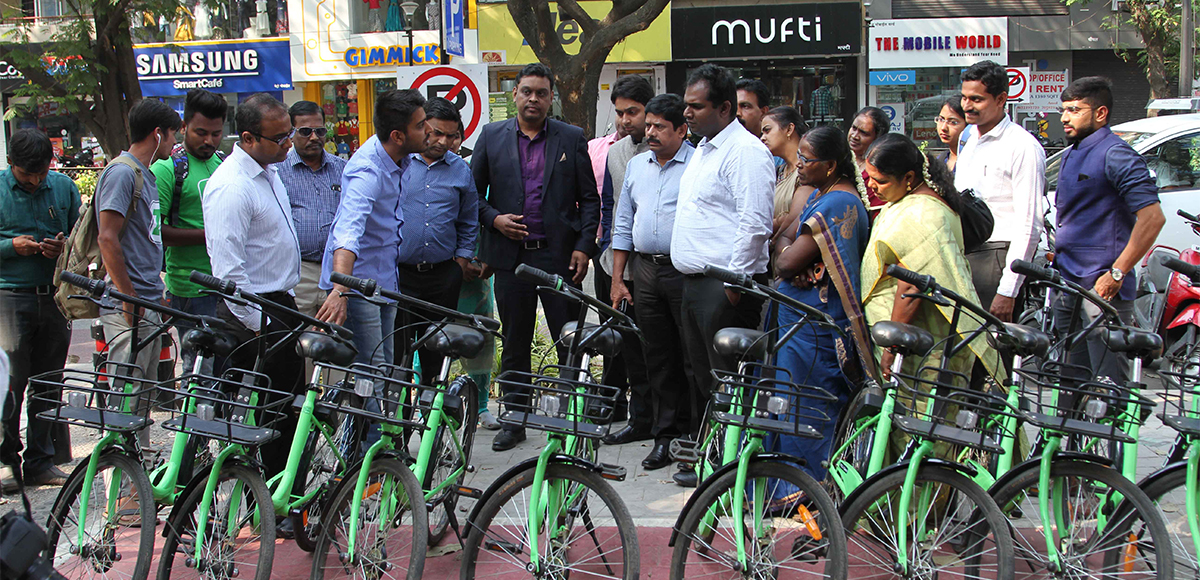
The discussion was followed by a site visit to Aundh-DP road to observe the seamless execution of Pune’s complete streets. Mr. Vikas Thakar, Pavetech Consultants, gave an insight into the implementation of high quality streets and detailed the design process of DP road. The delegates took the opportunity to experience Pune’s public bicycle sharing (PBS) system first-hand by cycling along the dedicated cycle tracks on DP Road. Pune’s dockless PBS system was proposed under the city’s Bicycle Plan which piloted 275 bicycles of the proposed total of 13,100 docked bicycles. The system received a great response from the delegates.

TN delegates checking Pune PBS

Tamil Nadu delegates testing Pune’s dockless PBS system

The delegates also visited a transformed public amenity space at Baner. Pune’s vision of creating recreational spaces has been revolutionised. Gone are the days when parks were the only public open spaces in the city. Underutilised and derelict parcels of land have been acquired by the Corporation and developed into theme-based amenity spaces. The two pilot projects in Baner are perfect examples of how cities can explore and catalyse the versatility of urban spaces.

Amenity space developed on the theme of ‘Art and Culture’ in Baner

Amenity space developed on the theme of ‘Art and Culture’ in Baner

Although smart cities are often synonymous with information and communication technologies, a city has to invest in human and social capital for improving the quality of life and achieving sustainable economic development. That is when it can truly become a smart city. And, after the exposure visit to Pune, it can be safely said that this is what cities in Tamil Nadu are aspiring for!


Filed Under: Pune Tagged With: Cycle sharing, Public Transport, Public-Private Partnership, Pune, Sustainable Transport, Tamil Nadu, Walking and Cycling

  • « Previous Page
  • 1
  • 2
  • Who We Are
    • Our Team
    • Contact Us
    • Opportunities
    • Our Approach
  • What We Do
    • Complete Streets and Parking Management
    • Public Transport
    • Transit Oriented Development
    • Inclusive Mobility
  • Where We Work
    • Agra
    • Ahmedabad
    • MAHARASHTRA
    • Pune – Pimpri-Chinchwad
    • Nashik
    • TAMIL NADU
    • Chennai
    • Coimbatore
    • JHARKHAND
    • Ranchi
    • NATIONAL
  • News
  • Resources
  • Get Involved
    • Donate

Copyright © 2025 · ITDP Responsive on Genesis Framework · WordPress · Log in


Loading Comments...