


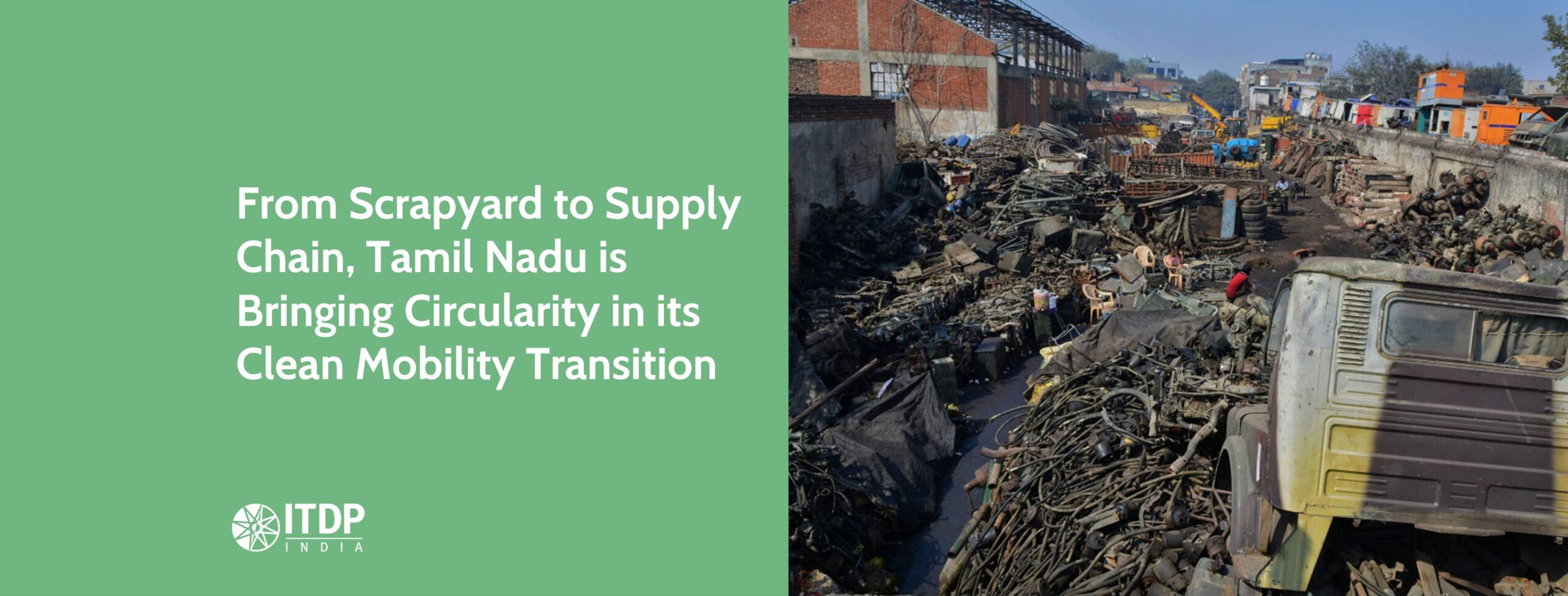
As India works towards its climate and clean air goals, efforts are focused on making the shift to cleaner vehicles happen faster. However, for this transition to succeed, two equally important challenges need to be addressed.
The first is moving older, more polluting vehicles off the road. In 2025, around 12 million vehicles across India were eligible for scrappage, yet between 2022 and 2025, fewer than 3% of them were actually scrapped. This is a serious problem because older vehicles do not just pollute a little more — they can pollute many times more. In fact, one BS4 truck or bus can emit as much pollution as around 14 BS6 vehicles, while one BS4 car can be equivalent to nearly 11 newer BS6 cars in terms of emissions. If cleaner mobility is to become a reality, this shift away from ageing, high-emission vehicles needs to happen at scale.
The second challenge is what happens once these vehicles begin to leave the system. Tamil Nadu alone is expected to see around 1.56 crore vehicles enter the scrapping market by 2030. At the same time, as EV adoption increases, the state will also begin to see a rise in battery waste over the coming years. This means that a sustainable transition is not only about bringing cleaner vehicles onto the road. We need to deal responsibly with the old vehicles, tyres, vehicle components, and batteries that this shift will leave behind. Without proper systems in place, end-of-life vehicles (ELVs) and batteries can create environmental and public health risks.

At the same time, vehicle components and batteries are valuable resources that contain valuable resources that can be recovered and reused, and should not be simply discarded. Critical minerals and rare earth elements used in EV batteries are limited, expensive, and highly import-dependent. Discarding what can be recovered works against the very idea of a sustainable transition.
Hence, the next phase for a Greener Tamil Nadu needs to go beyond adoption. It must help people move away from older, polluting vehicles, while also creating a responsible and circular pathway for the materials and components they leave behind. In many ways, this is what will determine whether the transition is truly clean.
The vision for a Greener Tamil Nadu
The manufacturing sector, including vehicle manufacturing, forms the backbone of Tamil Nadu’s economic growth story. As the state works towards becoming a trillion-dollar economy by 2030, the demand for materials and resources to support this growth will also rise significantly. In the mobility sector, this raises an important question: how can Tamil Nadu continue to move towards cleaner transport without creating a new burden of old vehicles, EV batteries, tyres, and parts that are left unmanaged?
Tamil Nadu’s recent policy direction – the Vehicle Scrappage Policy, implemented through G.O. Ms. No. 451, and the Tamil Nadu Circular Economy Investment Policy 2026, together address three parts of the transition:
- Moving people away from older, polluting vehicles;
- Preparing for the rise in end-of-life components and battery flows; and
- Reducing the pressure on limited and expensive raw materials through reuse, recycling, and second-life applications.

What Tamil Nadu’s Vehicle Scrappage Policy Means
Tamil Nadu’s Vehicle Scrappage Policy does more than create a process for scrapping old vehicles. It puts in place a more organised system for retiring vehicles that are old, unfit, damaged, or no longer economical to repair, while also linking scrappage to cleaner mobility goals.
For citizens, the policy creates a formal and digitally tracked pathway to scrap eligible vehicles through authorised Registered Vehicle Scrapping Facilities (RVSFs). By moving the process to the Vahan portal and authorised scrapping facilities, the policy seeks to make scrappage more transparent, accountable, and easier to navigate than informal channels.
The policy also lays down a method for determining scrap value, allowing vehicle owners to recover some value from an ageing vehicle through an authorised scrapping facility. It also provides a Certificate of Deposit, which can be used to access benefits when purchasing a new vehicle.

Beyond citizens, the policy also has implications for the scrapping and recycling ecosystem itself. By shifting vehicle retirement into a more formal and regulated system, it creates the possibility for the sector to gradually move away from unsafe and environmentally harmful dismantling practices towards safer, more standardised, and traceable methods. For workers and enterprises in this space, formalisation can also mean clearer processes, more predictable pricing, and stronger integration with authorised recycling and recovery industries. While much of the sector still operates informally today, policies like this begin to lay the groundwork for a more organisedecosystem over time.
At the same time, the policy recognises that this transition cannot rest on citizens alone. It requires the government itself to lead by example by phasing out vehicles in its own fleet that are older than 15 years. In Tamil Nadu, this applies to 11,908 government-owned vehicles, including those belonging to State Transport Undertakings and local bodies, which are to be disposed off through RVSFs. The policy also empowers the state to build the supporting ecosystem by enabling the establishment of scrapping facilities and automated testing stations, both of which are essential for making this shift work in practice.
Together, these provisions make the policy larger than a scrappage rule. It is both a citizen-facing and system-facing reform.
How the Circular Economy Investment Policy 2026 Strengthens the Clean Mobility Transition
If the Vehicle Scrappage Policy focuses on helping older vehicles exit the system more responsibly, the Tamil Nadu Circular Economy Investment Policy 2026 looks at what happens next. The policy identifies the automobile sector as a major part of the state’s greener industrial future and focuses on three linked areas: end-of-life vehicles, EV batteries, and tyres.
One of the clearest signals in the policy is that Tamil Nadu is preparing for scale. With 1.56 crore vehicles expected to enter the scrapping market by 2030, there is a need to build the industries and systems needed to recover value from them. The state is facilitating the development of Registered Vehicle Scrapping Facilities (RVSFs) and associated infrastructure, aligning with the national Voluntary Vehicle Fleet Modernisation Program (VVMP).
There is a major focus on advanced-chemistry cells and battery recycling, which is increasingly important as EV adoption rises. From a 3.94% adoption rate in 2022, Tamil Nadu reached 7.85% EV adoption in 2025, with over five lakh registered EVs as of February 2026. While this is a positive sign for cleaner mobility, it points to a challenge that is going to emerge. Since EV batteries typically last up to ten years, a large number of batteries will be reaching their end-of-life in the coming decade.
Instead of seeing used batteries only as a disposal challenge, the policy treats them as a source of valuable materials such as lithium, nickel, and cobalt that can be recovered and fed back into future manufacturing. This is particularly important for India, which remains heavily dependent on imports for these critical minerals — entirely so in the case of lithium and cobalt, and significantly for nickel and rare earth elements. Today, a large share of battery-related waste is either exported or lost to informal channels, representing not only an environmental concern but also economic loss and a resource security risk.

By creating systems to recover these materials from old batteries in a more robust and localised way, Tamil Nadu can help reduce future import dependence while building a more resilient EV ecosystem. To support this, the policy focuses on the entire battery value chain, including collection, diagnostics, dismantling, recycling, and material recovery. It also encourages second-life uses for batteries, such as for energy storage, backup power, and support for EV charging infrastructure.
The third component looks at tyres, which are among the most frequently replaced parts of a vehicle due to constant exposure and wear. A tyre typically lasts only one-fifth of a vehicle’s life, which means that the number of tyresreaching the end of their use is far greater than the number of vehicles. This becomes especially important in a country like India, which is the world’s third-largest automobile market, with the tyre manufacturing sector reaching a total production of 217 million units. Tamil Nadu plays a significant role in this ecosystem, contributing to nearly to 25% of the country’s total tyre exports, while also having the third largest vehicle fleet registrations in the country. Together, this means the state is likely to see a substantial volume of used tyres over time. In this context, the policy encourages more circular ways of handling used tyres, from recycling and retreading to creating downstream uses in other industries. This helps position circularity not only as an environmental response, but also as an industrial opportunity.

To make this ecosystem viable, the policy also introduces financial and institutional support. It offers incentives for new recycling and circular economy businesses, support for skilling and employment, and added assistance for smaller enterprises. It also proposes enabling infrastructure such as low-carbon green industrial parks, digital platforms to connect waste generators with authorised recyclers, and climate-focused funding mechanisms.
By supporting the recovery, recycling, and repurposing of old vehicle components, tyres, and batteries, Tamil Nadu is not only addressing an environmental challenge but also opening up new opportunities for investment in industries that can bring these materials back into productive use. This is especially relevant for EV batteries, where second-life applications and material recovery can create value beyond the vehicle’s first use.
Along with reducing carbon emissions, the Circular Economy Investment Policy 2026 focuses on building the industries, recovery systems, and material loops needed to make the transition from ICE vehicles more sustainable over time.
Tamil Nadu’s two recent reforms mark an important shift in how the clean mobility transition is being approached
Having these policies in place is, in itself, a positive start. At a time when vehicle registrations continue to rise across India – now at 42 crore – and Tamil Nadu alone accounts for over 3.5 crore registered vehicles, these reforms are a logical next step in preparing for the long-term realities of a growing and changing mobility ecosystem. The state’s vehicle registration has also continued to expand steadily in recent years, increasing by 6.98% in 2024 and 8.44% in 2025, underlining the need to think not only about cleaner vehicles entering the system, but also about how older vehicles, batteries, and materials exit it 15 years down the line.
At the same time, it is important to keep in mind that the EV ecosystem is still in a nascent stage, and the real promise of these reforms will depend on how effectively the government is able to build the supporting infrastructure, strengthen implementation, and translate policy intent into systems that work on the ground.
Written by Shreesha Arondekar, Senior Associate, Development and Communications, with inputs from Pavithiran R , Associate, Transport Systems and Electric Mobility and Sooraj E M Program Manager, Transport Systems and Electric Mobility
Edited by Donita Jose, Deputy Manager, Communications