ITDP India

Promoting sustainable and equitable transportation worldwide

  • Contact
  • ITDP India’s 2025
  • Who We Are
    • Our Approach
    • Contact Us
    • Career Opportunities
  • What We Do
    • Healthy Streets
    • Public Transport
    • Electric Mobility
    • Transit Oriented Development
    • Low Emission Zones
    • Inclusive Mobility
    • Traffic Reduction
  • Where We Work
    • NATIONAL
    • MAHARASHTRA
      • Pune
      • Pimpri Chinchwad
      • Nashik
    • TAMIL NADU
      • Chennai
      • Coimbatore
    • JHARKHAND
      • Ranchi
    • Agra
    • Ahmedabad
  • Blogs
  • Resources
    • Press
  • National Challenges
    • India Cycles4Change Challenge
    • Streets for People Challenge
    • Transport4All Challenge
  • Urbanlogue
    • Urbanlogue Webinars – Series One
    • Urbanlogue Webinars – Series Two
    • Urbanlogue Webinars – Series Three
    • Urbanlogue Webinars – Series Four

Tamil Nadu’s 2026-27 Budget Puts Streets, Buses and Charging on the Agenda

16th September 2026 by admin


The Tamil Nadu Chief Minister, C. Joseph Vijay, announced the state’s latest budget on August 05 and has unravelled what’s being called a new chapter for urban mobility taking shape in Tamil Nadu.  

The 2026–27 budget is being called a pioneering one for sustainable mobility, for not one, but two of its significant announcements. Firstly, the Chief Minister’s Integrated Urban Development Mission (CMIUD), has 11 sub-missions, includes the City Roads, Mobility and Transport as a dedicated sub-mission within a five-year framework. With ₹2,117 crore allocated this year and recurring funding envisioned, mobility gets a more focused place in the state’s urban development agenda.  Municipal Administration and Water Supply (MAWS) also ranked as the third highest-funded department of this year’s budget with a ₹29863 Crore allocation – a 12% increase compared to last year’s ₹26678 Crores, following School Education and Rural Development departments. 

The shift is also clear in the state’s approach to electric mobility. For the first time, the budget has committed dedicated funding for public EV charging, with ₹50 crore allocated this year with a target of having 20,000 charging stations over five years. 

 Alongside this, the investments in 1,000 AC e-buses for Chennai and charging infrastructure at MTC depots, the message is clear: Tamil Nadu is putting money behind a cleaner, more people-centred urban mobility future.  

Interestingly, it is not just the budget, this shift towards a sustainable mobility future is being reflected even in the MAWS policy note, which mentions concepts like complete streets, further reiterating that the state is walking the talk. The Vetri Tamizhagam Vision 2031, which is similar to a state-wide vision document, reinforces this direction, calling for citizen-friendly roads with footpaths, cycle tracks and storm water drains, alongside urban greening, climate resilience, and improved public transport infrastructure. 

Here are some of the key highlights from the budget that reiterate this 

Healthy Streets 

Key highlights:  

  1. The Chief Minister’s Integrated Urban Development Mission – A 5-year umbrella mission with a current financial year outlay of ₹2,117 crore. The 11 sub-missions are: 
  • City Infrastructure Development Plan. 
  • Urban Water Supply. 
  • Urban Underground Sewerage. 
  • Integrated Solid Waste Management. 
  • City Roads, Mobility and Transport. 
  • Urban Greening, Recreation and Open Spaces. 
  • Urban Water Bodies Development. 
  • Social Infrastructure. 
  • Safety and Security Mission. 
  • Digital Urban Governance. 
  • Public Health Mission. 

Why we are glad: Unlike traditional budgets in which urban investments are fragmented across departments and schemes, this year’s mission recognises that cities function as interconnected systems. Integrating transport, water, public spaces, and governance under a single programme creates opportunities for more coordinated planning and implementation. If operationalised well, this mission could improve project delivery while reducing duplication across agencies. 

2. a. People-friendly streets – The Chief Minister’s special announcement highlighted a dedicated budget of ₹165 Crores for this financial year to implement People-friendly streets initiatives across all municipal corporations excluding Chennai. This will include, transforming streets into modern urban thoroughfares with proper road connectivity, dedicated pedestrian pathways, separate cycling lanes, well-connected cross-streets, junction improvements, safe school access networks, and modern LED street lighting.  

b. What’s in it for Chennai: This year, two special announcements were additionally made by the hon. Chief Minister,  

  • Safe Routes to Schools: Piloting safer, child-friendly streets across Tondiarpet, Royapuram, Washermenpet and K.K. Nagar. 
  • Improvement of Traffic Islands/Junctions: 105 junctions to be transformed in Chennai under this initiative. 

These will be executed with a dedicated budget of ₹110 Crores for this financial year. 

It may be noted, under the overarching theme of “People-Friendly Modern Streets” the Greater Chennai Corporation is already pioneering the following initiatives, 

  • 200 km of footpaths: Expanding the pedestrian network to strengthen intra- and inter-neighbourhood connectivity, alongside parking management and transit integration. 

Complete Streets: Transforming streets across six key neighbourhoods with World Bank support under the Chennai City Partnership. 

Why we are glad: Last year, we noted that walking and cycling infrastructure have always received short shrift, but this year’s budget changes that, not only for metropolitan cities in Tamil Nadu but for all municipal corporations. This is a truly encouraging shift that prioritises the silent majority of street users who walk or use public transport for their daily commute.

What we recommend: Measurable targets and best-practice standards at the State level for planning, design, and implementation of these initiatives will be important to ensure that these commitments translate into high-quality streets across cities.  

3. Performance-based Maintenance Contracts and Namma Salai app: A dedicated allocation of ₹250 crores have been earmarked for Operations and Maintenance of roads. Encouraging user ownership, this announcement comes along with the  ‘Namma Salai’ mobile application, where citizens can report any road repairs to enable prompt rectification. 

Why we are glad: Operations and Maintenance, which is often a second thought, has become a priority line item in the State budget. Pre-defined Key Performance Indicators (KPIs) ensures greater accountability, quality implementation/restoration standards thereby lowering lifecycle costs of road assets. 

What we recommend: Roads often mean only carriageways. What we would like to see is regular maintenance of walking and cycling infrastructure (footpaths and cycle tracks), above-ground utilities (pillar boxes, streetlights, uneven manhole levels, hanging cables, street furniture etc.), which form an integral part of our Right of Way (RoW). Standardised KPIs shall be created specifically for these street elements to track maintenance measures and ensure that they are also timely repaired and well- maintained.  

  1. Climate resilience becomes urban and public infrastructure in this budget:  
  • Greening and Beautification as a part of CM’s Integrated Urban Development Mission: To expand Chennai’s green canopy and create people-centric public spaces, footpaths along major routes, and residential zones will also undergo greening and beautification. 
  • Blue-green infrastructure: Projects around Chennai’s water bodies to mitigate urban flooding, protecting environmental resources while creating sustainable spaces for community use. 
  • Cooum and Adyar river restoration: Global tenders and DPR for river rejuvenation, with boating facilities, riverfront promenades, and recreational spaces. 

Why we are glad: The budget recognises that climate resilience is increasingly inseparable from urban development. By integrating it into mainstream urban investments like streets and public space improvements, Tamil Nadu moves beyond conventional engineering approaches towards more nature-based solutions that can improve flood resilience, public health, and urban liveability. 

What we recommend: While these are significant policy commitments thought through a climate resilience intersectionality lens, mobility and street design should also be integrated. We’d like to see these translate into street-level specifics: minimum tree canopy cover along footpaths and cycle tracks as a heat-mitigation standard, and stormwater drainage channels built into every road/access created for the blue-green infrastructure.  Attaching dedicated, published allocations to each of these announcements will also be key to timely, accountable delivery. 

EV Charging  

  1. EV Charging Infrastructure Rollout: ₹50 crore has been allocated in 2026-27 towards developing public EV charging stations, with a target of establishing 20,000 public EV Charging Stations across Tamil Nadu over the next five years. 

Why we are glad: Charging availability is one of the biggest factors shaping EV adoption, and a clear five-year target signals a strong, sustained commitment to building out that network at scale. A wider public charging network also goes a long way in easing range anxiety – the hesitation many potential EV buyers feel about running out of charge with nowhere nearby to top up – making EVs a more confident, practical choice for everyday use. Setting a public, numeric goal like 20,000 stations gives citizens, industry, and charge point operators a concrete benchmark to plan around, rather than incremental, unclear expansion.

What we recommend: As the rollout progresses, publishing a phased plan will make the five-year journey easy to follow. This plan could cover districts and corridors which are to be prioritised first, explore how urban versus highway placement is sequenced, and what charger types (based on the interoperability standards and charging rate) are deployed where.  

  1. Residential EV Charging Incentive: ₹5 crore has been earmarked to incentivise the installation of EV charging stations. This supports Resident Welfare Associations (RWAs) in setting up charging infrastructure within housing societies and apartment complexes. 

Why we are glad: This initiative recognises that public charging infrastructure alone isn’t enough, a lot of EV charging naturally happens at home, overnight. By supporting RWAs directly, the government is making it easier for EV owners living in apartments and gated communities to access convenient charging where they live.

What we recommend: Creating a simple, standardised process and platform for RWAs to apply for and access this incentive would help more housing societies take it up smoothly. Sharing a few early success stories or model implementations from participating RWAs could also help other communities see how straightforward the process can be, encouraging wider adoption across the state. 

Public Transport 

  1. State Transport Undertaking (STU) subsidies and performance-linked funding: The budget provides a total allocation of ₹13,561 crore for the Transport Department. Within this,  ₹7,675 crore in allocated for operating subsidy to STUs statewide, along with ₹2,650 crore in performance gap funding, and ₹1,005 crore as share capital assistance. 

Why we are glad: What stands out here is the structure of the funding, not just the total. Separating an operating subsidy (₹7,675 crore) from the performance gap funding pool (₹2,650 crore) points toward outcome-linked support. This kind of disaggregation is useful because it makes it possible to track whether STUs are meeting service targets and to direct funding, accordingly, adding a layer of accountability alongside the base subsidy.

What we recommend: For performance gap funding, publishing the specific metrics used to define the “gap” – such as occupancy, route coverage, or fleet efficiency – would help make the outcome-linked intent of this funding fully visible and give each STU clarity on what improvements are being recognised and supported.  

For share capital assistance, structuring allocations around each STU’s actual capital needs such as fleet age, planned route expansion, or procurement targets would help the funding go further. Pairing both funding streams with a simple, public utilisation update showing funds released and used over the year would help showcase the impact of this investment as it reaches STUs across the state. 

  1. MTC Chennai: 1,000 electric buses for Chennai and a Gross Cost Contract ( GCC) model: The Budget commits to 1,000 new air-conditioned electric buses for Chennai’s Metropolitan Transport Corporation (MTC), procured and operated under GCC model, where private operators are paid per kilometre operated. Furthermore, a dedicated ₹500 crore has been earmarked for depot infrastructure to support this expanded electric fleet. 

Why we are glad: A fleet order of this scale, 1,000 buses in a single commitment, is a meaningful step toward decarbonising Chennai’s public transport and improving air quality across the city. Pairing the vehicle order with an upfront, dedicated depot infrastructure allocation is especially welcome: charging bays, grid connections, and maintenance yards are what determine whether an electric fleet runs reliably day to day, and developing this requires large investments. Funding them alongside the buses sets the rollout up to work in practice.

What we recommend: Depot selection could weigh proximity to high-frequency routes, grid capacity near substations and available land for charging and parking requirements. A mix of greenfield and brownfield depots would help – greenfield sites accommodate future network expansion, while upgrading brownfield depots lets the rollout prioritise existing high-demand routes early on.  
Strict service-level KPIs are best written directly into the GCC tenders. On route selection, underserved corridors depend on opportunity-charging infrastructure at layover points, not just the depot, so full coverage may need to be phased – starting with routes ready today while charging infrastructure is extended to underserved areas over time. 

  1. Diesel to Electric Bus Conversion: Around 100 diesel buses belonging to MTC Chennai, approximately 7 years old and in good condition, will be converted into electric buses and operated under the GCC Model. The necessary charging facilities and electrical infrastructure will be established at the depot, at an estimated cost of ₹13.6 crore. 

Why we are glad: Retrofitting existing, well-maintained buses into electric ones is an efficient way to go electric faster, it makes use of buses already in good shape while still delivering the emissions and air quality benefits of going electric. Alongside the depot-level charging and electrical infrastructure investment, this shows a practical, infrastructure-ready approach to expanding the electric fleet.  

What we recommend: Once these buses are running, sharing how they perform in terms of range, charging time and maintenance needs comparing to newly manufactured electric buses would be valuable in assessing conversion as a scalable model for the rest of the fleet. If it does, a clear plan for scaling up conversions across other ageing-but-serviceable buses in MTC’s fleet could offer a cost-effective complement to new electric bus procurement. 

  1. Special Buses for School Students: Special buses will operate during peak morning and evening hours for school students in rural, hilly, and interior areas where public transport service is currently inadequate. These buses will serve 140 schools, benefiting approximately 19,000 students.  

Why we are glad: This targets some of the hard-to-reach areas for public transport – rural, hilly, and interior regions, where students often face the biggest gaps in safe, reliable commuting options. Addressing this at the student level also has a ripple effect on families, easing the burden on parents who might otherwise need to arrange or accompany daily commutes themselves.  

What we recommend: Ensuring safe, walkable access to bus stops – especially in hilly terrain where road conditions can be challenging – would help students reach these buses safely on both ends of their commute. Reliability will also be key, since these buses need to align closely with school start and end times; clear, consistent scheduling would help both students and parents plan their day with confidence. 


Authors: Varsha V, Janani V
With inputs from: Vedavalli Vedantham, Bezylal Praysingh, Sooraj EM, Venugopal AV
Edited by Donita Jose 
Filed Under: Chennai, Healthy Streets, Public transport, Sustainable transport, Walking and cycling Tagged With: electric mobility, Healthy Streets, Public Transport, sustainable mobility Tamil Nadu, Tamil Nadu Budget 2026-27

From Scrapyard to Supply Chain, Tamil Nadu is Bringing Circularity in its Clean Mobility Transition 

10th April 2026 by admin


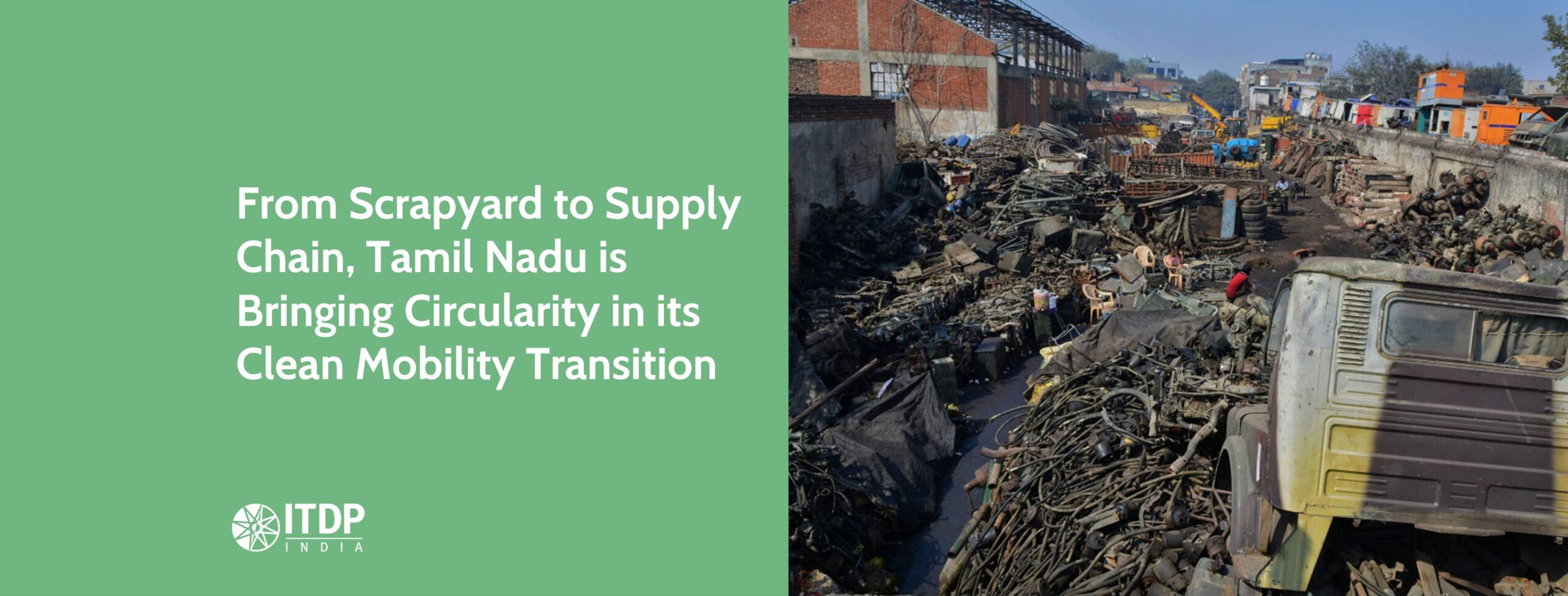
As India works towards its climate and clean air goals, efforts are focused on making the shift to cleaner vehicles happen faster. However, for this transition to succeed, two equally important challenges need to be addressed. 

The first is moving older, more polluting vehicles off the road. In 2025, around 12 million vehicles across India were eligible for scrappage, yet between 2022 and 2025, fewer than 3% of them were actually scrapped. This is a serious problem because older vehicles do not just pollute a little more — they can pollute many times more. In fact, one BS4 truck or bus can emit as much pollution as around 14 BS6 vehicles, while one BS4 car can be equivalent to nearly 11 newer BS6 cars in terms of emissions. If cleaner mobility is to become a reality, this shift away from ageing, high-emission vehicles needs to happen at scale. 

The second challenge is what happens once these vehicles begin to leave the system. Tamil Nadu alone is expected to see around 1.56 crore vehicles enter the scrapping market by 2030. At the same time, as EV adoption increases, the state will also begin to see a rise in battery waste over the coming years. This means that a sustainable transition is not only about bringing cleaner vehicles onto the road. We need to deal responsibly with the old vehicles, tyres, vehicle components, and batteries that this shift will leave behind. Without proper systems in place, end-of-life vehicles (ELVs) and batteries can create environmental and public health risks. 

At the same time, vehicle components and batteries are valuable resources that contain valuable resources that can be recovered and reused, and should not be simply discarded. Critical minerals and rare earth elements used in EV batteries are limited, expensive, and highly import-dependent. Discarding what can be recovered works against the very idea of a sustainable transition. 

Hence, the next phase for a Greener Tamil Nadu needs to go beyond adoption. It must help people move away from older, polluting vehicles, while also creating a responsible and circular pathway for the materials and components they leave behind. In many ways, this is what will determine whether the transition is truly clean. 

The vision for a Greener Tamil Nadu 

The manufacturing sector, including vehicle manufacturing, forms the backbone of Tamil Nadu’s economic growth story. As the state works towards becoming a trillion-dollar economy by 2030, the demand for materials and resources to support this growth will also rise significantly. In the mobility sector, this raises an important question: how can Tamil Nadu continue to move towards cleaner transport without creating a new burden of old vehicles, EV batteries, tyres, and parts that are left unmanaged? 

Tamil Nadu’s recent policy direction – the Vehicle Scrappage Policy, implemented through G.O. Ms. No. 451, and the Tamil Nadu Circular Economy Investment Policy 2026, together address three parts of the transition:  

  1. Moving people away from older, polluting vehicles;  
  2. Preparing for the rise in end-of-life components and battery flows; and 
  3. Reducing the pressure on limited and expensive raw materials through reuse, recycling, and second-life applications. 

What Tamil Nadu’s Vehicle Scrappage Policy Means 

Tamil Nadu’s Vehicle Scrappage Policy does more than create a process for scrapping old vehicles. It puts in place a more organised system for retiring vehicles that are old, unfit, damaged, or no longer economical to repair, while also linking scrappage to cleaner mobility goals. 

For citizens, the policy creates a formal and digitally tracked pathway to scrap eligible vehicles through authorised Registered Vehicle Scrapping Facilities (RVSFs). By moving the process to the Vahan portal and authorised scrapping facilities, the policy seeks to make scrappage more transparent, accountable, and easier to navigate than informal channels. 

The policy also lays down a method for determining scrap value, allowing vehicle owners to recover some value from an ageing vehicle through an authorised scrapping facility. It also provides a Certificate of Deposit, which can be used to access benefits when purchasing a new vehicle. 

Image source: Tata motors

Beyond citizens, the policy also has implications for the scrapping and recycling ecosystem itself. By shifting vehicle retirement into a more formal and regulated system, it creates the possibility for the sector to gradually move away from unsafe and environmentally harmful dismantling practices towards safer, more standardised, and traceable methods. For workers and enterprises in this space, formalisation can also mean clearer processes, more predictable pricing, and stronger integration with authorised recycling and recovery industries. While much of the sector still operates informally today, policies like this begin to lay the groundwork for a more organisedecosystem over time. 

At the same time, the policy recognises that this transition cannot rest on citizens alone. It requires the government itself to lead by example by phasing out vehicles in its own fleet that are older than 15 years. In Tamil Nadu, this applies to 11,908 government-owned vehicles, including those belonging to State Transport Undertakings and local bodies, which are to be disposed off through RVSFs. The policy also empowers the state to build the supporting ecosystem by enabling the establishment of scrapping facilities and automated testing stations, both of which are essential for making this shift work in practice. 

Together, these provisions make the policy larger than a scrappage rule. It is both a citizen-facing and system-facing reform.  

How the Circular Economy Investment Policy 2026 Strengthens the Clean Mobility Transition 

If the Vehicle Scrappage Policy focuses on helping older vehicles exit the system more responsibly, the Tamil Nadu Circular Economy Investment Policy 2026 looks at what happens next. The policy identifies the automobile sector as a major part of the state’s greener industrial future and focuses on three linked areas: end-of-life vehicles, EV batteries, and tyres. 

One of the clearest signals in the policy is that Tamil Nadu is preparing for scale. With 1.56 crore vehicles expected to enter the scrapping market by 2030, there is a need to build the industries and systems needed to recover value from them. The state is facilitating the development of Registered Vehicle Scrapping Facilities (RVSFs) and associated infrastructure, aligning with the national Voluntary Vehicle Fleet Modernisation Program (VVMP).  

There is a major focus on advanced-chemistry cells and battery recycling, which is increasingly important as EV adoption rises. From a 3.94% adoption rate in 2022, Tamil Nadu reached 7.85% EV adoption in 2025, with over five lakh registered EVs as of February 2026. While this is a positive sign for cleaner mobility, it points to a challenge that is going to emerge. Since EV batteries typically last up to ten years, a large number of batteries will be reaching their end-of-life in the coming decade.  

Instead of seeing used batteries only as a disposal challenge, the policy treats them as a source of valuable materials such as lithium, nickel, and cobalt that can be recovered and fed back into future manufacturing. This is particularly important for India, which remains heavily dependent on imports for these critical minerals — entirely so in the case of lithium and cobalt, and significantly for nickel and rare earth elements. Today, a large share of battery-related waste is either exported or lost to informal channels, representing not only an environmental concern but also economic loss and a resource security risk.  

Image source: Tata World

By creating systems to recover these materials from old batteries in a more robust and localised way, Tamil Nadu can help reduce future import dependence while building a more resilient EV ecosystem. To support this, the policy focuses on the entire battery value chain, including collection, diagnostics, dismantling, recycling, and material recovery. It also encourages second-life uses for batteries, such as for energy storage, backup power, and support for EV charging infrastructure. 

The third component looks at tyres, which are among the most frequently replaced parts of a vehicle due to constant exposure and wear. A tyre typically lasts only one-fifth of a vehicle’s life, which means that the number of tyresreaching the end of their use is far greater than the number of vehicles. This becomes especially important in a country like India, which is the world’s third-largest automobile market, with the tyre manufacturing sector reaching a total production of 217 million units. Tamil Nadu plays a significant role in this ecosystem, contributing to nearly to 25% of the country’s total tyre exports, while also having the third largest vehicle fleet registrations in the country. Together, this means the state is likely to see a substantial volume of used tyres over time. In this context, the policy encourages more circular ways of handling used tyres, from recycling and retreading to creating downstream uses in other industries. This helps position circularity not only as an environmental response, but also as an industrial opportunity. 

To make this ecosystem viable, the policy also introduces financial and institutional support. It offers incentives for new recycling and circular economy businesses, support for skilling and employment, and added assistance for smaller enterprises. It also proposes enabling infrastructure such as low-carbon green industrial parks, digital platforms to connect waste generators with authorised recyclers, and climate-focused funding mechanisms. 

By supporting the recovery, recycling, and repurposing of old vehicle components, tyres, and batteries, Tamil Nadu is not only addressing an environmental challenge but also opening up new opportunities for investment in industries that can bring these materials back into productive use. This is especially relevant for EV batteries, where second-life applications and material recovery can create value beyond the vehicle’s first use. 

Along with reducing carbon emissions, the Circular Economy Investment Policy 2026 focuses on building the industries, recovery systems, and material loops needed to make the transition from ICE vehicles more sustainable over time. 

Tamil Nadu’s two recent reforms mark an important shift in how the clean mobility transition is being approached 

Having these policies in place is, in itself, a positive start. At a time when vehicle registrations continue to rise across India – now at 42 crore – and Tamil Nadu alone accounts for over 3.5 crore registered vehicles, these reforms are a logical next step in preparing for the long-term realities of a growing and changing mobility ecosystem. The state’s vehicle registration has also continued to expand steadily in recent years, increasing by 6.98% in 2024 and 8.44% in 2025, underlining the need to think not only about cleaner vehicles entering the system, but also about how older vehicles, batteries, and materials exit it 15 years down the line.  

At the same time, it is important to keep in mind that the EV ecosystem is still in a nascent stage, and the real promise of these reforms will depend on how effectively the government is able to build the supporting infrastructure, strengthen implementation, and translate policy intent into systems that work on the ground. 

Written by Shreesha Arondekar, Senior Associate, Development and Communications, with inputs from Pavithiran R , Associate, Transport Systems and Electric Mobility and Sooraj E M Program Manager, Transport Systems and Electric Mobility 

Edited by Donita Jose, Deputy Manager, Communications 

Filed Under: Chennai, news Tagged With: auto recycling, automotive sector, battery recycling, circular economy, clean air, clean mobility, climate action, electric vehicles, end-of-life vehicles, energy transition, EV adoption, EV batteries, future of mobility, green policy, green transport, industrial policy, low emissions, recycling ecosystem, resource efficiency, sustainability, sustainable development, tyre recycling, urban mobility, vehicle scrappage

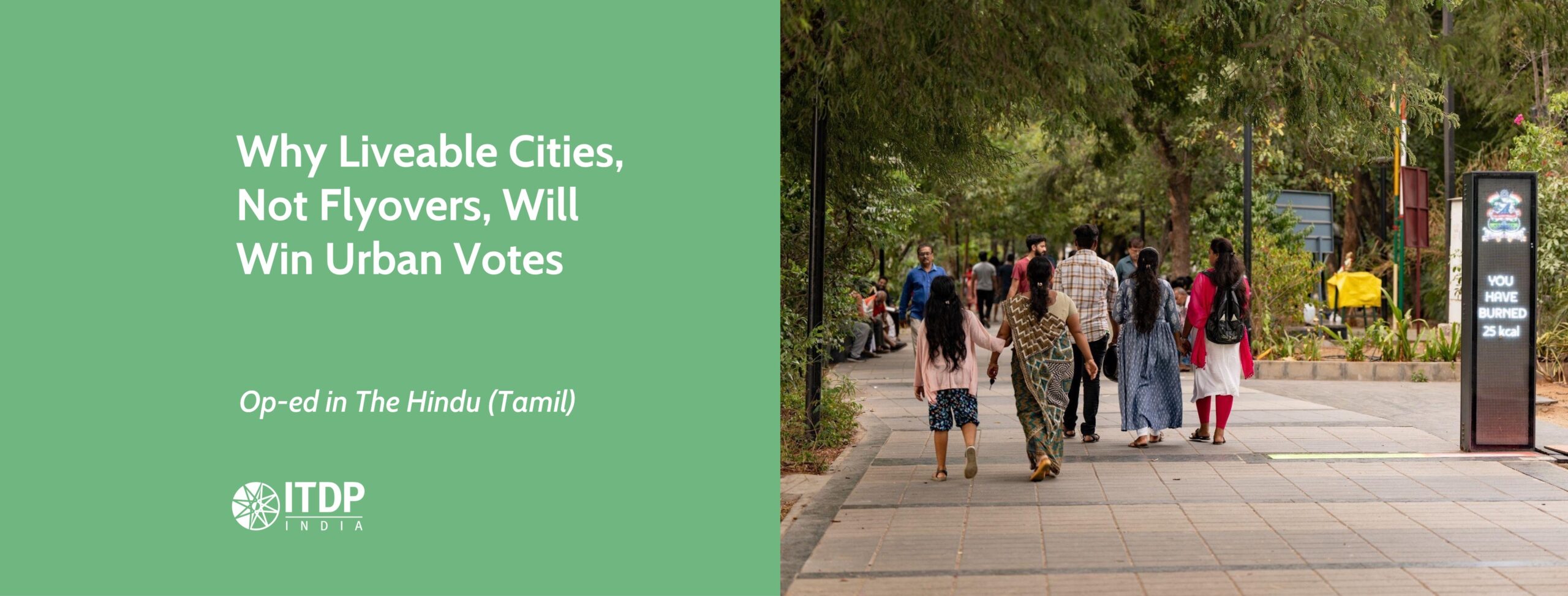
Why Liveable Cities, Not Flyovers, Will Win Urban Votes

8th April 2026 by admin


As published in The Hindu(Tamil)

For decades now, the opening of a new flyover has been the ultimate symbol of political progress. These towering structures of concrete and steel were marketed as the ultimate solution to congestion and a promise of modernity and speed.  

But ask any commuter on any major artery in our cities, and the answer is clear: the promise has expired. The congestion returns, often worse than before, while the immense investment delivers only fleeting relief for a small segment of commuters. 

The larger public sees very little benefit. 

The core problem here lies in an old belief in city planning: that we can build our way out of traffic. In reality, new roads encourage more people to use private vehicles. When driving becomes slightly easier, more cars and two-wheelers come onto the road. Soon, congestion returns. This cycle keeps repeating and cities keep spending huge public money on projects that are both environmentally and fiscally unsustainable.  

Globally, most forward-thinking cities have begun to question this approach. One famous example is Seoul in South Korea. The city famously dismantled a massive elevated highway through its centre, over the Cheonggyecheon stream. Many feared traffic chaos. Instead, Seoul gained a six-kilometre public park, better air quality, a 15% increase in public transport use, and rising property values. Traffic did not increase. The city became healthier and more liveable. 

San Francisco, Portland, and Paris have followed suit, removing urban highways to reclaim space for people, not just vehicles. These cities recognised that the competition for the future isn’t about which city is fastest to drive through, but which is the most desirable to live in. 

So, what is the political alternative in Tamil Nadu? It’s a platform that addresses the actual anxieties of the 21st-century voter: the crushing cost of living, the daily drain of the time-tax commute, and the health burden of toxic air. 

1. Fiscal Responsibility: Better Use of Public Money 

Flyovers are extremely expensive. One kilometre of flyover can cost ₹200 crore or more. This money serves a limited number of private vehicles. In contrast, the same amount can fund solutions that help far more people. 

For example, well-planned Bus Rapid Transit (BRT) corridors can move seven to eight times more people per hour than a flyover. The same budget can also buy around 100 electric buses or build over 100 kilometres of safe footpaths and pedestrian-friendly streets. 

The real question for governments should be: how can public money help the maximum number of people? Flyovers benefit a minority. Strong public transport systems benefit everyone—office workers, students, elderly citizens, women, and low-income families. From a financial point of view, investing in buses, walking, and cycling gives far better returns for taxpayers. 

2. The Daily “Time Tax” on Citizens 

For city residents, time has become a hidden tax. Hours are lost every week in traffic jams. This affects work, family life, health, and mental well-being. For professionals, small business owners, and gig workers, time lost is income lost. 

A city with frequent, reliable buses and good last-mile connectivity gives people back their time. Shorter and predictable commutes improve productivity and reduce stress. Today, many employees value an easy commute as much as salary hikes. Real estate prices already show this—areas close to good public transport are in high demand. 

When governments invest in strong public transport, they are not just improving mobility. They are strengthening the economy. Reduced travel time means more efficient cities and happier citizens. 

3. Public Health and Quality of Life 

Our cities are struggling with pollution, noise, and unsafe streets. Transport is one of the biggest contributors to air pollution and climate emissions. Every new flyover encourages more vehicle use, which worsens air quality. 

The alternative is cities designed for people. Safe footpaths, cycle tracks, shaded streets, and green spaces make cities healthier. These changes reduce respiratory illness, traffic accidents, and stress. Children can walk safely. Elderly citizens can move around without fear. Neighbourhoods become connected instead of divided by large concrete structures. 

This is not a luxury idea. It is about basic health, safety, and dignity in everyday life. 

What Voters Want Today

The voter is no longer impressed by a photo-op on an empty flyover. They are counting the hours lost in their week, calculating the fuel burning a hole in their pocket, and worrying about the air their children breathe. They are choosing quality of life. 

The winning manifesto will not list flyovers. It will pledge a statewide transit revolution – a commitment to doubling bus fleets, digitizing payments, and integrating schedules and ticketing so that a seamless multi-modal journey is a reality. It will promise to reclaim street space for people, turning dangerous corridors into complete streets. It will frame mobility not as a civic engineering challenge, but as the backbone of a prosperous, healthy, and efficient Tamil Nadu. 

The world’s most admired cities  have learned that you cannot build your way to prosperity with more concrete. Tamil Nadu has the chance to leapfrog the mistakes of the past and build truly smart, sustainable cities. The question is not whether we can afford to make this shift, but whether we can afford not to. The voter on the crowded bus, the parent worried about polluted air, and the citizen tired of traffic jams are waiting for an answer. And their votes will reflect it. 

Authored by A V Venugopal is a Program Manager at ITDP India, based in Chennai, where he leads sustainable mobility projects focused on street transformation and parking management. His work spans Tamil Nadu and extends nationally, in close collaboration with a multidisciplinary team. 

Filed Under: Chennai, news, Public transport, Walking and cycling Tagged With: Chennai, India, non-motorised transport, Parking, parking management, Public Transport, Safe Route To School, Sustainable Transport, Tamil Nadu, Walking and Cycling

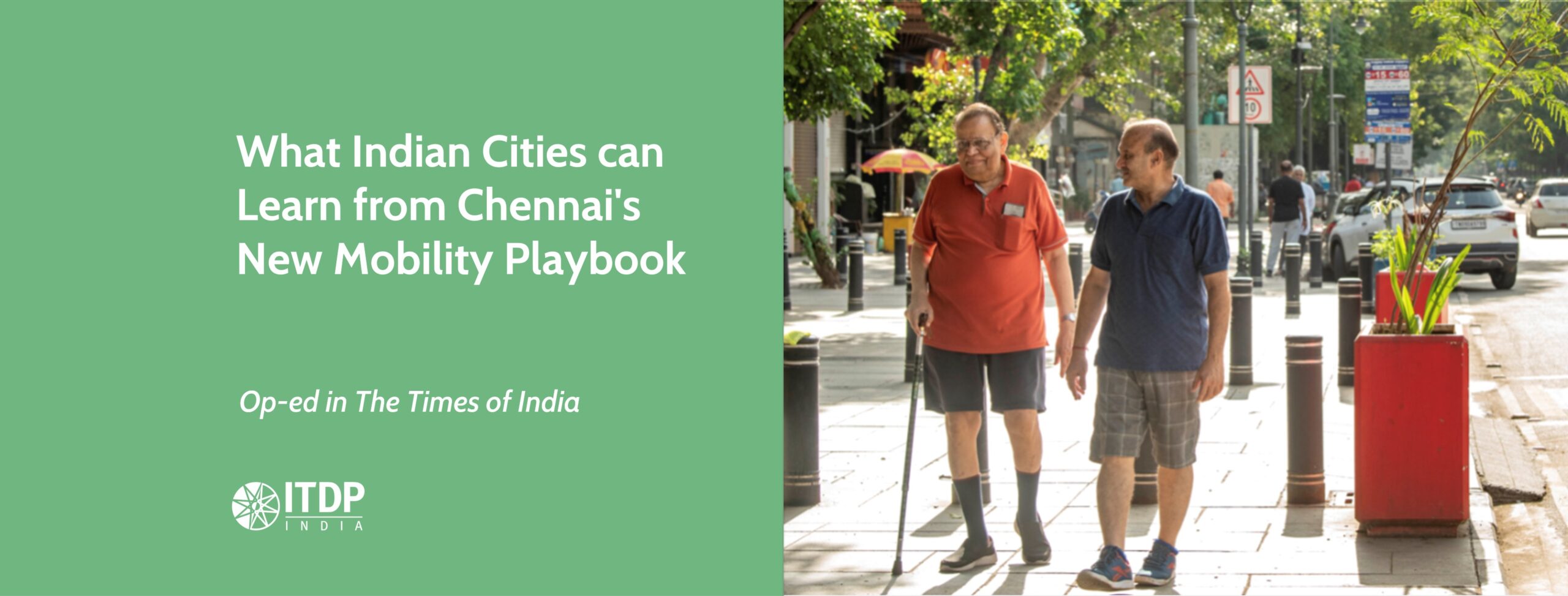
What Indian Cities can Learn From Chennai’s New Mobility Playbook

19th March 2026 by admin

As published in The Times of India

Indian cities do not suffer from a lack of transport plans; they struggle to turn those plans into coordinated action on the ground. Over the past two decades, most large cities have articulated similar ambitions—prioritising public transport, integrating land use and mobility, improving safety, and reducing dependence on private vehicles. Yet congestion has worsened, road fatalities remain high, and private vehicle ownership continues to rise across urban India. The problem has not been a lack of vision, but the difficulty of translating that vision into aligned implementation across agencies. 

Chennai reflects this broader national challenge. The city has planned for mobility before: a Comprehensive Traffic and Transportation Study in 2010 and a Comprehensive Mobility Plan in 2019, both aligned with national policy priorities around public transport, non-motorised travel, and land-use integration. Yet the outcomes fell short. This pattern is familiar across urban India: mobility plans do not fail because their goals are wrong, but because the institutional conditions required to implement them are weak. 

What’s Changed This Time 

For context, Chennai’s latest Comprehensive Mobility Plan (CMP) for 2023–2048 must be understood in this context. It is not the city’s first attempt at mobility planning, nor does it radically depart from earlier goals. 

But the key shift is institutional. With the operationalisation of the Chennai Unified Metropolitan Transport Authority (CUMTA) in 2022, Chennai now has a coordinating body for transport decisions across agencies and jurisdictions—something most Indian cities still lack in practice. Mandated under the CUMTA Act, the preparation of the Comprehensive Mobility Plan is a statutory requirement, marking a move away from ad-hoc planning towards a formally instituted process. This matters because fragmented decision-making, rather than a lack of projects, has fundamentally shaped poor mobility outcomes in Indian cities. 

Planning at the Right Scale, with the Right Evidence 

The CMP reflects the scale at which Chennai’s mobility challenges now operate. While earlier plans were anchored to a smaller planning area—1,189 square kilometres, the current CMP adopts a much broader metropolitan lens, covering 5,904 square kilometres. This expanded boundary brought rapidly urbanising suburban regions into the mobility planning framework, recognising that travel patterns, commuting pressures, and infrastructure demand today extend well beyond the city core and municipal limits. 

Planning at this scale required being backed by a stronger evidence base. The CMP draws on large-scale household surveys covering over 50,000 households and approximately two lakh citizens, complemented by fifteen primary surveys on traffic, parking, road conditions, freight movement, and travel behaviour. This shifts planning away from assumptions and corridor-level fixes towards a clearer understanding of how people travel across the region. 

Additionally, the planning process was participatory from the outset. Multiple government departments responsible for roads, public transport, planning, utilities, and finance, and public stakeholders, were engaged throughout, contributing to problem framing as well as solution design. By involving these agencies and the public from the outset, the CMP seeks to build shared ownership, an essential condition for implementation that earlier mobility plans often lacked. 

Where the Real Test Lies: Governance 

If evidence and participation explain why this CMP is different in its preparation, governance will determine whether it changes outcomes. Across Indian cities, mobility failures arise from projects implemented without alignment—often cancelling out each other’s benefits. Roads are widened while bus fleets stagnate for decades; metro and rail systems are built without reliable last-mile access; and parking supply continues to expand even as public transport struggles for priority. Each decision may appear defensible in isolation, but together they undermine the city’s mobility goals. 

Chennai’s CMP is explicit about this failure—and about what must change. At the centre of this shift is the role envisaged for the CUMTA. Unlike earlier arrangements that relied on goodwill or ad-hoc coordination, CUMTA is positioned as a reviewing authority for transport and mobility proposals initiated by different departments. The intent is straightforward: major transport interventions should proceed only if they align with the metropolitan mobility vision set out in the CMP. 

This is more than a procedural adjustment. It signals a shift in how transport decisions are expected to be made. Cities that have built high-performing urban mobility systems such as London and Singapore—have done so by consolidating authority, standardising dataand design systems, and enforcing alignment across agencies through institutions like Transport for London and the Land Transport Authority. Chennai’s CMP moves in this direction through proposals for standardised right-of-way design, region-wide data systems, parking management as a demand-management tool, and the exploration of a dedicated urban transport fund. 

Early Gains and the Test Ahead

This institutional experiment is already showing signs of traction. As the CMP is being integrated with the city’s Third Master Plan, its priorities are beginning to acquire statutory force through land-use planning. This alignment has the potential to significantly strengthen implementation—anchoring mobility decisions within the city’s formal planning framework and reducing the risk of fragmented or competing interventions. 

That said, it would be premature to treat this as a settled outcome. The durability of this shift will depend on consistent enforcement of alignment, the ability to resolve inter-agency conflicts, and the extent to which the coordinating institution’s role is sustained through administrative practice over time. 

What Could Change on the Ground 

If the CMP holds through implementation, its most visible impact will be a different everyday experience for commuters. Commutes become more predictable. Public transport becomes a reliable first choice rather than a reluctant compromise. Streets acquire clearer priorities, reducing conflict between buses, pedestrians, cyclists, and private vehicles. 

For residents in the metropolitan periphery—where growth has outpaced services—the plan’s metropolitan lens is especially significant. Better alignment of suburban rail, bus services, and regional connectivity with where people live and work can reduce dependence on two-wheelers and long, expensive commutes. Safer, more legible transport systems expand access for women, older adults, and children. Businesses benefit from more reliable labour access and logistics. 

A Test Case for Indian Cities 

Chennai’s CMP does not offer a shortcut, nor does it guarantee success. What it offers is a clearer diagnosis of why mobility planning has struggled in Indian cities—and a credible attempt to address those weaknesses through governance, coordination, and evidence-led decision-making. 

The lesson here is not that cities need better plans. Most cities already have them. The lesson is that without empowered institutions, shared ownership across departments, and mechanisms to enforce alignment, even the most technically sound plans will struggle to change outcomes. Chennai has begun to test that proposition. Other Indian cities would do well to pay attention. 

About the Authors 

I. Jeyakumar, is an retired officer of the Indian Railway Traffic Service (IRTS) from the 1997 batch, has been serving on deputation to the Government of Tamil Nadu as Member Secretary, Chennai Unified Metropolitan Transport Authority (CUMTA) since August 2022. He has been instrumental in building the organization and driving transformative initiatives such as the Comprehensive Mobility Plan, City Logistics Plan, Journey Planner cum QR-based Integrated Ticketing System, Parking Policy and Management for Chennai, Street Design for Safe Commute to School, and several other Multimodal Integration projects.  

Aswathy Dilip is the Managing Director of ITDP India. She is a sought-after expert in raising support for sustainable mobility from key decision-makers, governments, and stakeholders. With support from her team, she works with the National, State, and City governments; providing them with technical assistance on sustainable, inclusive, and equitable urban mobility. Her work has contributed to creating streets safe for walking and cycling, implementing parking reforms, accelerating transition and building support for high-quality, sustainable mass transit. She has a degree as an urban designer from Cardiff University, UK, with a bachelor’s in architecture. 

Filed Under: Chennai, E mobility, Public transport Tagged With: Chennai, India, non-motorised transport, Public Transport, Sustainable Transport, Walking and Cycling

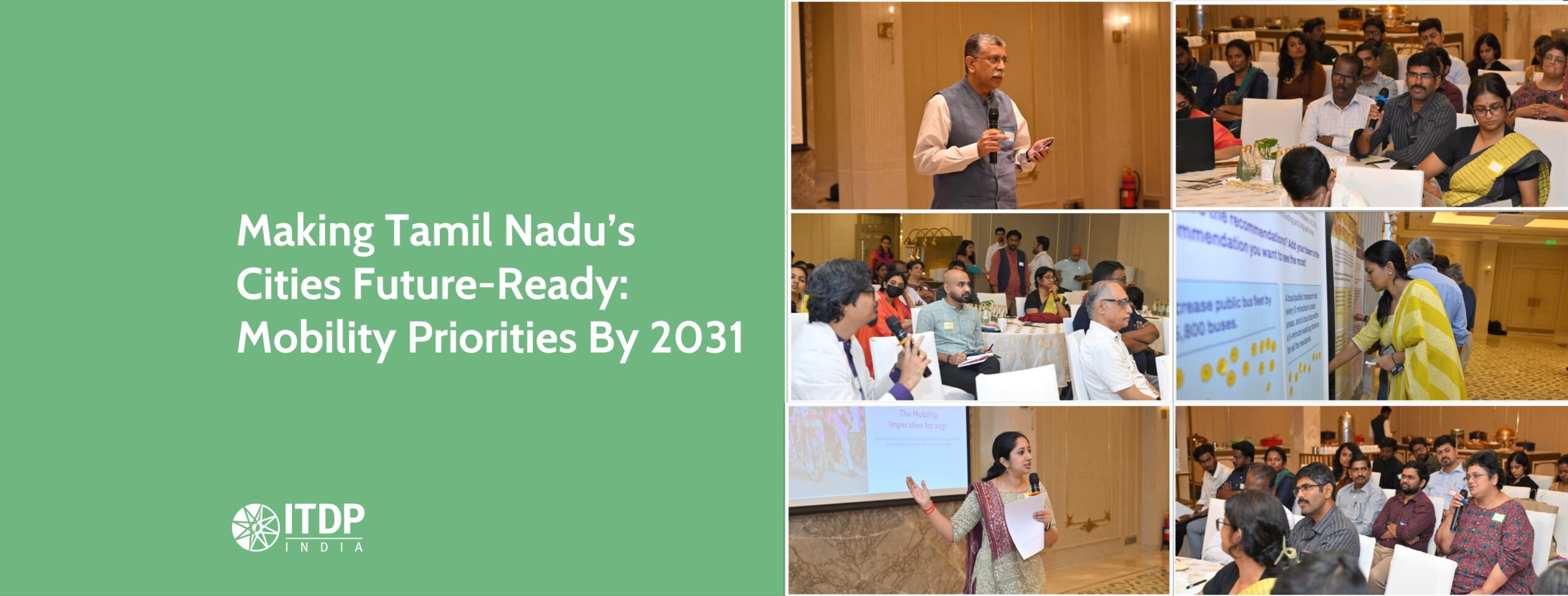
Making Tamil Nadu’s Cities Future-Ready:  Mobility Priorities By 2031

10th March 2026 by admin

Everyone talks about the future like it is all about gadgets and AI, with Robo dogs manning our cities, flying cars helping us cut the traffic at grade, and everything becoming ‘smart’ to save time.  

And while having some of these would actually make the future of cities more exciting and optimised, there is one uncomfortable truth that we can’t ignore: 
If we can’t fix the city’s mobility, by fixing the buses networks and fleet, footpaths, and the city’s air pollution — 2031 won’tfeel futuristic at all! 

And this degenerated version of future is already in play in many of our cities, where while we have summits on AI, the basic transport facilities are still tied to private vehicles and unsafe roads, forcing even the smartest minds feel humbled in front of the infrastructure. 

So, we asked a simple question: 
What does a realistic future-ready Tamil Nadu really look like? 

To answer this, it is crucial to acknowledge that transport is no longer a basic service issue for Tamil Nadu’s (TN) citizensthat simply moves people from point A to point B. It has become an issue of safety, women’s rights, and family livelihood. Increasingly, it has gone even beyond these fundamentals and become a climate issue as well, with the state’s GHG emissions growing by between 2005–2019. In major cities of TN, transport contributes up to one-third of total emissions. 

In this context, the Sustainable Mobility Network (SMN) has developed the Tamil Nadu (TN) Urban Mobility Priorities, 2031, which lists out four priority areas we wish to see addressed. These are built on the principle that safe transport and healthy cities are fundamental rights.  
 
While drafting the priority areas, the attempt was to ensure that these build on the existing schemes like TN road safety policy, TN EV Policy, Chennai parking policy, Chennai climate action plans, and CMPs, and doesn’t require for the state to reinvent the wheel. 

More and Convenient Public Transport for All!

Despite MoHUA’s recommendation of 60 buses per lakh urban population, major cities in TN operate with only 18 buses per lakh, totalling 7,909 buses across the state. To add to this, in Chennai, 50% residents lack access to a bus stop within walking distance inside the Chennai Metropolitan Area.  

Owing to this shortage of buses on the whole, even well-intended schemes like the Vidiyal Payanam scheme, which led to female ridership increasing from approximately 40%to 61.78%, has had a stunted impact. Inadequate fleet strength has led to overcrowding and long wait times for existing users, highlighting the need for more buses. 

What should be prioritised? 

First and foremost, to meet the current demand, at least 15,800 more buses are needed. This is to ensure that there is a ride for every 5-minutes by bus/ public transport in urban areas and a bus stop within 5-minute walking distance for all residents. While buses increase, it is crucial to ensure these new buses are low-floor, wheelchair friendly with ramps, automatic doors and emergency buttons. To further make it futuristic, enabling digital payments for all services, having real time passenger information and ensuring smooth transfer between various modes is crucial. 

Cleaning Up Urban Mobility

The average mode share of private vehicles is 35% in major TN cities; with Chennai Metropolitan Area alone reaching 63,413 private vehicles per lakh population! These are staggering numbers which not only leave the road networks choked with congestion, but also rapidly worsen air quality! Road transport is a major contributor to air pollution, with 4 million high-emissions vehicles in Chennai alone. This causes serious health concerns amongst citizens. 

What should be prioritised? 

When it comes to cleaning up air, every effort matters. 

Both pull and push measures. As pull measures, starting with 100% electrification of vehicles and buses in Chennai could be a start, with 50% target for other five largest cities. To further bolster cleaning up the air, ensuring smooth EV transition in private vehicles is key. For this, having one charger for every 20 EVs is crucial, along with incentivising scrapping vehicles older than 15 years.  

While EVs get promoted, disincentivising polluting vehicles is equally crucial. Here come the push factors. The state should also prioritise having a green tax on polluting vehicles along with implementation of Low Emission Zones in cities with population over 10 lakhs. 

A Pedestrian First Initiative! 

As per an analysis of Accident Data from Tamil Nadu State Transport Authority (TNSTA) and Traffic Police, 2022-2024 by ITDP IndiaIn Chennai and Coimbatore, pedestrians account for 30-50% of all road crash fatalities, highlighting the urgent need for safer streets. A school-going child in Chennai would encounter about 10 obstructions every 100 metres on a footpath, with parking being the leading contributor. The elderly and the differently-abled suffer the most. 

What should be prioritised? 

First and foremost, pedestrian- and cycle-friendly street design guidelines must be formally adopted and embedded into the Tamil Nadu Combined Development and Building Regulations (TNCDBR) and city masterplans. This can be the foundation of all future efforts. Next, all roads must be designed or redesigned in accordance with Indian Roads Congress codes, ensuring at least two-metre-wide, well-lit, continuous footpaths and accessible pedestrian crossings. 

Building on this foundation, speed-calmed zones should be implemented around hospitals, educational institutions, and markets to prioritise safety in high-footfall areas. There should also be a simultaneous focus on a Safe Routes to School programme, with a need to be rolled out in at least 50% of all government schools to protect children’s daily journeys. 

Finally, cities with populations above 10 lakhs must implement comprehensive parking policies and Area Level Parking Management plans to manage demand and reinforce safer, people-first streets. 

Urban Transport Planning to be Holistic and Coordinated!

Despite strong public demand for better buses and safer footpaths, nearly 70% of city budgets in Chennai, Coimbatore, and Erode are spent on flyovers and road development, which are vehicle-centric (as per a study on budgets of the three cities by ITDP India). This contradiction caters to only vehicle users, resulting in transport challenges. 

What should be prioritised? 
 
First, urban laws under the Tamil Nadu Motor Vehicle Rules (TNMVR) must be strengthened to explicitly protect pedestrians, cyclists, and public transport users. 

Next, a state-level Unified Transport Authority and an Urban Transport Fund should be established, along with Gender and Policy Labs in all cities to institutionalise inclusive and evidence-based decision-making. 

With governance structures in place, at least 60% of transport budgets must be allocated to public transport, clean mobility, walking, and cycling. 

All urban projects should then be aligned with city-level Comprehensive Mobility Plans, Road Safety Plans, and Climate Action Plans to ensure coherence and long-term impact. Finally, local public meetings and community audits must be conducted through city mobility forums to ensure transparency, accountability, and continuous citizen engagement. 

Will this future become the reality? 

The future of mobility in TN can’t be limited to a gadget, or an app, or a code. 

The future is whether a child can walk to school safely. 

Whether a woman can board a bus without fear. 

Whether an elderly citizen can cross the street without risking their life. 

Whether a young professional can breathe clean air on their commute. 

And encouragingly, Tamil Nadu is beginning to act on this vision, not just in words, but in budgets. 

In Chennai, a historic Rs 200 crore allocation for Safe Routes to Schools in the 2026 city budget, covering 50 km, marks the first-ever dedicated SRTS budget. This year also marks the second consecutive year of large-scale funding (Rs 250 crore) for walking and cycling infrastructure. The city has further committed Rs 50 crore for 25 km of Non-Motorised Transport corridors, Rs 110 crore for bus terminal redevelopment through PPP, Rs 40 crore for multimodal integration at Washermenpet and Chepauk–Marina, Rs 10 crore for junction improvements, and a citywide Smart Parking Management programme across 20 locations. Institutional reforms, including the strengthened Quality Control and Project Development Department, indicate that implementation capacity is being built alongside vision. 

In Coimbatore, the FY 26–27 budget allocates Rs 60 crore to build 26 km of footpaths by converting storm water drains into usable walkways, which is a transformative shift in reclaiming space for people. This is complemented by Rs 10 crore for Safe Streets on Trichy Road, Rs 5 crore for public EV charging infrastructure at 25 locations, and funding to operationalise the Diwan Bahadur (DB) Road multi-level car park (MLCP), opening opportunities for behaviour change campaigns. 

Alongside MTC’s phased induction of e-buses, the Bus First campaign, and CUMTA’s push for unified mobility guidelines, Tamil Nadu is increasingly aligning policy, funding, and governance structures toward a people-first mobility transition. 

If Tamil Nadu continues on this path – strengthening bus fleets, cleaning the air, prioritising pedestrians, and coordinating institutions, 2031 will not just be futuristic, it will feel equitable, breathable, and safe. 

The opportunity is here. The budgets are beginning to reflect intent. Now the task is to stay the course! 

Inputs from Sanchana S, Tejesvini Ravi, AV Venugopal, Sooraj EM, Bezylal Praysingh and Donita Jose, ITDP India

Filed Under: Chennai, Public transport Tagged With: Chennai, India, non-motorised transport, Public Transport, Sustainable Transport, Walking and Cycling

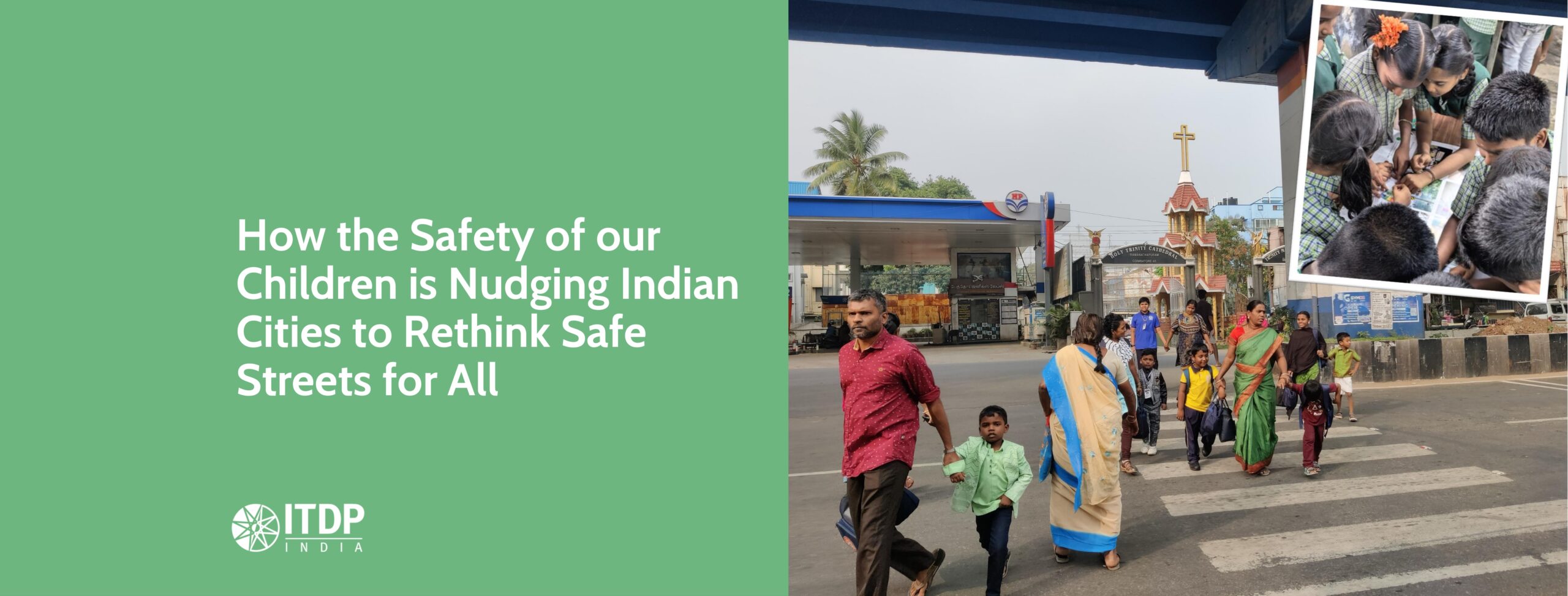
How the Safety of our Children is Nudging Indian Cities to Rethink Safe Streets for All

28th January 2026 by admin


In wildlife conservation, there’s a familiar problem: charismatic megafauna—the big, beautiful, crowd-pulling mammals—soak up attention and conservation efforts, while countless other species struggle to survive unnoticed. Logic tells us the most endangered species deserve priority, but emotion usually wins. Cute creatures move hearts, budgets, and policies in ways that less glamorous animals simply can’t. 

Urban transport in India suffers from the same bias. 

Flyovers—the “charismatic megafauna” of our cities

Flyovers, foot-over-bridges, and wide roads are the “charismatic megafauna” of our cities—high-visibility, headline-grabbing symbols of development and aspiration. Footpaths, signage, and pedestrian crossings are their overlooked cousins. Not  visually unappealing perhaps, but certainly less exciting, harder to champion, and rarely the first choice in infrastructure conversations. 

That’s why knowing there is demand for footpaths isn’t enough. People-centric mobility must become aspirational. It needs to be the popular narrative, the default choice, and the shared vision of how cities should move. To get there, we must focus on behaviour change of society at large—and one of the strongest catalysts for change in any society is children. 

Children don’t just represent the future; they influence the present. Some of the most successful road safety campaigns are rooted in schools because their impact extends far beyond classrooms. Children take lessons home, start conversations at the dinner table, and —most powerfully, —hold adults accountable. We may ignore posters and policies, but we rarely ignore our children. We change habits, make safer choices, and strive to be better role models for them. 

At the same time, children are among the most vulnerable users of our streets. Their physical and cognitive development limits their ability to judge speed, distance, and risk. As vehicle ownership rises and streets grow more hostile, children face increasing danger simply navigating their neighbourhoods. This makes the case for safer, child-friendly street design not just compelling, but urgent. 

If we want cities that truly work for everyone, we must start building streets that protect, empower, and prioritise our smallest citizens.  

The Rise of Safe School Zones 

It’s a widely accepted principle in urban design: when we design for the most vulnerable, we design for everyone. Yet, despite this common wisdom, our cities still lack sufficient evidence of street designs that meaningfully respond to children’s specific needs. 

Creating Safe School Zones is a critical first step in addressing this gap and the beginning of a much longer journey toward truly child-friendly streets across the city and not just the school zones. 

In Tamil Nadu, two cities have taken promising strides in this direction. Chennai and Coimbatore have announced Safe School Zone projects aimed at transforming the streets children use every day. 

In Chennai, the initiative covers two major interventions: 

Avvai Shanmugam Salai, Teynampet (2.5 km) 
A network of streets in K.K. Nagar (19.5 km) 

Together, these improvements are expected to benefit 31 schools (both private and corporation) across the city and impact nearly 4000 students from city corporation schools. 

 In Coimbatore, the projects include: 

Trichy Road and Kamarajar Road (2.5 km) 

School Streets at ten prominent locations across the city (4 km) 

These efforts will support 24 schools (both private and corporation) and impact nearly 6,300 children from city corporation schools alone. 

ITDP India has been supporting both cities in the rollout of these projects. However, from the very start, we took a slightly different approach with these two projects. We kept children and their voices at the heart of it! This is because any public project built on stakeholder consultations ensures inclusivity and democracy.  So, if we are designing streets for children, it is only natural that children themselves become part of the conversation. Yet their voices are rarely heard in urban planning unless we deliberately seek them out. Recognising this gap, we set out to design an ambitious—but fun activity created entirely for children. The goal was simple: to engage them in meaningful dialogue and understand, in their own words, what a truly safe school zone should look and feel like. 

If our streets are meant for children, then their perspectives should help shape them.  

Taking the Engagement into Classrooms 

In Chennai’s K.K. Nagar neighbourhood, six schools and 268 students came together to reimagine their everyday streets. In Coimbatore, the voices of 280 students from four schools added depth to this collective vision. These young citizens became active participants in shaping safer, more inclusive school neighbourhoods. 

Three thoughtfully designed activities were– 

Love it, Like it, Don’t Want it – My School Street Edition  

Designing My School Street
 

Map My Journey To School


Through this students reflected on their daily journeys, calling out safety concerns, moments of discomfort, and gaps in pedestrian infrastructure. The engagement culminated in an exercise where children articulated, in their own words, the design elements they wished to see on their school streets. Their responses offered a powerful qualitative lens into what truly defines a child-friendly street.  

Beyond insights, the process also produced a tangible outcome: a children-led walking route map, highlighting streets that need urgent improvement, based on the routes they walk every day. Such maps can directly inform the creation of a priority network for implementing safe school street infrastructure. 

Perhaps most striking was what children already knew. Their reflections on “good” and “bad” streets revealed a strong awareness of safety and accessibility, even if they did not know the terminology to explain them. Across both cities, their top priorities were clear: road safety and traffic management, street maintenance, and pedestrian infrastructure. Listening to them reminds us that the path to safer streets begins by seeing the city through the eyes of its youngest pedestrians. 

Seeing the success of this approach, we at ITDP India are now striving to ensure that working with children is embedded within the scope of all “Safe Streets to School” design projects. As part of this resolution, design consultants are required to conduct surveys and interviews with students to ensure that street designs are sensitive, inclusive, and scaled to the needs of young users. 

School streets or school zones envisioned through this process are places of calm and care: slow-moving traffic, interactive street edges, brightly coloured pedestrian crossings, clear and attractive wayfinding, reflectorised signage (that glow in the dark), and wide, comfortable walkways with dedicated pick-up and drop-off bays. While colours and motifs can be standardised citywide, each street is carefully contextualised to its surroundings. 

School Zones as a Planning Paradigm for the Whole City 

While school streets are daily lifelines for children, caregivers, and communities, Safe School Zones could be more than a safety intervention – they could be the strategic lens we need to reimagine truly accessible streets. When designed thoughtfully, a network of pedestrian pathways around a dense cluster of schools can do far more than serve students. It can seamlessly overlap with neighbourhood markets, bus termini, and other civic anchors, creating a walkable ecosystem that benefits everyone. 

This idea closely mirrors the promise of first- and last-mile connectivity (FLMC) to public transport. Yet, in our planning priorities, the footpath is profoundly underrated as an FLMC service. It is often sidelined in favour of the more “charismatic” mini-buses or other forms of Intermediate Public Transport, despite being the most universal and inclusive mode of access. 

Footpaths are the city’s quiet first responders—used by every road user, every day, often without notice, yet indispensable to the functioning of urban life. Investing in them, especially through the lens of Safe School Zones, is not just about mobility. It is about dignity, safety, and building cities that place people first. It may not be the most glamorous piece of infrastructure, but it is definitely the one needing collective attention and support.   

By Sanchana S, Senior Associate, ITDP India

Edited by Donita Jose, Senior Associate, ITDP India

Filed Under: Chennai, news Tagged With: Chennai, Coimbatore, India, non-motorised transport, Parking, parking management, Safe Route To School, Sustainable Transport, Tamil Nadu, Walking and Cycling

25 Wins from 2025 that Shaped Urban Mobility

20th January 2026 by admin


At ITDP India, everything we do is guided by three goals: Increase public transport ridership, electrify urban transport systems, and secure funding at scale, to make the former two goals possible.
And what’s our grand vision? People-first, low-emission cities. In 2025, every win was shaped by these three goals, and this shared vision.
Some wins may look small on their own like a humble brick: a policy here, a budget allocation there, a guideline approved. But stack them together and you start to see the city being built to enable people moving smoothly, one sustainable decision at a time. Check out our crisp listicle on 25 wins from 2025 that Shaped Urban Mobility. This captures the winning moments of everyday work towards the big picture.

Brick by Brick: 25 Milestones that Shaped Our Cities

Filed Under: Chennai, news Tagged With: Chennai, Coimbatore, India, non-motorised transport, Parking, parking management, Safe Route To School, Sustainable Transport, Tamil Nadu, Walking and Cycling

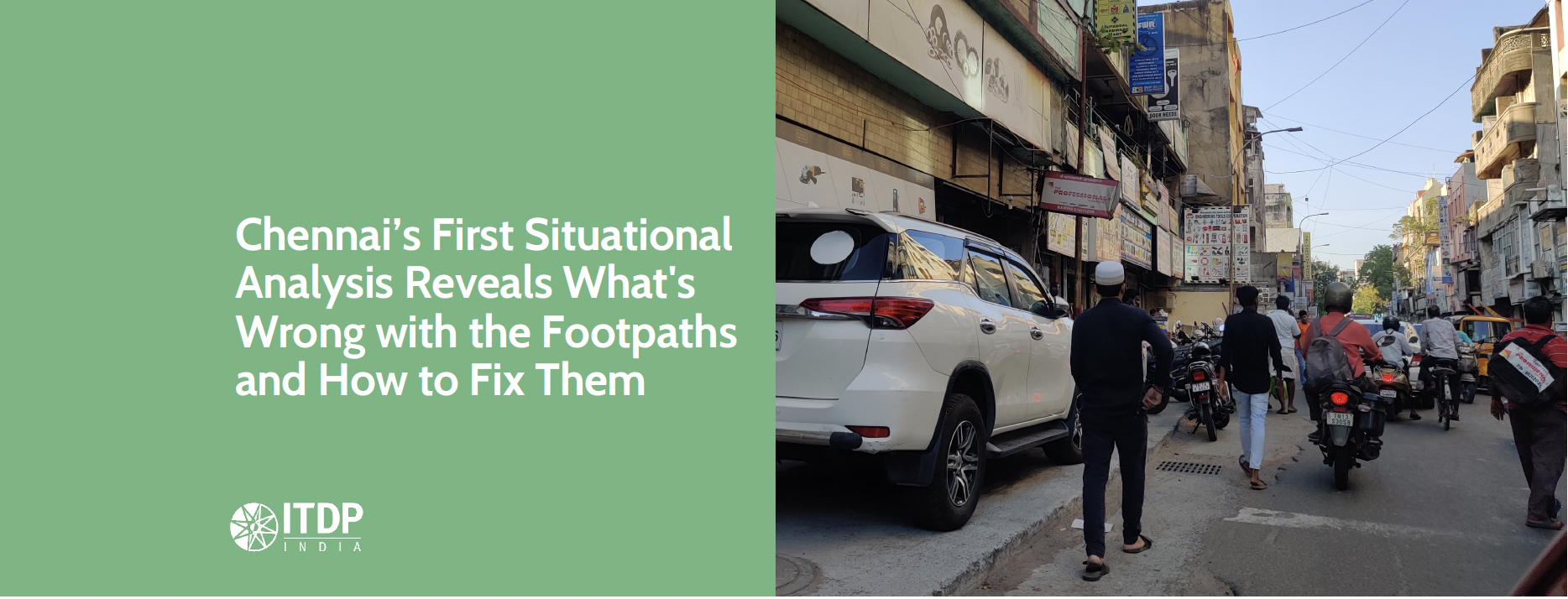
Chennai’s First Situational Analysis Reveals What’s Wrong with the Footpaths and How to Fix Them

3rd December 2025 by admin


Assessments are a part of everyone’s life. Ask a student, a professional, or even a patient, almost everyone is put through a series of tests, to check whether their performance is upto the mark or not. In the same way, don’t you think our cities need a thorough assessment, once every few years? 

Assessments and analysis can help a lot, as if holding a report card up the face of city decision makers to assess what works and what doesn’t. It is with this thought that in 2023-2024, ITDP India’s team, embarked on an ambitious journey to assess and score the situation of the city’s streets and how walkable they are! 

But why assess walkability?

Walking is the most fundamental and natural mobility for most people in the city. It is a birthright for everyone to have and own, and to move, and access different parts of the city, that often gets taken for granted. 

Picture this in fact! Almost 23% of trips in Chennai are made by ‘walking’, as per the Comprehensive Mobility Plan for Chennai Metropolitan Area (CMP), 2023. However, walking on arterial and sub-arterial (internal) streets continues to pose a high risk for pedestrians.  

And these risks are translating into fatalities. Between 2019 and 2023, for instance, while Chennai took extraordinary measures to reduce the total number of accidents and fatalities, pedestrian fatalities still constituted a significant number. As per data assessed and analysed by ITDP India, pedestrian deaths made up 43% of all road accident deaths in Chennai. Furthermore, of all pedestrian related accidents in Chennai in 2023, 30% ended up as fatalities. This is an increase from 11% and 22%, respectively in 2019.  

The above data point is crucial to delve into given that the city adopted the Non Motorised Transport (NMT) Policy in 2014, and it followed through by developing over 170 km of footpaths on key Bus Route Roads. This begs the question; what happened to those footpaths? Are they intact? Are they being utilised as was once imagined? Do they need improvements? These are some of the questions that ITDP India’s latest study, called Situational Analysis of Chennai’s Footpaths, attempts to answer.  

What is a Situational Analysis?

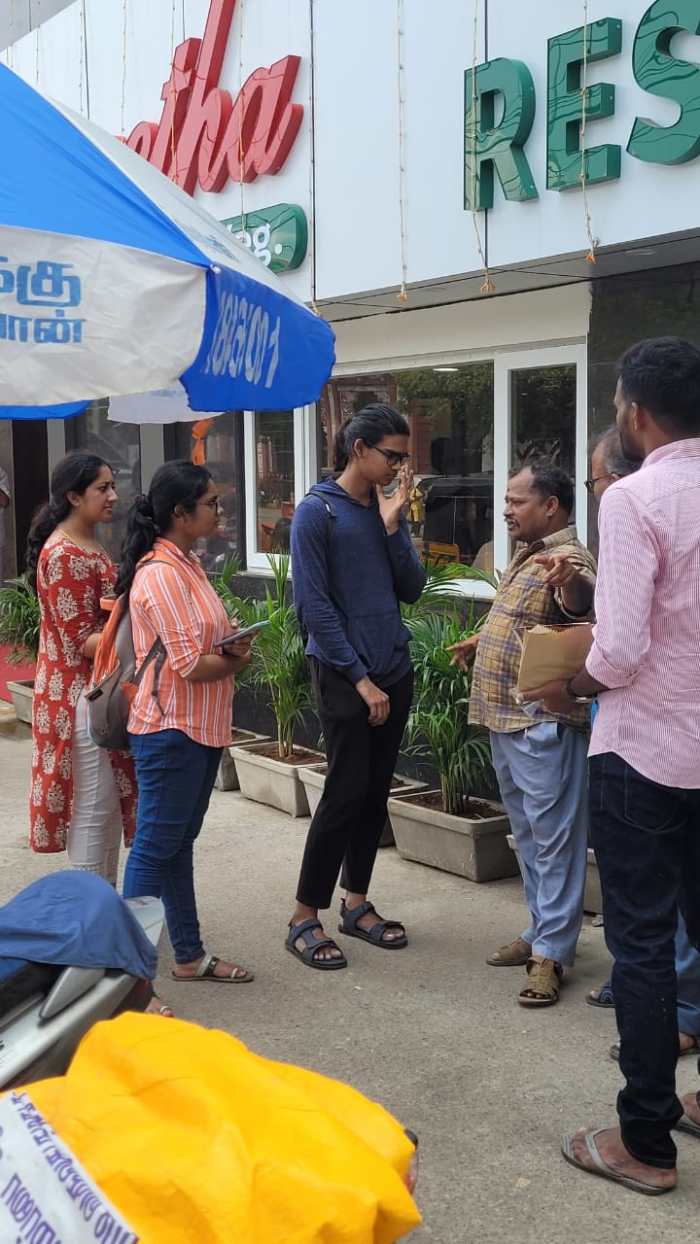
A situational assessment aims to understand the current condition of infrastructure in detail, highlighting the merits and demerits of footpaths in comparison to standards. It also builds a good database of the infrastructure and develops a scoring system to prioritise streets where footpaths require immediate attention. The study in Chennai identified 14 streets across different zones of Chennai, in which 32 km of footpaths were mapped and observed, and over 1700 user perception surveys were conducted.  More importantly, this study also provides a framework to analyse the impact of this humble piece of infrastructure on its users, for the future as well.   

How was Situational Analysis done? What parameters were used?

 Every pedestrian infrastructure was viewed from three dimensions:

Design Mapping

How efficient is the design and how well it has adhered to the standards. This was done by using the MerginMaps which uses 14 performance indicators  

User Perception Survey
Gathering insights from vulnerable groups (young, elderly pedestrians, cyclists, public transport users) on footpath experience, using 8 indicators. 

Observation Surveys
Analyzing traffic volume and user behavior based on 9 indicators of optimal street usage. 

The data collected was then analysed through the lens of 4 key parameters of Healthy Streets:   

  1. Ease of Mobility – The ease with which pedestrians can walk on wide, seamless, continuous footpaths free of obstructions.  
  1. Safety—The availability of dedicated pedestrian crossing infrastructure, traffic calming elements, a buffer between carriageway and footpath, street lighting, and active property edges ensures pedestrians’ personal and physical safety.   
  1. Universal Accessibility – Inclusion of the vulnerable sections of society, such as the elderly, children, pregnant women, and persons with other physical challenges, through design.  
  1. Livability – A sense of comfort and belonging created by the presence and integration of street play, street commerce, and other socio-economic activities, in addition to providing functional footpaths.   

What were the key findings of the Situational Analysis?

The study provides insights into the importance of footpaths as well as having good footpaths to improve their usability.    

Footpath Design User PerceptionObservation Survey
Ease of Mobility & Universal Accessibility 55% of footpaths across all streets were found to be of inadequate width.  58% of those who reported that the footpaths are not walkable are women Only 40% of the pedestrians are seen walking on footpaths. Most prefer walking on the carriageway due to obstructions and inadequate design.  
40% of the total length of all streets lacked a footpath. 
 
76% of respondents found the streets had several obstructions on the footpath. On average, only 13.21% of modes of commute during peak hours on streets is walking.  
On average 10 obstructions per 100m and parking constitutes 40% of all the types of obstructions, followed by encroachments like commercial spillover, advertisements, construction debris etc. 
Safety & Livability Street lights illuminate only 61% of the streets. 
 
The total number of pedestrian crossing points provided is 50% below the required number per IRC standards. 
57% of respondents who reported having difficulty crossing the street, and who found it unsafe at night are women 
 
73% of respondents find streets unsafe to cross, and 71% of them are concerned about speeding vehicles while crossing. 
Speeds in neighbourhood-level streets are able to go as high as 60kmph. 
Speed breakers followed by pedestrian crossing points are most effective traffic calming measures observed.  
48% of all pedestrians are women, showing the need for inclusive design.  

How did individual streets perform?

To further make the analysis granular, a scoring framework was used which helped rate the performance of the footpath infrastructure across all 14 streets on all 31 indicators of performance. It also helped identify the nature of intervention required, based on varying performance:  

  1. A street with a rating of 25 or more can be improved through strict enforcement and minor repairs and interventions.   
  1. Streets rated 19 to 25 would require enforcement to remove obstructions, improve footpath surfaces, and introduce accessible crossing infrastructure.  
  1. Streets with a rating of 14 to 19 would require repairs to improve the continuity of footpaths, remove obstructions, and introduce safe midblock crossing infrastructure.  
  1. Streets with ratings below 14 should be redesigned and restructured completely. 

Here the winning street was Pedestrian Plaza, scoring a brilliant 25.71, whereas the poorest performing street was CP Ramaswamy Road scoring just 12.72 on 30.

The following inferences can be drawn from the studies, as well as the score card. 

  1. Streets prioritising pedestrians are safer, more accessible, and liveable: Pedestrian Plaza, CSIR, and Wallajah Road have exceeded basic footpath requirements, catering comprehensively to pedestrian needs. 
     
  • Pedestrian Plaza
  • Pedestrian Plaza
  • Pedestrian Plaza
  • Pedestrian Plaza
  1. Continuous and consistent footpath standards across the entire street length are crucial for ensuring ease of pedestrian mobility. Streets such as Sardar Patel Road and Peter’s Road demonstrate that design and perception scores do not align with each other.  
  • Peter’s Road
  • Peter’s Road
  • Peter’s Road
  1. Pedestrian crossings and traffic calming measures should be prioritised alongside footpath provision: Despite adequate pedestrian infrastructure, streets like Perambur High Road, Peter’s Road, and Sardar Patel Road show moderate performance.  
  • Perambur High Road
  • Perambur High Road
  • Perambur High Road
  1. In streets without formal footpaths, stormwater drains double as walking zones but lack pedestrian safety and comfort. This necessitates efficient drainage design for clear walking zones, as is evident in streets such as C.P. Ramaswamy Salai, Anna Main Road, Eldams Road, and Broadway.  
  • Eldams Road
  • Eldams Road
  • oplus_2
  1. The absence of an enforcement/O&M framework results in footpath encroachment, diminishing clear walking zones for pedestrians. Streets that perform fairly, such as Old Jail Road, Thirumalai Pillai, Gandhi Irwin, and Thiru Vi Ka High Road, illustrate this issue as they were all once refurbished under the 170km of BRR road transformation project, benefits of which did not continue due to poor maintenance. 
  • Gandhi Irwin Road
  • Gandhi Irwin Road
  • Gandhi Irwin Road
  • Gandhi Irwin Road
  • Gandhi Irwin Road

Recommendations for Chennai to improve its network of streets

Good footpaths are a win-win for all citizens. On one hand it can reduce travel costs for low-income households, on the other hand, it boosts physical health and improves inclusivity by encouraging more women, elderly, children, and vulnerable people to use public spaces. An overarching benefit for all sections is also that it lowers emissions by promoting walking and cycling and can address congestion. The results of the study helped identify key priorities to improve footpaths:  

Way Forward

An assessment is good as long as the feedback is implemented on. At ITDP India we are happy to share that the results and recommendations of the study were showcased to the city engineers. This was presented during a workshop organized by ITDP India, focusing on the significance of Healthy Street Design guidelines to enhance footpath design and usability in the city.  

Capacity Development Workshop for Bus Routes Roads Department in 2024

Since then, the Greater Chennai Corporation has committed to several initiatives aimed at strengthening pedestrian infrastructure. These initiatives include identifying new networks for footpath repairs and reconstruction, conducting audits to assess the condition of existing street infrastructure, and creating a Standard Operating Procedure (SOP) for the operations and maintenance of the city’s footpaths. To boost these initiatives further, the state allocated a Rs 200 crore budget to build and improve over 200 km of footpaths in Chennai in 2025, which is the first dedicated budget for pedestrian infrastructure. This work is being carried out with technical assistance from ITDP India. 

It is also pertinent to note that this exercise has been replicated in multiple cities by ITDP India, showcasing a powerful methodology that can be embraced by many more.  

This isn’t just about rating pavements; it’s about reimagining streets as spaces of safety, accessibility, and shared humanity. The path ahead is clear: Chennai’s footpaths need more than repairs, the city does need to prioritise the scale-up of footpaths across the city. They demand a collective awakening—to see sidewalks not as afterthoughts, but as lifelines. The data is here. The solutions exist. Now, will we walk the talk? 


By Sanchana S, Senior Associate, ITDP India

Edited by Donita Jose, Senior Associate, ITDP India

Filed Under: Chennai, news Tagged With: Chennai, Coimbatore, India, non-motorised transport, Parking, parking management, Safe Route To School, Sustainable Transport, Tamil Nadu, Walking and Cycling

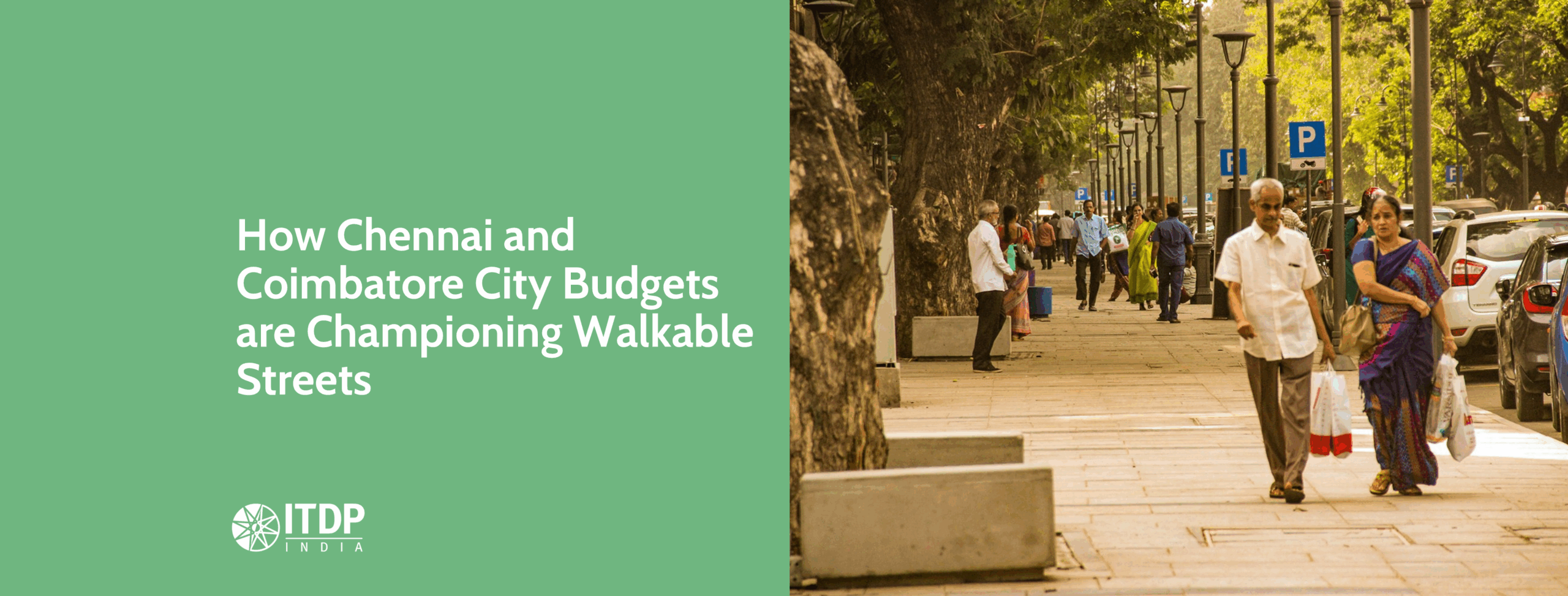
How Chennai and Coimbatore City Budgets are Championing Walkable Streets

20th May 2025 by admin


For years, major cities in Tamil Nadu have prioritised vehicles through budgetary allocations and infrastructure. This is despite the fact that two-thirds of all trips in the state are made by walking, cycling, or using public transport. This year, however, the tide is turning. The Tamil Nadu Budget 2025 marks a pivotal shift with Chennai and Coimbatore taking the lead, placing Non-Motorised Transport (NMT) —like walking and cycling—at the heart of mobility planning, and reimagining streets as spaces for people, not just cars. What sets this budget apart is not just the scale of funding, but the values it reflects—equity, safety, and access for all. 

While this development is a step in the right direction and is still in its nascent stages, Chennai’s strides towards creating walking and cycling friendly streets echo some of the early moves seen in cities like Singapore. Singapore has long been a role model for Southeast Asia, known for its  integrated public transport and walkable, people-friendly streets, backed by landmark investments like the 1 billion Singapore Dollars’ fund for last-mile connectivity in 2016, and forward-looking policies such as the Active Mobility Act (2017) and Multi-Modal Transport Act (2021). Anchored by the Tamil Nadu Budget 2025, which earmarks significant investments in footpaths, smart parking, and Safe Routes to School pilots, Chennai’s journey could chart a similar course—if implementation keeps pace with vision. 

A Historic Leap for Walkability in Chennai 

A landmark first – ₹200 crore dedicated funding for 170 km of footpaths in Chennai  

This year’s budget has earmarked ₹200 crore for the implementation of 170 km of high-quality footpath in Chennai. This is the largest investment for pedestrian infrastructure in the city to date, and the first time since the Non-Motorised Transport (NMT) Policy of 2014 that footpath development has received such focused financial backing. Announced by Hon’ble Minister K.N. Nehru on March 25, 2025, this move is more than just a line item in a budget—it is a powerful reaffirmation of the state’s commitment to safer, more inclusive streets for all, especially vulnerable road users including children, the elderly, and Persons with Disabilities (PwDs).  

Chennai’s journey: From marginal to meaningful investments!

Chennai’s journey toward walkable streets began with ambition. Following the adoption of its pioneering Non Motorised Transport Policy in 2014  the city saw average annual footpath investments rise to ₹72 crore, resulting in the creation of over 170 km of footpaths between 2014 and 2019—most of it funded through the Tamil Nadu Urban Road Infrastructure Fund (TURIF). During this time, the city also tapped into the Smart Cities Mission’s Area-Based Development (ABD) funds to implement the now-celebrated Pedestrian Plaza and its feeder streets in T. Nagar.    

Citizens walking safely on Pedestrian Plaza

To scale up its efforts, Chennai launched the Complete Streets program in 2020 (earlier known as “Mega Streets”) with a dedicated ₹100 crore allocation under the Chennai City Partnership with the World Bank. The project aimed to reimagine neighbourhood-level street networks by integrating underground utility upgrades and walk and cycle-friendly above-ground infrastructure. However, the first implementation phase, under progress, covers only around 11 km, leaving behind the demand for a city-wide network of functional footpaths largely unmet.   

Ongoing implementation under the Complete Streets Project at Khader Nawaz Khan Road, Nungambakkam

Analysing the budgetary spending, we found that from 2022 to 2025, Chennai’s investment in footpaths plummeted to just ₹13 crore per year on average. A modest recovery came in FY 2024–25, with ₹25 crore earmarked for 21 km of footpaths, but this was still far from enough to undo years of underinvestment.  

Source: Budget Expenditure categorised by type of work and scheme, FY 2012 – January 2025 (Bus Route Road Department)  

However, our analysis also pointed out that over all these years, road resurfacing and carriageway upgrades continued unhindered, reflecting an annual average spending of ₹84 Crores, and a consistent focus toward vehicle-centric planning.  

Source: Budget Expenditure categorised by type of work and scheme, FY 2012 – January 2025 (Bus Route Road Department)  

A renewed push: Bringing safety and equity to the forefront 

Any policy without dedicated, sustained funding is just a wish. For Chennai to become truly walkable, sustained investment and quality implementation must now follow the city’s renewed aspirations, and 2025 marks a good beginning with this significant dedicated allocation for NMT infrastructure. Analysis of spending patterns on NMT infrastructure over the last three years, reveals that footpath implementation in Chennai relied on piecemeal funding drawn from state and city-level schemes—such as the Tamil Nadu Urban Road Infrastructure Fund (TURIF) and Singara Chennai 2.0. In the absence of a dedicated budget, investments in Non-Motorised Transport (NMT) remained inconsistent and limited in scale. This year’s ₹200 crore commitment by Chennai, marks an eightfold increase over last year’s spending on walking and cycling. This signals a much-needed shift from fragmented support to focused investment.

This renewed focus on walkability couldn’t have come at a more critical time. While Chennai has made commendable progress in reducing overall road crashes, the proportion of pedestrian fatalities has seen a troubling rise from 11% in 2019 to a staggering 43% in 2023.  

Source: Road Accidents Reports (2019-2022), MoRTH & Road Accident Analysis in Tamil Nadu 2023, TNSTC  

This persistent gap between mobility patterns and infrastructure safety highlights the urgent need for course correction, which this budget begins to address. The ₹200 crore allocation is a long-overdue shift toward building streets that are shared public spaces where everyone can move freely and safely. To transform this intent into tangible impact and ensure that the budget is effectively utilised, aligned with diverse mobility initiatives, and executed on time, a dedicated coordinating agency like the Chennai Unified Metropolitan Transport Authority (CUMTA) is crucial.  

Bringing It All Together: CUMTA as the institutional backbone  

Much like Singapore’s shift to a car-lite city was steered by its Land Transport Authority through various institutional reforms and proactive policymaking, Chennai’s mobility transition is now gaining momentum through the leadership of the Chennai Unified Metropolitan Transport Authority (CUMTA). With a clear mandate to coordinate mobility efforts across the Chennai Metropolitan Area (CMA), CUMTA is emerging as the anchor institution for Chennai’s people-first mobility vision. 

As part of the Budget 2025, Honourable Minister for Housing & Urban Development, Thiru S. Muthusamy announced an array of progressive initiatives led by CUMTA.  

  • Building on the newly adopted Parking Policy, CUMTA will pilot Smart Parking Management in Anna Nagar, reclaiming public space and improving local access. 
  • CUMTA is also developing Comprehensive Street Design Guidelines for the entire Chennai Metropolitan Area—including Tambaram, Avadi, and Kanchipuram—to create safer, more inclusive streets across jurisdictions.  
  • Complementing this, CUMTA is also drafting the Traffic Impact Assessment Guidelines to help cities manage congestion and ensure new developments align with sustainable transport goals.  

These initiatives go hand-in-hand with Tamil Nadu’s growing investment in Non-Motorised Transport—signalling not just a shift in budget priorities, but a change in how cities are planned and governed. With institutions like CUMTA at the helm, Tamil Nadu is building long-lasting systems to realise its people-first mobility vision. 


Coimbatore Steps Up: Scaling Sustainable Mobility Initiatives 

Building on Chennai’s momentum, Coimbatore is making its own strides towards a more people-centric mobility scenario with this year’s budget embedding sustainable mobility into the city’s planning priorities. Two key initiatives are set to guide this: revising the Coimbatore Street Design Guidelines and developing a comprehensive NMT Action Plan. These tools will help the city set a strong foundation for designing safer, more inclusive streets at scale. 

Coimbatore has been grappling with concerns on road safety, with road fatalities rising over 1000 in 2023; ranking highest in the state. In addition to various other initiatives to address this, a ₹2.5 crore allocation has been announced for a Safe Routes to School pilot on Trichy High Road, covering 2.5 km of critical access routes. Together, these moves reflect Coimbatore’s growing commitment to creating well-planned, safe, walkable streets and mark a step forward in scaling sustainable mobility across Tamil Nadu. 

A Decade of Partnership: ITDP’s Ongoing Commitment 

Since 2009, ITDP in India has worked closely with the Greater Chennai Corporation (GCC), Chennai Unified Metropolitan Transport Authority (CUMTA), and Coimbatore City Municipal Corporation to help shape their sustainable mobility vision.  

Over the years, ITDP has supported with technical research and guidance on key policies and guidelines adopted by city governments, such as the Non-Motorised Transport Policy, Parking Policy, and the Complete Streets Framework. We are also continuing to help cities build the capacity to implement them through on-ground workshops, experiential street audits, and engagements with city leaders. Our role has also included providing technical support and data-driven insights to guide decision-making and strengthen the case for healthier, more equitable streets. 

We are happy and proud to have contributed to realising these milestones and are extremely grateful for the past and present city leadership for their sustained support in championing these initiatives. 

Capacity Development Workshop for Bus Routes Roads Department in 2024

A Win Worth Celebrating—and Building On 

These announcements are worth celebrating, especially for cities like Chennai and Coimbatore, that are leading this change at the forefront. However, the real measure of success lies in how well we translate this vision and intent into long-lasting impact on the ground. 

Here are a few pointers for the city governments to make this fruitful:  

  • Chennai’s ambitious plan to implement 170 km of footpaths must be guided by a clear network planning strategy and aligned with CUMTA’s Comprehensive Mobility Plan. 
  • Bringing on board qualified technical experts and consultants will be key to ensuring street designs meet the standards laid out in the city’s adopted guidelines. 
  • Facilitating capacity building for contractors and engineers is equally important to ensure high-quality street implementation. Field engineers must closely monitor implementation quality using well-defined performance indicators to ensure accountability at every step.  
  • Cities must also embed Operations & Maintenance (O&M) systems right from the planning stage, to ensure infrastructure remains functional and safe for all users. 
  • Annually recurring budgets for NMT including dedicated budgets for O&M must be institutionalised, so cities can plan consistently and scale.  
  • One persistent challenge our cities face is siloed execution, where lack of co-ordination leads to utility works disrupting newly built footpaths and guidelines/policies exist on paper without enforcement. Addressing this will require strong inter-agency collaboration, clear mandates, and sustained leadership from institutions like CUMTA. 

Chennai and Coimbatore have taken a significant first step. Now, they must stay the course—scaling these successes across other cities of Tamil Nadu, building systems, and creating streets where walking, cycling, and shared mobility are not just possible, but preferred. 


By Varsha Vasuhe, Senior Associate, ITDP India

Edited by Kashmira Dubash, Deputy Director, ITDP India

Filed Under: Chennai, news Tagged With: Chennai, Coimbatore, India, non-motorised transport, Parking, parking management, Safe Route To School, Sustainable Transport, Tamil Nadu, Walking and Cycling

Parking Reimagined: Chennai’s Parking Policy is Paving the Way for Better Streets

14th April 2025 by admin


Commuting in Chennai’s streets often feels like a game of Would You Rather?—except that the choices aren’t fun. 

Would you rather drive in circles for 20 minutes looking for a parking spot, only to settle for an informal parking space with an arbitrary fee? Or walk on the roadside, dodging parked bikes and cars, weaving through traffic, and hoping for a safe path? 

In Chennai, these aren’t just hypothetical scenarios, with a population of 15.37 million and 9.2 million registered vehicles, the Chennai Metropolitan Area (CMA) faces a severe parking crunch as there’s nearly two vehicles for every three people in the city. A driver struggling to park in a narrow lane, while a pedestrian—with an elderly companion or child—undertaking challenging obstacles on a short 500-meter walk, dodging haphazard parking one side and speeding vehicles on another- are common scenes we all encounter. 

Sadly, neither choice makes the city easy to move around and aren’t working for anyone, just like how a would-you-rather game has no correct response. 

But can the new parking policy and on-ground parking management be the answer, that can lead to a win-win situation for everyone using the street?  
 
That’s exactly what Chennai has set course for. This year, the city took a historic step toward better parking management by launching a progressive Parking Policy for the entire 5,904 sq. km of the Chennai Metropolitan Area, which includes four corporations – Chennai, Tambaram, Avadi, Kancheepuram, 12 municipalities, 13 town panchayats, 22 panchayat unions and one special grade town panchayat. The policy was developed by the Chennai Unified Metropolitan Transport Authority (CUMTA), which will not only plan, design and strategise, but also oversee its implementation and monitoring. 

Since April 2022, ITDP India has been a key technical partner, supporting CUMTA in shaping this landmark policy.  

Stakeholder Meeting with GCC and GCTP in September 2022

This policy not only addresses the city’s growing parking challenges through area-level parking plans, Travel Demand Management measures, but also brought together key stakeholders—including Greater Chennai Corporation (GCC), Avadi and Tambaram Corporations, Traffic Police, Highways, and Chennai Metropolitan Development Authority (CMDA)—through extensive consultations. 

CUMTA’s Parking Policy: Transforming Urban Mobility  

CUMTA’s newly adopted Parking Policy 2025 is more than just a set of regulations—it’s a transformative approach to managing limited parking space efficiently, reducing congestion, and improving mobility. Here’s a look at its key highlights of the policy: 

1. Managing parking at the area level and creating neighbourhood wide solutions, to prevent spillovers  

What does the policy say?
With the new policy, Chennai is shifting from scattered parking management in isolated streets, to a structured, Area-Level Parking (ALP) Management plan with demand-based pricing, clear regulations, and smart enforcement. The plan allocates parking spots in every street, based on the demand, and uses both ground teams and technology to manage parking efficiently across the neighbourhood. 

Why is it important? 
Managing parking in a few streets isn’t effective and can make the problem worse by causing spillover and more traffic in the adjoining streets. But when we look at a whole area and its network of streets together, we can address the neighbourhood’s need for parking more effectively. This also ensures that street space is used efficiently and is accessible to all street users. By using a demand-based pricing system, we can discourage unnecessary car/bike use and encourage people to choose more sustainable options, like public transport or cycling. 

Site Visit in Anna Nagar Chennai towards preparation of ALP (CUMTA x ITDP India x Street Matrix)

2. Prioritising Pedestrians, Cyclists, and Public Transport users, Before Parking

What the policy says? 
The policy ensures that the city agencies build safe, continuous footpaths and well-integrated NMT infrastructure. The policy gives precedence to footpath allocation over parking.  The policy ensures that parking space is allocated to a street, only after sufficient footpaths and carriageway space is available.    

Why is it important?
More than 60% of trips starts and ends on foot. Poor footpaths/no footpaths push pedestrians onto carriageways, increasing their exposure to moving vehicles and reducing safety. Presence of NMT infrastructure reduces vehicle dependence, easing parking demand, and optimising street space, ensuring safer, more inclusive streets. This way parking plans will also nudge the city agencies to ensure walkable footpath are available, leading to wider footpath coverage. 

Pedestrian Plaza at T.Nagar with On-Street Parking Management.

3. Demand-Based Dynamic Pricing and Smart Enforcement to Shape People’s Parking Behaviour 

What does the policy say?
Parking rates under the new policy will be dynamic based on the area. It will vary, by vehicle size, location of the parking spot, time of day, and demand. On-street parking will be priced higher than off-street options (government or private MLCPs, parking lots, etc.). This will nudge those wanting to park their vehicles for long term (more than 2 hours) to look for off-street options and allowing the on-street parking lots to be open for short terms users. Prepaid parking will replace postpaid models to encourage planned usage.  
As per the parking policy, enforcement measures will be taken up for the following kind of violations: double parking, parking in no-parking zone, parking on footpath, non-payment of parking fees etc. These violations will be discouraged with the use of technological interventions through sensors, cameras, etc. and on-ground parking teams. 

Why is it important?  
Pricing strategies help manage demand for parking, reduce congestion, and discourage personal vehicle user. Only those willing to pay end up coming in cars and bikes, while the rest may turn to other sustainable options.  
For example, T. Nagar, a bustling commercial area, has a higher parking charge of Rs. 60 per hour for cars, while in other areas, the charge is Rs. 20 per hour.  
In contrast, the proposed parking charges for Anna Nagar are Rs. 40 per hour. These rates have been set based on factors such as, how majority of the people commute while visiting the area, availability of public transport, land use, and considerations for traffic management. 
Enforcement strategies are an important tool for behaviour change. The focus of the policy is to not penalise the violator but discourage the violations. By adding penalties and punitive actions to the violations, people’s parking habits can be modified for the better. 

Comprehensive on-street and off-street parking fee strategy at Pedestrian Plaza at T.Nagar

4. Chennai to take a centralised approach to parking management with a Parking Management Unit (PMU) 

What does the policy say?  
The policy establishes the need for a single authority to manage parking holistically. The Parking Management Unit (PMU) will be this single authority and will function under CUMTA. It will be responsible for planning, pricing, enforcement, and implementation across agencies. 

Why is it important?  
A single authority streamlines decision-making, prevents fragmented implementation across agencies, and ensures consistency in pricing, enforcement, and monitoring. In many other cities, this was a critical reason why parking policies failed to bring the results as expected, as the implementation and enforcement were split among multiple agencies. 


5. Policy allows for Legal & Policy Amendments to other key legislations 

What does the policy say?  
For on-street parking spaces: As per the policy, Traffic Police, Urban Local Body, and Road Owning Agency can pass an official order to delegate parking responsibility and enforcement to CUMTA’s PMU. This will ensure seamless management across agencies.  
For off-street parking spaces: The policy recommends amendments to TNCDBR (Development Control Regulations of TN). This will help redefine how much off-street parking must be made provided in any property development. For example, in areas with high coverage of public transport, the overall number of permissible parking lots is reduced. This follows the concept of parking maximums, to ensure people use the public transport that is easily available and are not dependent on personal vehicles. 

Meeting at CUMTA with CEPT-CRDF (TNCDBR Consultant) in August 2023

Why is it important?
Contextualising the existing legal framework is critical for effective enforcement, regulatory clarity, and integrating parking seamlessly into urban planning frameworks.  As per the current legal framework, the parking management roles are fragmented with Traffic Police and Urban Local Bodies on planning, pricing, implementation and enforcement. The new policy allows CUMTA to take up the responsibility from different agencies and be the sole management unit- through the PMU. 


6. Parking Fee collected from the area to be re-invested back in the area 

What does the policy say?
Surplus parking revenue will be ring-fenced for local improvements, including better footpaths, cycling infrastructure, and public spaces. This approach ensures that the benefits of effective parking management are directly felt by the community, enhancing the quality of life and encouraging more sustainable modes of transport. 

Why is it important?
Unlike traditional models where parking fees is looked at as a general pool of revenue, not linked to any one location, Chennai’s Parking Policy ensures that the revenue collected is re-directed to prioritise improvements in that specific location. 
Currently, the annual parking revenue in Anna Nagar is approximately Rs. 35 lakhs. However, with effective parking management, it is estimated that this could increase to Rs. 3.3 crore per year. This is because, the current practice in Anna Nagar involves pricing per parking slot, rather than, an hourly basis, and not all streets have designated parking slots, resulting in an isolated approach. In contrast, the proposed plan adopts a cluster approach with hourly pricing, ensuring a more organised and efficient system. This revenue will be reinvested into improving Anna Nagar’s mobility, streets, green spaces, etc. 

Future-Proofing Chennai’s Streets

The policy also allows for some future-proof strategies like Urban Freight Management, EV charging integration, Travel Demand Management.

  1.   Urban Freight Management: This is a structured city-level and area-level approach to regulate the  movement of goods. This ensures dedicated loading/unloading zones are allocated on the streets  to reduce congestion and improve last-mile logistics. 
  2.  EV Charging Integration: To ensure that streets can accommodate the growing number of electric vehicles (EVs), the parking policy emphasises the need to integrate both on-street and off-street e-charging infrastructure. By planning for EV charging within parking spaces, the policy supports the shift to cleaner mobility. 
  3. Travel Demand Management (TDM): The policy also allows to create customised strategies for schools, workplaces, and commercial hubs by promoting sustainable commuting options, staggered work hours, and shared mobility to reduce peak-hour congestion.  

How will CUMTA ensure this policy is implemented well and monitored? 

Currently CUMTA has kickstarted the implementation of the policy through Area Level Plan in Anna Nagar. They will roll it out by hiring parking service providers who will manage collection of fees, enforcement etc. This will be a pilot intervention, learnings from which will inform future implementation. Since this is a technology driven parking management plan, CUMTA has also initiated the development of a parking app and a centralised command center for monitoring. The implementation of this pilot will be monitored through 14 robust Key Performance Indicators (KPIs).  


Conclusion 

Chennai’s streets, once vibrant corridors of life, now prioritise metal over people. And for years, moving through the city has felt like a never-ending game of Would You Rather?—drive in circles hunting for parking or weave through a maze of parked vehicles on foot. 

The Parking Policy changes that. It doesn’t force citizens to choose between driving and walking or taking public transport. Instead, it ensures that everyone gets their fair share of space on the road. 

This policy isn’t just a document—it’s the end of a bad game and the beginning of a better city. And that’s a milestone worth celebrating. 


By Sangami Nagarajan, Associate Urban Planning,
With Inputs from Venugopal AV, Programme Manager

Edited by Donita Jose

Filed Under: Chennai, news Tagged With: Chennai, Climate Resilliance, E-BUS, Electric bus, electric mobility, India, non-motorised transport, Parking, parking management, Public Transport, Sustainable Transport, Sustainable Transport Policy, Tamil Nadu, Vehicular Pollution, Walking and Cycling

  • 1
  • 2
  • Next Page »
  • Who We Are
    • Our Team
    • Contact Us
    • Opportunities
    • Our Approach
  • What We Do
    • Complete Streets and Parking Management
    • Public Transport
    • Transit Oriented Development
    • Inclusive Mobility
  • Where We Work
    • Agra
    • Ahmedabad
    • MAHARASHTRA
    • Pune – Pimpri-Chinchwad
    • Nashik
    • TAMIL NADU
    • Chennai
    • Coimbatore
    • JHARKHAND
    • Ranchi
    • NATIONAL
  • News
  • Resources
  • Get Involved
    • Donate

Copyright © 2026 · ITDP Responsive on Genesis Framework · WordPress · Log in

Loading Comments...