ITDP India

Promoting sustainable and equitable transportation worldwide

  • Contact
  • ITDP India’s 2025
  • Who We Are
    • Our Approach
    • Contact Us
    • Career Opportunities
  • What We Do
    • Healthy Streets
    • Public Transport
    • Electric Mobility
    • Transit Oriented Development
    • Low Emission Zones
    • Inclusive Mobility
    • Traffic Reduction
  • Where We Work
    • NATIONAL
    • MAHARASHTRA
      • Pune
      • Pimpri Chinchwad
      • Nashik
    • TAMIL NADU
      • Chennai
      • Coimbatore
    • JHARKHAND
      • Ranchi
    • Agra
    • Ahmedabad
  • Blogs
  • Resources
    • Press
  • National Challenges
    • India Cycles4Change Challenge
    • Streets for People Challenge
    • Transport4All Challenge
  • Urbanlogue
    • Urbanlogue Webinars – Series One
    • Urbanlogue Webinars – Series Two
    • Urbanlogue Webinars – Series Three
    • Urbanlogue Webinars – Series Four

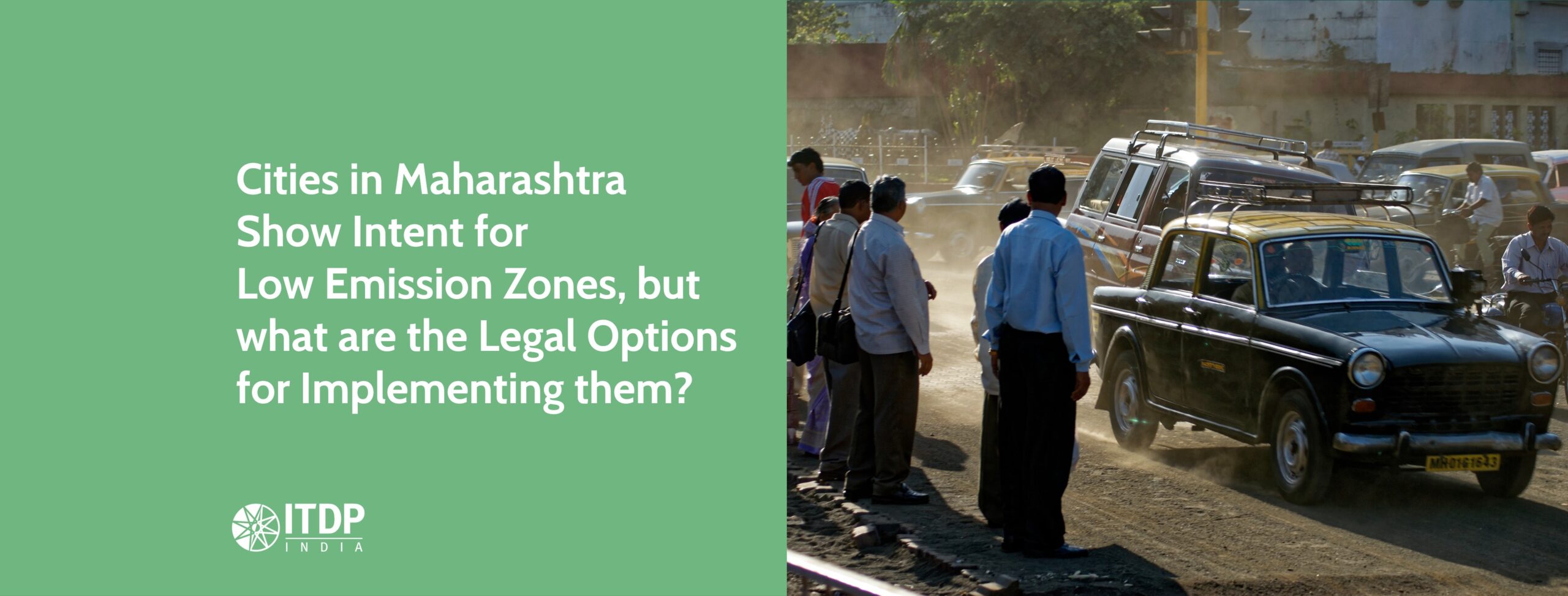
Cities in Maharashtra Show Intent for Low Emission Zones, but what are the Legal Options for Implementing them?

21st August 2026 by admin


As Pune prepares to implement a Low Emission Zone (LEZ), an important question lies at the centre of the discussion: how can cities legally regulate high-polluting vehicles?   

Low emission zones (LEZs) are designated zones in a city where the use of polluting vehicles is restricted or discouraged. Such zoning aims to improve local air quality and health by reducing vehicle tailpipe emissions. One pathway to implement LEZ is straightforward restriction – banning old polluting vehicles from entering identified areas. The other is more strategic; using pricing mechanisms to discourage the use of polluting vehicles while also generating resources to support sustainable transport initiatives. 

ITDP India is working with Pune to implement the idea of introducing a charge on high polluting vehicles. Instead of relying solely on bans, the aim is to introduce a levy on older and more polluting vehicles entering the LEZ. How this can be done is simple: create a system where cleaner mobility becomes the easier and more affordable choice. 

However, choosing “pricing” is not just a policy shift. It is also a legal one. 

In order to kick-start a LEZ, the legal pathway used to introduce these charges must be carefully structured. The legislation supporting it, the authority under which the charge is introduced, and terminology used will determine whether the system can withstand legal scrutiny. 

Understanding the Existing Legal Landscape for Clean Air   

India does not currently have a single consolidated law governing Low Emission Zones. Instead, implementation depends on multiple laws and authorities working together. At the constitutional level, the right to a clean environment is recognised under Article 21, while Article 48-A places a duty on the State to protect and improve the environment. 

Beyond this constitutional backing, several legislations create the broader framework within which an LEZ can operate. 

  • The Environment (Protection) Act, 1986 (EPA) grants the Central Government wide powers to regulate polluting activities and restrict certain areas when necessary for environmental protection. 
  • The Air (Prevention and Control of Pollution) Act, 1981 empowers both the State Pollution Control Board and State Government to plan and implement pollution-abatement programmes, including issuing binding directions. 
  • The Motor Vehicles Act, 1988 allows State Governments to regulate vehicle movement in the interest of public safety and convenience. 

Meanwhile, the Maharashtra Municipal Corporations (MMC) Act, 1949 directs municipal corporations to undertake environmental protection measures. However, the Act currently does not explicitly empower the city to levy environmental charges linked to vehicular pollution. 

This gap becomes central when discussing how Pimpri Chinchwad Municipal Corporation (PCMC) and Pune Municipal Corporation (PMC) can independently implement a pricing-based LEZ. 

What are the Possible Legal Pathways for Indian Cities to Introduce Pricing in LEZ 

To better understand how pricing can be introduced within a Low Emission Zone (LEZ), ITDP India conducted a legal study in the context of Pimpri Chinchwad. The objective was to identify the various legal pathways available for introducing a pricing mechanism and assess which of them could provide a legally robust foundation. The study identifies three possible pathways through which an LEZ and its associated pricing mechanism could be implemented. While the analysis was undertaken for Pimpri Chinchwad, these pathways may also be relevant for other cities in Maharashtra, including Pune. However, they should be viewed as potential legal options rather than definitive solutions. Their feasibility will ultimately depend on discussions with the respective city corporation and a detailed assessment of the city’s legal and administrative context. 

Option I: Implementing Pricing underthe Air (prevention and control of pollution) Act 1981)  

Approaching the Maharashtra State Government under the Air Act provides one of the most viable legal pathways for introducing pricing under a Low Emission Zone. As Maharashtra is already declared an Air Pollution Control Area, the State Government can impose targeted restrictions and environmental charges to address air pollution. 

Under the same Act, the Maharashtra Pollution Control Board (MPCB) is empowered to plan and implement pollution-abatement measures, issue binding directions, and collect restitutionary damages linked to environmental harm. Together, these provisions provide a strong legal basis for introducing pollution pricing through an LEZ. 

Option II: Implementing Pricing under the Maharashtra Municipal Corporation Act (MMC), 1949 

This pathway enables greater local autonomy but also presents the greatest legal challenge. Under the MMC Act, municipal corporations such as PMC and PCMC can regulate transit and impose certain special charges, but only after getting approval from General Body. Further, the Act does not provide authority to levy environmental charges linked to vehicular pollution. 

As a result, cities seeking to independently implement a pricing-based Low Emission Zone would require legislative amendments. In Maharashtra, this would involve strengthening Section 208 of the MMC Act. At present, Section 208 permits the levy of special charges primarily in cases involving physical damage to roads or traffic obstruction, but it does not explicitly recognise environmental protection or air pollution control as valid grounds for imposing such charges. 

A stronger legal foundation would require amending the provision to: 

  • explicitly recognise environmental protection and vehicular pollution control as legitimate grounds for regulating vehicle movement and levying special charges 
  • authorise the levy of environmental charges for these purposes through the existing mechanism under the Act, including the requirement for approval by the Corporation. 

Option III: Implementing pricing under the Environment (Protection) Act, 1986 

This pathway relies on action by the Central Government through the Ministry of Environment, Forest and Climate Change (MoEFCC). While it provides a strong legal basis for implementing a Low Emission Zone (LEZ), it is less likely to be pursued directly by a city, as the necessary powers rest with the Central Government. 

The Environment (Protection) Act provides wide-ranging powers to protect and improve environmental quality. In the context of an LEZ, the most relevant provisions include the power to: 

  • restrict areas where certain operations or processes may be prohibited or permitted only subject to safeguards (Section 3(2)(v)) 
  • issue binding directions for the regulation or prohibition of activities contributing to pollution (Section 5) 
  • prescribe environmental standards and stricter emission limits for specific areas through the Environment (Protection) Rules, 1986 

Using these powers, the Central Government could notify an area in Pune or Pimpri Chinchwad as a Low Emission Zone and prescribe restrictions or environmental charges for high-polluting vehicles. Since the necessary statutory powers already exist under the EPA, this pathway would not require amendments to existing legislation.

The Terminology Matters for Low Emission Zones: Fee vs Charge

At first glance, the difference between a “fee” and a “charge” may seem minor. Legally, however, the distinction is critical. 

A fee is generally understood as something charged in return for a service or benefit provided to the payer. However, this creates a challenge for an LEZ. An LEZ does not provide a direct service to the driver entering the zone. Instead, it restricts access in order to protect public health and reduce environmental harm. If the levy is framed as a “fee”, it becomes vulnerable to legal challenges on the grounds that no direct service is being provided. 

This is where the concept of an Environment Compensation Charge (ECC), or a “Special Charge”, becomes important. 

Unlike a fee, an environmental compensation charge is linked to the idea of compensating for environmental harm caused by polluting activities. Judicial precedents already recognise the principle of restitutionary and compensatory damages in environmental matters. Framing the levy this way creates a far more resilient legal foundation for implementation. 

Building Legally Resilient Low Emission Zones in Indian Cities 

As Pune and Pimpri Chinchwad move closer to implementing Low Emission Zones, with Pune starting the preliminary phases from June 2026, the urgency of establishing a legally secure framework continues to grow. 

If immediate implementation is the priority, pathways through the Central Government, State Government, or MPCB currently offer the strongest legal footing. Existing legislation and precedents already support the collection of environmental charges through these routes. 

However, if cities seek greater local control and long-term autonomy, it requires legislative reform. In this process, terminology itself becomes a form of legal protection. Framing the levy as Environmental Compensation rather than a service-based fee could determine whether the city’s efforts withstand future legal scrutiny. 

For a policy designed to improve air quality and public health in the long term, legal resilience will be just as important as technical planning.

Authors: Shreesha Arondekar, with technical input from Parin Visariya 
Project team: Parin Visariya, Siddhartha Godbole 
Editor: Donita Jose 


Frequently Asked Questions

  1. What is a Low Emission Zone? A Low Emission Zone is a designated area where the older, polluting vehicles are either restricted, discouraged, or required to pay a charge to enter. The goal is to improve air quality by reducing vehicle emissions in areas with high pollution levels. 
  2. Will an LEZ affect all vehicles? No. LEZs typically target vehicles based on their emission performance. Cleaner vehicles may be exempt, while older and more polluting vehicles may face restrictions or charges. 
  3. How does a pricing-based LEZ work? Instead of completely banning vehicles, a pricing-based LEZ imposes a charge on vehicles that do not meet specified emission standards. The charge acts as a disincentive for using polluting vehicles, providing flexibility while still influencing travel behaviour. It allows vehicle owners to make choices while creating a financial incentive to shift towards cleaner vehicles or sustainable transport options. 
  4. How can revenue collected through an LEZ be used? The LEZ charge is not designed as a revenue-generating mechanism. The primary intention of levying a charge is to discourage continued use of high polluting vehicles and gradually phase them out. Revenue from LEZ charges will support initiatives that directly reduce air pollution such as investing in procuring electric buses, and improving walking and cycling infrastructure. 
> Annexure

THE ENVIRONMENT (PROTECTION) ACT, 1986 
 
(1) Section 3 
“3. Power of Central Government to take measures to protect and improve environment.— 
(1) Subject to the provisions of this Act, the Central Government shall have the power to take all such measures as it deems necessary or expedient for the purpose of protecting and improving the quality of the environment and preventing, controlling and abating environmental pollution. 
 
(2) In particular, and without prejudice to the generality of the provisions of sub-section (1), such measures may include measures with respect to all or any of the following matters, namely:— 
(i) co-ordination of actions by the State Governments, officers and other authorities— 
(a) under this Act, or the rules made thereunder; or 
(b) under any other law for the time being in force which is relatable to the objects of this Act; 
(ii) planning and execution of a nation-wide programme for the prevention, control and abatement of environmental pollution; 
(iii) laying down standards for the quality of environment in its various aspects; 
(iv) laying down standards for emission or discharge of environmental pollutants from various sources whatsoever: 
Provided that different standards for emission or discharge may be laid down under this clause from different sources having regard to the quality or composition of the emission or discharge of environmental pollutants from such sources; 
(v) restriction of areas in which any industries, operations or processes or class of industries, operations or processes shall not be carried out or shall be carried out subject to certain safeguards; 
(vi) laying down procedures and safeguards for the prevention of accidents which may cause environmental pollution and remedial measures for such accidents; 
(vii) laying down procedures and safeguards for the handling of hazardous substances; 
(viii) examination of such manufacturing processes, materials and substances as are likely to cause environmental pollution; 
(ix) carrying out and sponsoring investigations and research relating to problems of environmental pollution; 
(x) inspection of any premises, plant, equipment, machinery, manufacturing or other processes, materials or substances and giving, by order, of such directions to such authorities, officers or persons as it may consider necessary to take steps for the prevention, control and abatement of environmental pollution; 
(xi) establishment or recognition of environmental laboratories and institutes to carry out the functions entrusted to such environmental laboratories and institutes under this Act; 
(xii) collection and dissemination of information in respect of matters relating to environmental pollution; 
(xiii) preparation of manuals, codes or guides relating to the prevention control and abatement of environmental pollution; 
(xiv) such other matters as the Central Government deems necessary or expedient for the purpose of securing the effective implementation of the provisions of this Act. 
 
(3) The Central Government may, if it considers it necessary or expedient so to do for the purposes of this Act, by order, published in the Official Gazette, constitute an authority or authorities by such name or names as may be specified in the order for the purpose of exercising and performing such of the powers and functions (including the power to issue directions under Section 5) of the Central Government under this Act and for taking measures with respect to such of the matters referred to in sub-section (2) as may be mentioned in the order and subject to the supervision and control of the Central Government and the provisions of such order, such authority or authorities may exercise the powers or perform the functions or take the measures so mentioned in the order as if such authority or authorities had been empowered by this Act to exercise those powers or perform those functions or take such measures.” 
 
(2) Section 5 
“5. Power to give directions — Notwithstanding anything contained in any other law but subject to the provisions of this Act, the Central Government may, in the exercise of its powers and performance of its functions under this Act, issue directions in writing to any person, officer or any authority and such person, officer or authority shall be bound to comply with such directions. 
 
Explanation.—For the avoidance of doubts, it is hereby declared that the power to issue directions under this section includes the power to direct— 
(a) the closure, prohibition or regulation of any industry, operation or process; or 
(b) stoppage or regulation of the supply of electricity or water or any other service.” 
 
(3) Section 6 
“6. Rules to regulate environmental pollution —  
(1) The Central Government may, by notification in the Official Gazette, make rules in respect of all or any of the matters referred to in Section 3. 
 
(2) In particular, and without prejudice to the generality of the foregoing power, such rules may provide for all or any of the following matters, namely:— 
(a) the standards of quality of air, water or soil for various areas and purposes; 
(b) the maximum allowable limits of concentration of various environmental pollutants (including noise) for different areas; 
(c) the procedures and safeguards for the handling of hazardous substances; 
(d) the prohibition and restrictions on the handling of hazardous substances in different areas; 
(e) the prohibition and restrictions on the location of industries and the carrying on of processes and operations in different areas; 
(f) the procedures and safeguards for the prevention of accidents which may cause environmental pollution and for providing for remedial measures for such accidents.” 
 
(4) Section 15 
“15. Penalty for contravention of provisions of Act, rules, orders and directions —  
(1) Where any person contravenes or does not comply with any of the provisions of this Act or the rules made or orders or directions issued thereunder for which no penalty is provided, he shall be liable to penalty in respect of each such contravention which shall not be less than ten thousand rupees but which may extend to fifteen lakh rupees. 
 
(2) Where any person continues contravention under sub-section (1), he shall be liable to additional penalty of ten thousand rupees for every day during which such contravention continues.” 
 
(5) Section 15-C 
“15-C. Adjudicating officer —  
(1) The Central Government, for the purposes of determining the penalties under this Act, may appoint an officer not below the rank of Joint Secretary to the Government of India or a Secretary to the State Government to be the adjudicating officer, to hold an inquiry and to impose penalty in the manner, as may be prescribed: 
 
Provided that the Central Government may appoint as many adjudicating officers as may be required. 
 
(2) The adjudicating officer may— 
(a) call upon any person alleged to have contravened or not complied with the provisions of this Act and the rules made thereunder or having the knowledge of the facts and circumstances of the case; 
(b) require such person to produce any record, register or other document in his possession or any other document, which in the opinion of the adjudicating officer may be relevant to the subject-matter. 
 
(3) The adjudicating officer shall, after giving the person a reasonable opportunity of being heard in the matter, and if, on such inquiry, he is satisfied that the person concerned has contravened or has not complied with the provisions of this Act or the rules made thereunder, he may impose such penalty as he thinks fit in accordance with the provisions of Sections 14-A, 14-B, 15, 15-A or Section 15-B, as the case may be. 
 
(4) The adjudicating officer, while adjudicating the quantum of penalty under sub-section (3), shall have due regard to the following, namely:— 
(a) the population and the area impacted or affected due to such contravention or non-compliance; 
(b) the frequency and duration of such contravention or non-compliance; 
(c) the vulnerability of the class of persons likely to be adversely affected by such contravention or non-compliance; 
(d) the damage caused or likely to be caused to any person, as a result of such contravention or non-compliance, if any; 
(e) the undue gain derived out of such contravention or non-compliance; and 
(f) such other factor, as may be prescribed. 
 
(5) The amount of penalty imposed under the provisions of Sections 14-A, 14-B, 15, 15-A or 15-B, as the case may be, shall be in addition to the liability to pay relief or compensation under Section 15 read with Section 17 of the National Green Tribunal Act, 2010 (19 of 2010).” 
 
(6) Section 25 
“25. Power to make rules.— 
(1) The Central Government may, by notification in the Official Gazette, make rules for carrying out the purposes of this Act. 
 
(2) In particular, and without prejudice to the generality of the foregoing power, such rules may provide for all or any of the following matters, namely:— 
(a) the standards in excess of which environmental pollutants shall not be discharged or emitted under Section 7; 
(b) the procedure in accordance with and the safeguards in compliance with which hazardous substances shall be handled or cause to be handled under Section 8; 
(c) the authorities or agencies to which intimation of the fact of occurrence or apprehension of occurrence of the discharge of any environmental pollutant in excess of the prescribed standards shall be given and to whom all assistance shall be bound to be rendered under sub-section (1) of Section 9; 
(d) the manner in which samples of air, water, soil or other substance for the purpose of analysis shall be taken under sub-section (1) of Section 11; 
(e) the form in which notice of intention to have a sample analysed shall be served under clause (a) of sub-section (3) of Section 11; 
(f) the functions of the environmental laboratories, the procedure for the submission to such laboratories of samples of air, water, soil and other substances for analysis or test; the form of the laboratory report; the fees payable for such report and other matters to enable such laboratories to carry out their functions under sub-section (2) of Section 12; 
(g) the qualifications of Government Analyst appointed or recognised for the purpose of analysis of samples of air, water, soil or other substances under Section 13; 
(ga) the manner of holding inquiry and imposing penalty by the adjudicating officer under sub-section (1) and other factors for determining quantum of penalty under clause (f) of sub-section (4) of Section 15-C; 
(gb) the other amount under clause (c) of sub-section (2) of Section 16; 
(gc) the other purposes under clause (c) of sub-section (3) of Section 16; 
(gd) the manner of administration of Fund under sub-section (4) of Section 16; 
(ge) form for maintenance of accounts of the Fund and for preparation of annual statement of accounts under sub-section (1) of Section 16-A; 
(gf) form for preparing annual report of the Fund under Section 16-B; 
(h) the manner in which notice of the offence and of the intention to make a complaint to the Central Government shall be given under clause (b) of Section 19; 
(i) the authority or officer to whom any reports, returns, statistics, accounts and other information shall be furnished under Section 20; 
(j) any other matter which is required to be, or may be, prescribed.” 
 
AIR (PREVENTION AND CONTROL OF POLLUTION) ACT, 1981 
 
(1) Section 4 
“4. State Pollution Control Boards constituted under Section 4 of Act 6 of 1974 to be State Boards under this Act — In any State in which the Water (Prevention and Control of Pollution) Act, 1974, is in force and the State Government has constituted for that State a State Pollution Control Board under Section 4 of that Act, such State Board shall be deemed to be the State Board for the Prevention and Control of Air Pollution constituted under Section 5 of this Act, and accordingly that State Pollution Control Board shall, without prejudice to the exercise and performance of its powers and functions under that Act, exercise the powers and perform the functions of the State Board for the prevention and control of air pollution under this Act.” 
 
(2) Section 5 
“5. Constitution of State Boards —  
(1) In any State in which the Water (Prevention and Control of Pollution) Act, 1974 (6 of 1974), is not in force, or that Act is in force but the State Government has not constituted a 8[State Pollution Control Board] under that Act, the State Government shall, with effect from such date as it may, by notification in the Official Gazette, appoint, constitute a State Board for the Prevention and Control of Air Pollution under such name as may be specified in the notification, to exercise the powers conferred on, and perform the functions assigned to that Board under this Act. 
 
(2) A State Board constituted under this Act shall consist of the following members, namely:— 
(a) a Chairman, being a person having special knowledge or practical experience in respect of matters relating to environmental protection, to be nominated by the State Government: 
Provided that the Chairman may be either whole-time or part-time as the State Government may think fit; 
(b) such number of officials, not exceeding five, as the State Government may think fit, to be nominated by the State Government to represent that Government; 
(c) such number of persons, not exceeding five, as the State Government may think fit, to be nominated by the State Government from amongst the members of the local authorities functioning within the State; 
(d) such number of non-officials, not exceeding three, as the State Government may think fit, to be nominated by the State Government to represent the interests of agriculture, fishery or industry or trade or labour or any other interest which, in the opinion of the Government, ought to be represented; 
(e) two persons to represent the companies or corporations owned, controlled or managed by the State Government, to be nominated by that Government; 
(f) a full-time member-secretary having such qualifications, knowledge and experience of scientific, engineering or management aspects of pollution control as may be prescribed, to be appointed by the State Government: 
 
Provided that the State Government shall ensure that not less than two of the members are persons having special knowledge or practical experience in respect of matters relating to the improvement of the quality of air or the prevention, control or abatement of air pollution. 
 
(3) Every State Board constituted under this Act shall be a body corporate with the name specified by the State Government in the notification issued under sub-section (1), having perpetual succession and a common seal with power, subject to the provisions of this Act, to acquire and dispose of property and to contract, and may by the said name sue or be sued.” 
 
(3) Section 16 
“16. Functions of Central Board.— 
(1) Subject to the provisions of this Act, and without prejudice to the performance of its functions under the Water (Prevention and Control of Pollution) Act, 1974 (6 of 1974), the main functions of the Central Board shall be to improve the quality of air and to prevent, control or abate air pollution in the country. 
 
(2) In particular and without prejudice to the generality of the foregoing functions, the Central Board may— 
(a) advise the Central Government on any matter concerning the improvement of the quality of air and the prevention, control or abatement of air pollution; 
(b) plan and cause to be executed a nationwide programme for the prevention, control or abatement of air pollution; 
(c) co-ordinate the activities of the State Boards and resolve disputes among them; 
(d) provide technical assistance and guidance to the State Boards, carry out and sponsor investigations and research relating to problems of air-pollution and prevention, control or abatement of air pollution; 
(dd) perform such of the functions of any State Board as may be specified in an order made under sub-section (2) of Section 18; 
(e) plan and organise the training of persons engaged or to be engaged in programmes for the prevention, control or abatement of air pollution on such terms and conditions as the Central Board may specify; 
(f) organise through mass media a comprehensive programme regarding the prevention, control or abatement of air pollution; 
(g) collect, compile and publish technical and statistical data relating to air pollution and the measures devised for its effective prevention, control or abatement and prepare manuals, codes or guides relating to prevention, control or abatement of air pollution; 
(h) lay down standards for the quality of air; 
(i) collect and disseminate information in respect of matters relating to air pollution; 
(j) perform such other functions as may be prescribed. 
 
(3) The Central Board may establish or recognise a laboratory or laboratories to enable the Central Board to perform its functions under this section efficiently. 
 
(4) The Central Board may— 
(a) delegate any of its functions under this Act generally or specially to any of the committees appointed by it; 
(b) do such other things and perform such other acts as it may think necessary for the proper discharge of its functions and generally for the purpose of carrying into effect the purposes of this Act.” 
 
(4) Section 17 
“17. Functions of State Boards.— 
(1) Subject to the provisions of this Act, and without prejudice to the performance of its functions, if any, under the Water (Prevention and Control of Pollution) Act, 1974 (6 of 1974), the functions of a State Board shall be— 
(a) to plan a comprehensive programme for the prevention, control or abatement of air pollution and to secure the execution thereof; 
(b) to advise the State Government on any matter concerning the prevention, control or abatement relating to air pollution; 
(c) to collect and disseminate information relating to air pollution; 
(d) to collaborate with the Central Board in organising the training of persons engaged or to be engaged in programmes relating to prevention, control or abatement of air pollution and to organise a mass-education programme relating thereto; 
(e) to inspect, at all reasonable times, any control equipment, industrial plant or manufacturing process and to give, by order, such directions to such persons as it may consider necessary to take steps for the prevention, control or abatement of air pollution; 
(f) to inspect air pollution control areas at such intervals as it may think necessary, assess the quality of air therein and take steps for the prevention, control or abatement of air pollution in such areas; 
(g) to lay down, in consultation with the Central Board and having regard to the standards for the quality of air laid down by the Central Board, standards for emission of air pollutants into the atmosphere from industrial plants and automobiles or for the discharge of any air pollutant into the atmosphere from any other source whatsoever not being a ship or an aircraft: 
Provided that different standards for emission may be laid down under this clause for different industrial plants having regard to the quantity and composition of emission of air pollutants into the atmosphere from such industrial plants; 
(h) to advise the State Government with respect to the suitability of any premises or location for carrying on any industry which is likely to cause air pollution; 
(i) to perform such other functions as may be prescribed or as may, from time to time, be entrusted to it by the Central Board or the State Government; 
(j) to do such other things and to perform such other acts as it may think necessary for the proper discharge of its functions and generally for the purpose of carrying into effect the purposes of this Act. 
 
(2) A State Board may establish or recognise a laboratory or laboratories to enable the State Board to perform its functions under this section efficiently.” 
 
(5) Section 18 
“18. Power to give directions —  
(1) In the performance of its functions under this Act— 
(a) the Central Board shall be bound by such directions in writing as the Central Government may give to it; and 
(b) every State Board shall be bound by such directions in writing as the Central Board or the State Government may give to it: 
 
Provided that where a direction given by the State Government is inconsistent with the direction given by the Central Board, the matter shall be referred to the Central Government for its decision. 
 
(2) Where the Central Government is of the opinion that any State Board has defaulted in complying with any directions given by the Central Board under sub-section (1) and as a result of such default a grave emergency has arisen and it is necessary or expedient so to do in the public interest, it may, by order, direct the Central Board to perform any of the functions of the State Board in relation to such area, for such period and for such purposes, as may be specified in the order. 
 
(3) Where the Central Board performs any of the functions of the State Board in pursuance of a direction under sub-section (2), the expenses, if any, incurred by the Central Board with respect to the performance of such functions may, if the State Board is empowered to recover such expenses, be recovered by the Central Board with interest (at such reasonable rate as the Central Government may, by order, fix) from the date when a demand for such expenses is made until it is paid from the person or persons concerned as arrears of land revenue or of public demand. 
 
(4) For the removal of doubts, it is hereby declared that any direction to perform the functions of any State Board given under sub-section (2) in respect of any area would not preclude the State Board from performing such functions in any other area in the State or any of its other functions in that area.” 
 
(6) Section 19 
“19. Power to declare air pollution control areas —  
(1) The State Government may, after consultation with the State Board, by notification in the Official Gazette, declare in such manner as may be prescribed, any area or areas within the State as air pollution control area or areas for the purposes of this Act. 
 
(2) The State Government may, after consultation with the State Board, by notification in the Official Gazette,— 
(a) alter any air pollution control area whether by way of extension or reduction; 
(b) declare a new air pollution control area in which may be merged one or more existing air pollution control areas or any part or parts thereof. 
 
(3) If the State Government, after consultation with the State Board, is of opinion that the use of any fuel, other than an approved fuel, in any air pollution control area or part thereof, may cause or is likely to cause air pollution, it may, by notification in the Official Gazette, prohibit the use of such fuel in such area or part thereof with effect from such date (being not less than three months from the date of publication of the notification) as may be specified in the notification. 
 
(4) The State Government may, after consultation with the State Board, by notification in the Official Gazette, direct that with effect from such date as may be specified therein, no appliance, other than an approved appliance, shall be used in the premises situated in an air pollution control area: 
Provided that different dates may be specified for different parts of an air pollution control area or for the use of different appliances. 
 
(5) If the State Government, after consultation with the State Board, is of opinion that the burning of any material (not being fuel) in any air pollution control area or part thereof may cause or is likely to cause air pollution, it may, by notification in the Official Gazette, prohibit the burning of such material in such area or part thereof.” 
 
(7) Section 20 
“20. Power to give instructions for ensuring standards for emission from automobiles — With a view to ensuring that the standards for emission of air pollutants from automobiles laid down by the State Board under clause (g) of sub-section (1) of Section 17 are complied with, the State Government shall, in consultation with the State Board, give such instructions as may be deemed necessary to the concerned authority in charge of registration of motor vehicles under the Motor Vehicles Act, 1939 (4 of 1939), and such authority shall, notwithstanding anything contained in that Act or the rules made thereunder be bound to comply with such instructions.” 
 
(8) Section 31-A 
“31-A. Power to give directions.—Notwithstanding anything contained in any other law, but subject to the provisions of this Act and to any directions that the Central Government may give in this behalf a Board may, in the exercise of its powers and performance of its functions under this Act, issue any directions in writing to any person, officer or authority, and such person, officer or authority shall be bound to comply with such directions. 
 
Explanation.—For the avoidance of doubts, it is hereby declared that the power to issue directions under this section includes the power to direct— 
(a) the closure, prohibition or regulation of any industry, operation or process; or 
(b) the stoppage or regulation of supply of electricity, water or any other service.” 
 
MOTOR VEHICLES ACT, 1988 
 
(1) Section 109 
“109. General provision regarding construction and maintenance of vehicles —  
(1) Every motor vehicle shall be so constructed and so maintained as to be at all times under the effective control of the person driving the vehicle.  
 
(2) Every motor vehicle shall be so constructed as to have right hand steering control unless it is equipped with a mechanical or electrical signalling device of a prescribed nature.  
 
(3) If the Central Government is of the opinion that it is necessary or expedient so to do in the public interest, it may by order published in the Official Gazette, notify that any article or process used by a manufacturer shall conform to such standard as may be specified in that order.” 
 
(2) Section 110 
“110. Power of Central Government to make rules —  
(1) The Central Government may make rules regulating the construction, equipment and maintenance of motor vehicles and trailers with respect to all or any of the following matters, namely:—  
(a) the width, height, length and overhang of vehicles and of the loads carried;  
(b) the size, nature, maximum retail price and condition of tyres, including embossing thereon of date and year of manufacture and the maximum load carrying capacity;  
(c) brakes and steering gear;  
(d) the use of safety glasses including prohibition of the use of tinted safety glasses;  
(e) signalling appliances, lamps and reflectors;  
(f) speed governors;  
(g) the emission of smoke, visible vapour, sparks, ashes, grit or oil;  
(h the reduction of noise emitted by or caused by vehicles;  
(i) the embossment of chassis number and engine number and the date of manufacture;  
(j) safety belts, handle bars of motor cycles, auto-dippers and other equipments essential for safety of drivers, passengers and other road users;  
(k) standards of the components used in the vehicle as inbuilt safety devices;  
(l) provision for transportation of goods of dangerous or hazardous nature to human life;  
(m) standards for emission of air pollutants;  
(n) installation of catalytic convertors in the class of vehicles to be prescribed;  
(o) the placement of audio-visual or radio or tape recorder type of device in public vehicles;  
(p) warranty after sale of vehicle and norms therefor: 
Provided that any rules relating to the matters dealing with the protection of environment, so far as may be, shall be made after consultation with the Ministry of the Government of India dealing with environment.  
 
(2) Rules may be made under sub-section (1) governing the matters mentioned therein, including the manner of ensuring the compliance with such matters and the maintenance of motor vehicles in respect of such matters, either generally in respect of motor vehicles or trailers or in respect of motor vehicles or trailers of a particular class or in particular circumstances.  
 
(3) Notwithstanding anything contained in this section,— (a) the Central Government may exempt any class of motor vehicles from the provisions of this Chapter; (b) a State Government may exempt any motor vehicle or any class or description of motor vehicles from the rules made under sub-section (1) subject to such conditions as may be prescribed by the Central Government.” 
 
(3) Section 115 
“115. Power to restrict the use of vehicles — The State Government or any authority authorised in this behalf by the State Government, if satisfied that it is necessary in the interest of public safety or convenience, or because of the nature of any road or bridge, may by notification in the Official Gazette, prohibit or restrict, subject to such exceptions and conditions as may be specified in notification, the driving of motor vehicles or of any specified class or description of motor vehicles or the use of trailers either generally in a specified area or on a specified road and when any such prohibition or restriction is imposed, shall cause appropriate traffic signs to be placed or erected under section 116 at suitable places: Provided that where any prohibition or restriction under this section is to remain in force for not more than one month, notification thereof in the Official Gazette shall not be necessary, but such local publicity as the circumstances may permit, shall be given of such prohibition or restriction.” 
 
(4) Section 194 
“194. Driving vehicle exceeding permissible weight —  
(1) Whoever drivers a motor vehicle or causes or allows a motor vehicle to be driven in contravention of the provisions of section 113 or section 114 or section 115 shall be punishable with minimum fine of two thousand rupees and an additional amount of one thousand rupees per tonne of excess load, together with the liability to pay charges for off-loading of the excess load.  
 
(2) Any driver of a vehicle who refuses to stop and submit his vehicle to weighing after being directed to do so by an officer authorised in this behalf under section 114 or removes or causes the removal of the load or part of it prior to weighing shall be punishable with fine which may extend to three thousand rupees.” 
 
MAHARASHTRA MUNICIPAL CORPORATIONS ACT, 1949 
 
(1) Section 63(1b) 
“63. Matters to be provided for by the Corporation — It shall be incumbent on the Corporation to make reasonable and adequate provision, by any means or measures which it is lawfully competent to it to use or to take, for each of the following matters, namely :— (1b) urban forestry, protection of the environment and promotion of ecological aspects;” 
 
(2) Section 66(42) 
“66. Matters which may be provided for by Corporation at its discretion — The Corporation may, in its discretion, provide from time to time, either wholly or partly, for all or any of the following matters, namely:— (42) any measure not hereinbefore specifically named, likely to promote public safety, health, convenience or instruction.” 
 
(3) Section 82 
“82. Constitution of Municipal Fund — Subject to the provisions of this Act and the rules and subject to the provisions of Section 44 of the Bombay Primary Education Act, 1947 (Bom. LXI of 1947)— 
(a) all moneys received by or on behalf of the Corporation under the provisions of this Act or of any other law for the time being in force, or under any contract, 
(b) all proceeds of the disposal of property by or on behalf of the Corporation, 
(c) all rents accruing from any property of the Corporation, 
(d) all moneys raised by any tax levied for the purposes of this Act, 
(e) all fees and fines payable and levied under this Act or under any rule, by-law, regulation or standing order other than fines imposed by a Court, 
(f) all moneys received by way of compensation or for compounding offences under the provisions of this Act, 
(g) all moneys received by or on behalf of the Corporation from the Government or public bodies, private bodies or private individuals by way of grant or gift or deposit, subject, however, to the conditions, if any, attached to such grant, gift or deposit, and 
(h) all interest and profits arising from any investment of, or from any transaction in connection with, any money belonging to the Corporation, shall be credited to a fund which shall be called “ the Municipal Fund” and which shall be held by the Corporation in trust for the purposes of this Act, subject to the provisions herein contained.” 
 
(4) Section 88 
“88. Purpose for which Municipal Fund is to be applied — The moneys from time to time credited to the Municipal Fund shall be applied in payment of all sums, charges and costs necessary for carrying this Act into effect, or of which the payment shall be duly directed or sanctioned under any of the provisions of this Act or of any other law for the time being in force inclusive of,— 
(a) the expenses of every ward election; 
(b) the salary, joining time allowances and other allowances of the Commissioner and of leave and pension contribution, if any, payable on his account to the State Government; 
(c) the salaries and other allowances of all municipal officers and servants and all contributions to provident funds, pensions, gratuities and compassionate allowances payable under the provisions of this Act or the regulations or of the statement framed under this Act for the time being in force; 
(d) all expenses and costs incurred by the Commissioner in the exercise of any power or the discharge of any duty conferred or imposed upon him by this Act, including moneys which he is required or empowered to pay by way of compensation; 
(e) the grant payable under Section 44 of the Bombay Primary Education Act, 1947 (Bom. XLI of 1947), to the Primary Education Fund maintained thereunder for the City; 
(f) the loans advanced under the rules for building purposes; 
(g) any sum chargeable under Section 108; 
(h) every sum payable,— 
(i) under Section 422 or sub-section (1) of Section 449 to the State Government; 
(ii) under a decree or order of a civil or criminal court passed against the Corporation or against the Commissioner, Deputy Commissioner or Assistant Commissioner ex-officio; 
(iii) under a compromise of any suit or other legal proceeding or claim effected under Section 481; 
(i) contributions to public institutions; 
(j) expenses incurred on the provision of traffic signs.” 
 
(5) Section 127 
“127. Taxes to be imposed under this Act — 
(1) For the purposes of this Act, the Corporation shall impose the following taxes, namely:— 
(a) property taxes; 
(b) a tax on vehicles, boats and animals. 
 
(2) In addition to the taxes specified in sub-section (1) the Corporation may for the purposes of this Act and subject to the provisions thereof impose any of the following taxes, namely:— 
(c) a tax on dogs; 
(d) a theatre tax; 
(e) a toll on animals and vehicles entering the City; 
(f) any other tax (not being a tax on profession, trades, callings and employments), which the State Legislature has power under the Constitution to impose in the State. 
 
(2A) Notwithstanding anything contained in sub-section (1) or sub-section (2), no tax or toll shall be levied on motor vehicles save as provided in section 20 of the Bombay Motor Vehicles Tax Act, 1958. 
 
(3) The Municipal taxes shall be assessed and levied in accordance with the provisions of this Act and the rules. 
 
(4) Nothing in this section shall authorise the imposition of any tax which the State Legislature has no power to impose in the State under the Constitution.” 
 
(6) Section 149 
“149. Procedure to be followed in levying other taxes.— 
(1) In the event of the Corporation deciding to levy any of the taxes specified in sub-section (2) of section 127, it shall make detailed provisions, in so far as such provision is not made by this Act, in the form of rules, modifying, amplifying or adding to the rules at the time in force for the following matters, namely:— 
(a) the nature of the tax, the rates thereof, the class or classes of persons, articles or properties liable thereto and the exemptions therefrom, if any, to be granted; 
(b) the system of assessment and method of recovery and the powers exercisable by the Commissioner or other officers in the collection of the tax; 
(c) the information required to be given of liability to the tax; 
(d) the penalties to which person evading liability or furnishing incorrect or misleading information or failing to furnish information may be subjected; 
(e) such other matters, not inconsistent with the provisions of this Act, as may be deemed expedient by the Corporation: 
 
Provided that no rules shall be made by the Corporation in respect of any tax coming under clause (f) of sub-section (2) of section 127 unless the State Government shall have first given provisional approval to the selection of the tax by the Corporation. 
 
(2) The rules shall be submitted by the Corporation to the State Government and the State Government may either refuse to sanction them or refer them back to the Corporation for further consideration or sanction them either as they stand or with such modifications as it thinks fit, not, however, involving an increase in the rate or rates of the levy or the extent thereof. 
 
(3) Any sanction given by the State Government under sub-section (2) shall become operative on such date not earlier than one month from the date of the sanction as the State Government shall specify in the order of sanction, and the Corporation shall be competent to levy the tax covered by the sanction as from the date so specified. 
 
(4) The Corporation and the State Government shall take such steps as may be practicable to ensure that the date specified in the order of sanction is the first day of April, unless the sanction is given in pursuance of a proposal for supplementary taxation under section 150: 
 
Provided that nothing in sub-section (4) shall affect the power of the Corporation to levy a tax as from a date later than the first day of April if the sanction of the State Government is not given by the first day of March immediately preceding and if the State Government in the order of sanction specifies a date later than the first day of April for the commencement of the levy of the tax. 
 
(5) The provisions of this section shall apply, as far as may be, to any alterations which the Corporation may from time to time decide to make in the rates fixed for any tax, or in the class or classes of persons, articles, or properties liable thereto or in the exemptions therefrom, if any, to be granted.” 
 
(7) Section 208 
“208. Power to prohibit use of public streets for certain kinds of traffic —  
(1) It shall be lawful for the Commissioner with the sanction of the Corporation to,— 
(a) prohibit vehicular traffic in any particular public street vesting in the Corporation so as to prevent danger, obstruction or inconvenience to the public by fixing up posts at both ends of such street or portion of such street; 
(b) prohibit in respect of all public streets, or particular public streets, the transit of any vehicle of such form, construction, weight or size or laden with such heavy or unwieldy objects as may be deemed likely to cause injury to the roadways or any construction thereon, or risk of obstruction to other vehicles or pedestrians along or over such street or streets, except under such conditions as to time, mode of traction or locomotion, use of appliances for protection of the roadway, number of lights and assistants, and other general precautions and the payment of special charges as may be specified by the Commissioner generally or specially in each case. 
 
(2) Notices of such prohibitions as are imposed under sub-section (1) shall be posted up in conspicuous places at or near both ends of the public streets or portions thereof to which they relate, unless such prohibitions apply generally to all public streets.” 
 
(8) Section 456 
“456. Power of State Government to make rules —  
(1) The State Government may at any time require the Corporation to make rules under Section 454 in respect of any purpose or matter specified in Section 457. 
 
(2) If the Corporation fails to comply with such requisition within such reasonable time as may be fixed by the State Government, the State Government may, after previous publication, make such rules and the rules so made shall, on final publication in the Official Gazette, have effect as if enacted in this Act.” 
 
(9) Section 457(13)(k) 
“457. Matters in respect of which rules may be made — In particular, and without prejudice to the generality of the powers conferred by Section 454, rules made thereunder may provide for or regulate all or any of the following purposes and matters, namely :— (13) Sanitary provisions.— (k) the prevention and regulation of the discharge of smoke, steam, fumes and noxious vapours;” 

Filed Under: Low Emission Zones Tagged With: Air Pollution, Environmental Compensation Charge, Low Emission Zones, Pimpri chinchwad, Pune, Sustainable Transport

  • Who We Are
    • Our Team
    • Contact Us
    • Opportunities
    • Our Approach
  • What We Do
    • Complete Streets and Parking Management
    • Public Transport
    • Transit Oriented Development
    • Inclusive Mobility
  • Where We Work
    • Agra
    • Ahmedabad
    • MAHARASHTRA
    • Pune – Pimpri-Chinchwad
    • Nashik
    • TAMIL NADU
    • Chennai
    • Coimbatore
    • JHARKHAND
    • Ranchi
    • NATIONAL
  • News
  • Resources
  • Get Involved
    • Donate

Copyright © 2026 · ITDP Responsive on Genesis Framework · WordPress · Log in

Loading Comments...