ITDP India

Promoting sustainable and equitable transportation worldwide

  • Contact
  • Who We Are
    • Our Approach
    • ITDP India’s 2024
    • Contact Us
    • Career Opportunities
  • What We Do
    • Healthy Streets
    • Public Transport
    • Electric Mobility
    • Transit Oriented Development
    • Low Emission Zones
    • Inclusive Mobility
    • Traffic Reduction
  • Where We Work
    • NATIONAL
    • MAHARASHTRA
      • Pune
      • Pimpri Chinchwad
      • Nashik
    • TAMIL NADU
      • Chennai
      • Coimbatore
    • JHARKHAND
      • Ranchi
    • Agra
    • Ahmedabad
  • Blogs
  • Resources
  • National Challenges
    • India Cycles4Change Challenge
    • Streets for People Challenge
    • Transport4All Challenge
  • Urbanlogue
    • Urbanlogue Webinars – Series One
    • Urbanlogue Webinars – Series Two
    • Urbanlogue Webinars – Series Three
    • Urbanlogue Webinars – Series Four
  • Press

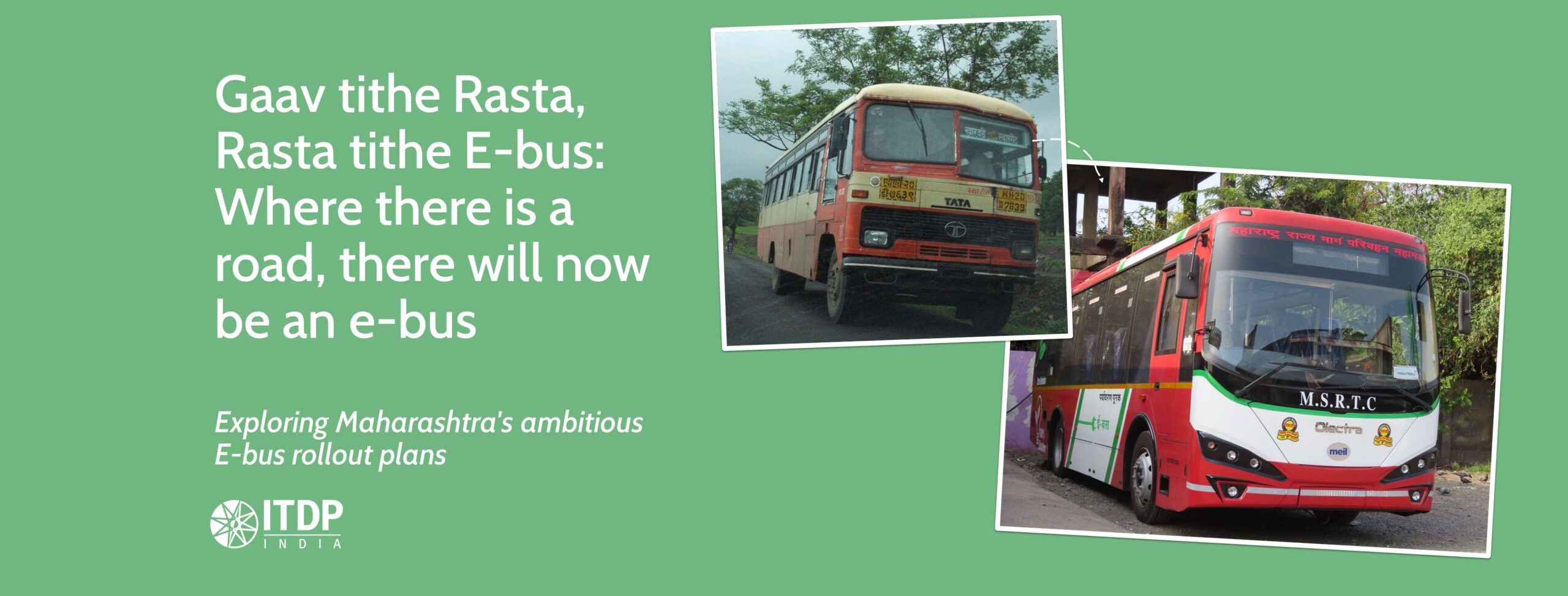
Gaav tithe Rasta, Rasta tithe E-bus: Where there is a road, there will now be an e-bus

29th August 2024 by admin

Exploring Maharashtra’s ambitious E-bus rollout plans 


With the Maharashtra State Road Transport Corporation (MSRTC) observing its 75th anniversary in June 2023, its motto— ‘Gaav tithe rasta, rasta, tithe ST’, meaning ‘Where there is a road, there is state transport’—has truly stood the test of time.  

In 75 years of operations, its ever-growing fleet of over 15,000 buses has relentlessly served every nook and corner of the state, operating nearly 60 lakh kilometres per day. And as it heads into its centenary years, the Corporation has decided to make another ambitious leap – to electrify its fleet. It is in this light, that we look at the Corporation’s plan to electrify 25% of its rural bus fleet, with the addition of 5,150 new electric buses (e-buses) —unheard of in India’s state road transport landscape. 

Why is this important? 

To put this achievement in perspective, traditionally, Indian State Transport Undertakings (STUs) have focused on electrifying city (urban) bus fleets due to the ease and cost-efficiency of setting up urban charging infrastructure. In this context, MSRTC’s decision to order 5,150 e-buses for rural operations is groundbreaking, rooted in this simple but uncommon logic—Why can’t citizens from rural areas, who serve as a backbone to Maharashtra’s economy, enjoy the same quality of service with AC e-buses as citizens in cities? 

This bold move by MSRTC has not only positioned it as a pioneer but has also provided a blueprint for other STUs looking to undertake similar electrification interventions in the future.  

So, how did MSRTC begin this transformation journey for its iconic red buses known as the Red Fairy or Laal Pari? 

How it all began 

While electrification started with the procurement of 150 e-buses under the FAME II scheme in 2021, the true push for transitioning at this scale came with the Bombay High Court (HC) appointing a High Power Committee in 2022 to revive the operations of MSRTC. The committee submitted a revival plan to the Bombay HC which was subsequently approved. This particular plan outlined the need to scale up MSRTC’s fleet size from its existing 15,000 buses to 22,000 buses within just three years by the year 2025. 

To achieve this, MSRTC opted for the Public-Private Partnership (PPP) model. The Corporation developed a plan to stagger purchasing of e-buses in two segments—5,150 e-buses and 500 diesel buses on Gross Cost Contract (GCC), and another 2,200 diesel buses on outright purchase.  

This incorporation of 5,150  e-buses will also help them achieve a significant fleet electrification target above 25% by 2025, which aligns with the state electrification policy. 

Lessons from MSRTC’s Journey

While the intent was set right from 2022, there are many lessons to be learned from the MSRTC’s journey, which was not without its challenges. Being one of the first STUs to take up electrification, the path towards it was lesser known.

  1. Ensuring manufacturers customise bus body specifications for rural needs 

When MSRTC set out to procure e-buses for district operations in 2022, no manufacturer was making e-buses to cater to the specific needs of rural operations. Majority of the e-buses were being manufactured for urban settings.  

The Corporation then sought specific models of buses, by adding clauses in the tender for bus body specifications under AIS (Automotive Industry Standards) 34, 52, 153, 140 that have regular floor design and good ground clearance unlike some of the existing variants. This ensured that these e-buses were built with robust quality to navigate to navigate the narrow roads and difficult terrains in rural areas, where roads may not be in the best conditions.  

  1. Identifying the right types of buses  

While district and rural buses serve as the backbone of Maharashtra, serving the routes with medium to low demand with e-buses had to be taken up tactfully. To ensure that the buses procured do not end up running empty, MSRTC decided to procure two types of buses, keeping in mind traffic demand, ridership patterns, load factors, and headway. 

The first type was 12m buses; – 2,800 of the total consignment were of this dimension. These buses are primarily tailored for high-traffic and high-demand scenarios, earmarked for express routes connecting major districts, metropolitan cities, and prominent pilgrim and tourist destinations. 

The second type was 9m buses, totaling 2,350 vehicles, specifically allocated for with mid to low demand routes, emphasising connectivity between district headquarters, taluk-level towns, and villages. These routes often serve as vital lifelines for residents in more remote areas.  

3. Selecting strategic locations for charging infrastructure  

One significant challenge was selecting locations for charging infrastructure. Not all depots could support EV charging infrastructure due to high costs and power supply issues.  

Thus, MSRTC chose depots based on these three criteria: depots with existing operations, ideally located to minimise dead kilometres, and those in close proximity to high-tension power supply lines. 

By selecting depots that fulfilled these three criteria, they could reduce cost for extensive new electrical infrastructure development. Furthermore, depots with overnight bus parking facility for maintenance were also prioritised. 

The depots were also given e-buses in a staggered manner to address any potential operational disruptions due to power supply failures. MSRTC decided that at any point, only 30%-50% of the selected depot fleet will be electric, while the remaining 70%-50% will consist of Compressed Natural Gas (CNG)/Liquefied Natural Gas (LNG) and diesel buses, serving as backup. However, in bigger cities where multiple depots are in proximity to one another, MSRTC intends to develop a few depots as 100% electric depots.  

The total cost associated with this process is estimated at INR 650 crores, for which, MSRTC has sought financial assistance from the state government. 

  1. Selecting the optimum routes to ensure success 

While e-buses are a sustainable choice for the future, to ensure financial viability, the route selection was a meticulous process.  

MSRTC developed a strategy that focused on electrifying routes with the highest ridership, high earnings per kilometre, and the lowest bus replacement ratio. The effort to identify such routes was entirely in-house, drawing upon the extensive ground-level expertise and insights from various divisions within the Corporation. 

Future of the Red Fairy  

The discourse of sustainable transport often focuses solely on urban areas and their residents, highlighting the need for infrastructure like electric buses, cycling tracks, e-vehicles, and so on. 

However, with this one initiative, MSRTC has ensured that an entire generation of citizens from rural areas of Maharashtra will have their first experience in smooth, electric buses rather than noisy diesel-powered ones. This shift has the potential to redefine their perspective on the true benefits of a bus- a mode they will use not out of compulsion, but by choice. 

 As MSRTC moves forward with an alternative fuel strategy beyond electrification, by adding 50 CNG buses to its fleet and retrofitting 6,000 existing diesel buses to operate on LNG and CNG, the move could further push the cause of clean air in rural areas. 

MSRTC’s overall shift to a Gross Cost Contract model for the 5,150 new e-bus and 500 diesel buses, will also enable it to achieve cost efficiency, something which all STUs are aiming for in the long run.  The model helps to mitigate the risks associated with heavy up-front capital investment because the actual purchase of buses is not their responsibility and maintenance expenses e are also taken care of by the contractors.  

With such multi-pronged reforms in place, MSRTC could set a steady course for the next few decades riding on the e-red fairy and being a role model for other transport operators across the country. 

For more insights read the detailed report


Written by Donita Jose, Senior Associate, Communications and Development, ITDP India

With Technical Inputs from Aditya Rane, Senior Associate – Transport Systems and Electric Mobility, ITDP India

Filed Under: Uncategorised Tagged With: Electric bus, electric mobility, India, Maharashtra, MORTH, MSRTC, nutp, Public Transport, Rural bus, Sustainable Transport, Sustainable Transport Policy

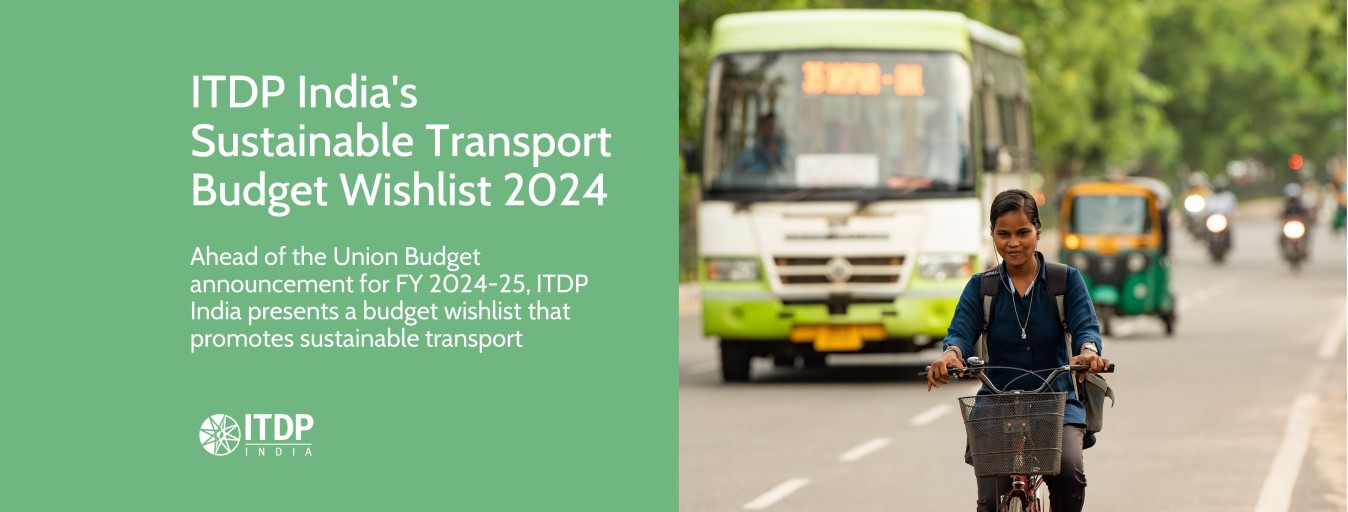
Budget 2024: A Wishlist for Sustainable Transport by ITDP India

16th July 2024 by admin


As the Finance Minister of India prepares to announce the new budget for the country shortly, our diverse team has brainstormed a list of budgetary interventions we wish to see in the upcoming budget and beyond.  

In a post-pandemic world, as our cities grow more rapidly than ever, facing various climate change impacts, our wishlist aims to put ‘sustainability’ at the forefront of our transport and urban policies. Here is a list of five action areas where we seek to see increased focus and budget prioritisation. 

1. Ensuring allocation of Transport Budgets towards Sustainable Mobility  

What we want: At least 50-60% of the total transport budget to be allocated for sustainable mobility projects including public bus transport, e-buses, walking, cycling, micro-mobility, e-shared passenger and freight across Indian cities. 

Why: As per 2011 Census, nearly 72% of trips in India are on foot, cycle, and public transport. It is only fair that the transport budget reflects this proportion, ensuring that sustainable transport receives the attention and funding it deserves. 

2. Prioritising More Buses, Better Buses, Greener Buses 

What we want:  A 15-fold scale-up of national programs like the PM E-Bus Sewa Scheme to ensure More Buses, Better Buses, and Green Buses in all cities with financial support. Financial support should be provided to public bus operators in the form of viability gap funding on Gross Cost Contracts (GCC). 

Electrification of private sector buses, which make up for 93% of buses in India, presents an opportunity for reducing emissions that can be facilitated through lower interest rates for loans, longer loan tenure, and a leasing model. 

Why: Public and private bus transport forms the backbone of Indian transportation, catering to 30 crore daily passenger trips. It is crucial to improve both the quality and quantity of both the public and private buses through prioritised investments in better and greener options.  

With ~20 lakh public and private buses in India. Even if just one-fifth of these buses go electric, it could reduce 85 lakh tonnes of CO2 emissions per year– helping India achieve its 2070 Net Zero vision.  

3.Creating Walking and Cycling Friendly Indian cities  

What we want: Specific budgetary allocation and a national commitment towards creating walking and cycling-friendly streets across Indian cities. All states should be guided towards adopting state-level street design guidelines, policies, and action plans. These must be followed when taking up upgradation or street development work.  

Why: A robust walking and cycling infrastructure provide a highly cost-effective means of mitigating greenhouse gas emissions, improving public health, saving money for residents, increasing access to opportunities and improving public safety in cities. For this very reason, world over attempt is being made to increase walking and cycling. But in India, already 48% of the population commutes by walking or cycling, as per Census 2011. This goes to show that we have a strong demand for walking and cycling. 

Despite the clear and significant benefits that investments in walking & cycling infrastructure bring to pedestrians, cyclists, and society at large, this is not adequately reflected in the transport budgets or actions of national, state, and city agencies. The lack of prioritisation for safe walking and cycling infrastructure has been a persistent issue across Indian cities and should be a key focus moving forward.

4.Connecting the Dots: Seamless Integration

What we want: Budget allocation for cities with ongoing and upcoming metro projects to ensure seamless physical, information, and fare integration. The integration should be based on the local area plans, between different modes of transportation including bus, metro, suburban rail, walk, and cycle within a 500m radius of any station area, to encourage a modal shift to sustainable modes of transport.  

Why: Seamless integration plays a crucial role in making people shift to sustainable transport.  The journey must be convenient, seamless, and connected right from planning, boarding, alighting, payments etc. Unless these are integrated, private vehicle users may not shift to sustainable transport modes. 

5. Pricing Pollution

What we want: Provide policy, technical, and budgetary support to states and cities towards adopting parking policies, implementing parking management measures, and setting up low emission zones with a mobility component. These measures can discourage the use of polluting vehicles through pricing and reduce traffic congestion. The national government could encourage cities to develop newer revenue sources by pricing parking and polluting vehicles. 

Why: As per the World Air Quality Report 2023, India is the third most polluted country in the world. Several Indian cities like Delhi, feature in the infamous list of most polluted places in the world. There is an urgent need for separate budget allocation to implement strategies that tackle vehicular pollution and congestion which can lead to lower costs related to road maintenance, healthcare, and fuel consumption. 

Cities can also generate new revenue sources by pricing parking and implementing charges for polluting vehicles. This revenue can be reinvested in sustainable urban mobility projects. 

But how can these be effectively rolled out ensuring accountability for cities? Well, here are some suggestions:  

a. Set up a National Sustainable Mobility Mission, empowered to allocate funds under an Urban Transport Fund, monitor projects, and fastrack sustainability mobility projects across state/cities.  

b. Adopt a result-oriented approach for every project undertaken via the National Sustainable Mobility Mission. For every project, a framework is to be adopted, and budget should be specifically allocated within project costs for ‘Impact assessment of infrastructure’ and performance audit of programs to ensure public money is spent wisely benefitting large masses. 

c. Empower those cities that have an operational Unified Metropolitan Transport Authority (UMTA) or a Green Mobility Cell to avail the budgetary support from the national mission. These entities should be empowered legally and financially to facilitate coordination, planning, and execution of sustainable transport initiatives among various agencies.  

d. Set up a Green Mobility Data Centre for data-driven decision-making. These data-centres can collect granular and gender-disaggregated mobility data, analyse the same. The collected data can be used for planning, design, budgeting, management, enforcement, and performance evaluation of all mobility interventions and initiatives. 

e. Empower the states and cities to revise existing Motor Vehicle Acts, Municipal and District Acts with rules for prioritising pedestrian-friendly infrastructure to avail the budgetary support. Cities will have to ensure that all upgraded or newly laid out street development will be completed with the provision of safe, continuous, and comfortable pedestrian infrastructure as per the national street design guidelines. 

f. Create a national platform for technical experts who can especially support Tier 2 and Tier 3 cities in piloting and scaling up infrastructure projects. This will ensure high quality planning, design, and implementation of the projects across India. 

g. Mandate state and city transport to make allocations in transport budgets that benefit women, gender minorities, and vulnerable users. It’s enforcement can be done by setting up Inclusive Mobility Committee and/or Inclusion officers. Initiatives such as women-led transport cooperatives for ride sharing services, measures to ensure travel safety, training for these users in roles like drivers, mechanics and engineers should be explored 

As we began compiling our wish list, we realised that what we truly desire is a return to prioritising the basics. We seek strong national commitment to fulfil the 2030 sustainable mobility vision for India, where all cities have: 

A– Accessible and safe streets for all. 

B– Buses near everyone, everywhere, on time. 

C– Congestion and pollution free cities. 


Written by

Team ITDP India

Filed Under: Uncategorised Tagged With: budget expectations, Delhi, electric mobility, fame scheme, Finance Minister, India, MAUD, MoHUA, MORTH, nutp, Public Transport, Sustainable Transport, Sustainable Transport Policy, UMTAS, Union Budget 2024, Walking and Cycling

  • « Previous Page
  • 1
  • 2
  • 3
  • Who We Are
    • Our Team
    • Contact Us
    • Opportunities
    • Our Approach
  • What We Do
    • Complete Streets and Parking Management
    • Public Transport
    • Transit Oriented Development
    • Inclusive Mobility
  • Where We Work
    • Agra
    • Ahmedabad
    • MAHARASHTRA
    • Pune – Pimpri-Chinchwad
    • Nashik
    • TAMIL NADU
    • Chennai
    • Coimbatore
    • JHARKHAND
    • Ranchi
    • NATIONAL
  • News
  • Resources
  • Get Involved
    • Donate

Copyright © 2025 · ITDP Responsive on Genesis Framework · WordPress · Log in