ITDP India

Promoting sustainable and equitable transportation worldwide

  • Contact
  • ITDP India’s 2025
  • Who We Are
    • Our Approach
    • Contact Us
    • Career Opportunities
  • What We Do
    • Healthy Streets
    • Public Transport
    • Electric Mobility
    • Transit Oriented Development
    • Low Emission Zones
    • Inclusive Mobility
    • Traffic Reduction
  • Where We Work
    • NATIONAL
    • MAHARASHTRA
      • Pune
      • Pimpri Chinchwad
      • Nashik
    • TAMIL NADU
      • Chennai
      • Coimbatore
    • JHARKHAND
      • Ranchi
    • Agra
    • Ahmedabad
  • Blogs
  • Resources
    • Press
  • National Challenges
    • India Cycles4Change Challenge
    • Streets for People Challenge
    • Transport4All Challenge
  • Urbanlogue
    • Urbanlogue Webinars – Series One
    • Urbanlogue Webinars – Series Two
    • Urbanlogue Webinars – Series Three
    • Urbanlogue Webinars – Series Four

What Indian Cities can Learn From Chennai’s New Mobility Playbook

19th March 2026 by admin

As published in The Times of India

Indian cities do not suffer from a lack of transport plans; they struggle to turn those plans into coordinated action on the ground. Over the past two decades, most large cities have articulated similar ambitions—prioritising public transport, integrating land use and mobility, improving safety, and reducing dependence on private vehicles. Yet congestion has worsened, road fatalities remain high, and private vehicle ownership continues to rise across urban India. The problem has not been a lack of vision, but the difficulty of translating that vision into aligned implementation across agencies. 

Chennai reflects this broader national challenge. The city has planned for mobility before: a Comprehensive Traffic and Transportation Study in 2010 and a Comprehensive Mobility Plan in 2019, both aligned with national policy priorities around public transport, non-motorised travel, and land-use integration. Yet the outcomes fell short. This pattern is familiar across urban India: mobility plans do not fail because their goals are wrong, but because the institutional conditions required to implement them are weak. 

What’s Changed This Time 

For context, Chennai’s latest Comprehensive Mobility Plan (CMP) for 2023–2048 must be understood in this context. It is not the city’s first attempt at mobility planning, nor does it radically depart from earlier goals. 

But the key shift is institutional. With the operationalisation of the Chennai Unified Metropolitan Transport Authority (CUMTA) in 2022, Chennai now has a coordinating body for transport decisions across agencies and jurisdictions—something most Indian cities still lack in practice. Mandated under the CUMTA Act, the preparation of the Comprehensive Mobility Plan is a statutory requirement, marking a move away from ad-hoc planning towards a formally instituted process. This matters because fragmented decision-making, rather than a lack of projects, has fundamentally shaped poor mobility outcomes in Indian cities. 

Planning at the Right Scale, with the Right Evidence 

The CMP reflects the scale at which Chennai’s mobility challenges now operate. While earlier plans were anchored to a smaller planning area—1,189 square kilometres, the current CMP adopts a much broader metropolitan lens, covering 5,904 square kilometres. This expanded boundary brought rapidly urbanising suburban regions into the mobility planning framework, recognising that travel patterns, commuting pressures, and infrastructure demand today extend well beyond the city core and municipal limits. 

Planning at this scale required being backed by a stronger evidence base. The CMP draws on large-scale household surveys covering over 50,000 households and approximately two lakh citizens, complemented by fifteen primary surveys on traffic, parking, road conditions, freight movement, and travel behaviour. This shifts planning away from assumptions and corridor-level fixes towards a clearer understanding of how people travel across the region. 

Additionally, the planning process was participatory from the outset. Multiple government departments responsible for roads, public transport, planning, utilities, and finance, and public stakeholders, were engaged throughout, contributing to problem framing as well as solution design. By involving these agencies and the public from the outset, the CMP seeks to build shared ownership, an essential condition for implementation that earlier mobility plans often lacked. 

Where the Real Test Lies: Governance 

If evidence and participation explain why this CMP is different in its preparation, governance will determine whether it changes outcomes. Across Indian cities, mobility failures arise from projects implemented without alignment—often cancelling out each other’s benefits. Roads are widened while bus fleets stagnate for decades; metro and rail systems are built without reliable last-mile access; and parking supply continues to expand even as public transport struggles for priority. Each decision may appear defensible in isolation, but together they undermine the city’s mobility goals. 

Chennai’s CMP is explicit about this failure—and about what must change. At the centre of this shift is the role envisaged for the CUMTA. Unlike earlier arrangements that relied on goodwill or ad-hoc coordination, CUMTA is positioned as a reviewing authority for transport and mobility proposals initiated by different departments. The intent is straightforward: major transport interventions should proceed only if they align with the metropolitan mobility vision set out in the CMP. 

This is more than a procedural adjustment. It signals a shift in how transport decisions are expected to be made. Cities that have built high-performing urban mobility systems such as London and Singapore—have done so by consolidating authority, standardising dataand design systems, and enforcing alignment across agencies through institutions like Transport for London and the Land Transport Authority. Chennai’s CMP moves in this direction through proposals for standardised right-of-way design, region-wide data systems, parking management as a demand-management tool, and the exploration of a dedicated urban transport fund. 

Early Gains and the Test Ahead

This institutional experiment is already showing signs of traction. As the CMP is being integrated with the city’s Third Master Plan, its priorities are beginning to acquire statutory force through land-use planning. This alignment has the potential to significantly strengthen implementation—anchoring mobility decisions within the city’s formal planning framework and reducing the risk of fragmented or competing interventions. 

That said, it would be premature to treat this as a settled outcome. The durability of this shift will depend on consistent enforcement of alignment, the ability to resolve inter-agency conflicts, and the extent to which the coordinating institution’s role is sustained through administrative practice over time. 

What Could Change on the Ground 

If the CMP holds through implementation, its most visible impact will be a different everyday experience for commuters. Commutes become more predictable. Public transport becomes a reliable first choice rather than a reluctant compromise. Streets acquire clearer priorities, reducing conflict between buses, pedestrians, cyclists, and private vehicles. 

For residents in the metropolitan periphery—where growth has outpaced services—the plan’s metropolitan lens is especially significant. Better alignment of suburban rail, bus services, and regional connectivity with where people live and work can reduce dependence on two-wheelers and long, expensive commutes. Safer, more legible transport systems expand access for women, older adults, and children. Businesses benefit from more reliable labour access and logistics. 

A Test Case for Indian Cities 

Chennai’s CMP does not offer a shortcut, nor does it guarantee success. What it offers is a clearer diagnosis of why mobility planning has struggled in Indian cities—and a credible attempt to address those weaknesses through governance, coordination, and evidence-led decision-making. 

The lesson here is not that cities need better plans. Most cities already have them. The lesson is that without empowered institutions, shared ownership across departments, and mechanisms to enforce alignment, even the most technically sound plans will struggle to change outcomes. Chennai has begun to test that proposition. Other Indian cities would do well to pay attention. 

About the Authors 

I. Jeyakumar, is an retired officer of the Indian Railway Traffic Service (IRTS) from the 1997 batch, has been serving on deputation to the Government of Tamil Nadu as Member Secretary, Chennai Unified Metropolitan Transport Authority (CUMTA) since August 2022. He has been instrumental in building the organization and driving transformative initiatives such as the Comprehensive Mobility Plan, City Logistics Plan, Journey Planner cum QR-based Integrated Ticketing System, Parking Policy and Management for Chennai, Street Design for Safe Commute to School, and several other Multimodal Integration projects.  

Aswathy Dilip is the Managing Director of ITDP India. She is a sought-after expert in raising support for sustainable mobility from key decision-makers, governments, and stakeholders. With support from her team, she works with the National, State, and City governments; providing them with technical assistance on sustainable, inclusive, and equitable urban mobility. Her work has contributed to creating streets safe for walking and cycling, implementing parking reforms, accelerating transition and building support for high-quality, sustainable mass transit. She has a degree as an urban designer from Cardiff University, UK, with a bachelor’s in architecture. 
Filed Under: Chennai, E mobility, Public transport Tagged With: Chennai, India, non-motorised transport, Public Transport, Sustainable Transport, Walking and Cycling

EV Charging Infrastructure in India: What is Slowing Down States?

8th October 2025 by admin


Read time ~8 minutes

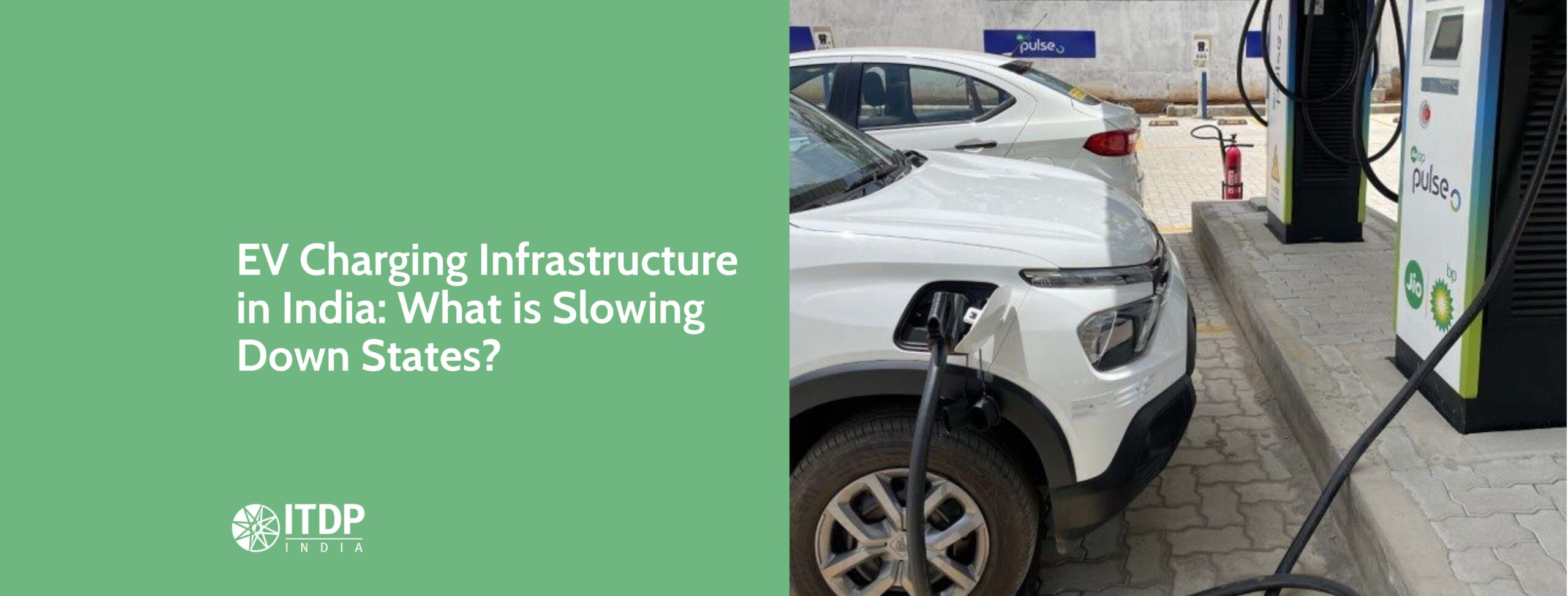
India’s streets are buzzing with new EVs — but plugging them to charging isn’t always easy. Charging points are still too few, often hard to find, and sometimes unreliable. While this is a concerning gap, it is also an opportunity to create space for innovation and leadership to boost the number of charging stations. 
 
This is a critical piece in the puzzle as India has set out an ambitious goal of having 30% of all new vehicles sales to be electric by 2030. In order to support this growth, complementary infrastructure support, such as charging infrastructure, is the urgent need of the hour.   

  • Snapshots of growing charging infrastructure in the country
  • Snapshots of growing charging infrastructure in the country
  • Snapshots of growing charging infrastructure in the country
  • Snapshots of growing charging infrastructure in the country

Current scenario and progress made so far 

A recent report by CareEdge Ratings, puts the growth and the challenges in perspective. The report found that between FY22 to early FY25, there have been a surge from approximately 5,151 public charging stations to 26,367 public charging stations in India. This marks a 72 per cent Compound Annual Growth Rate (CAGR) in a three-year period. 
 
However, the reports also contextualises how this growth isn’t exactly sufficient. The same, CareEdge report highlights that despite this accelerated growth, there is still just one public charging station per 235 EVs, which can be quite an unpleasant experience for the users with long wait times and range anxiety. 

This makes it clear that the charging ecosystem, while growing, is still lagging behind the pace of EV adoption. But why this delay? 

The bottlenecks 

From identifying available land parcels, to site selections, to approvals, state and cities have to tackle many challenges in order to create a suitable environment for the private charge point operators to set up charging stations. Unless a basic record of land available, feasible sites, grid preparedness, low electric establishment costs, etc is created, having charging stations come up at scale is a challenge. Many of these steps are interconnected and difficult to tackle- 

  1. Identifying Land parcels- One of the foremost challenges for states is finding suitable land, especially for public charging stations. In most Indian cities, land is controlled by multiple government bodies—municipal corporations, revenue departments, schools, transport undertakings, etc. For this, there is need for the nodal agency to coordinate among all and find parcels for establishing infrastructure. Even if there is a nodal agency to coordinate this, it is often the Chief Secretary’s office, which has the powers and authority to seek such information. However, land-owning agencies may not prioritise allocation of land for EV charging, due to a lack of awareness or competing priorities.
  2. Selecting the right locations- Even when land parcels are identified, determining where to place charging stations requires careful feasibility studies. National guidelines recommend having at least one charging station within every 1 km × 1 km grid in urban areas and one every 20 km on highways.  These locations have to be carefully identified keeping in mind a combination of factors like land use, traffic flow patterns, building density, vehicle population, popular hotspots etc. But often times, such data is readily unavailable and constantly evolving making it a challenge for states to empirically choose sites. In reality, states are depending on three types of feasibility studies- Operational feasibility studies, financial feasibility studies, and technical feasibility. In terms of operational feasibility- aspects like whether there are any active drain lines/water bodies etc are taken into account and in technical viability aspects like availability of sufficient electricity supply are looked into. At the same time in financial viability, how soon the charging station can break even is examined.  
  3. Coordination with Land Owning Agencies – In most Indian states, land-owning agencies lack effective tools to estimate the revenue potential of a charging station on their land. As a result, they often show little interest in allocating key land parcels or investing in basic electricity infrastructure. This undermines the concept of a plug-and-play model. In such cases, CPOs (Charging Point Operators) must take on the responsibility of establishing upstream infrastructure themselves, leading to additional delays and more complex implementation steps.  
  4. Creating a financially viable ecosystem: A big challenge for states in growing EV charging is making it a viable business for Charge Point Operators (CPOs). Right now, the high cost of setting up power connections and the high electricity tariffs make it hard for CPOs to recover their investment. Unless states reduce these power connection costs and make tariffs more reasonable, private players will hesitate to invest, slowing down the expansion of charging stations. 
  5. Ensuring electricity girds can support the plan– It has been observed in Indian cities that there is a lack of regional EV load assumptions, which further limits planning at the state and DISCOM levels. Without these, states could hit roadblocks eventually. This information is crucial as existing grids may be able to support EV load, but not for a future demand. Eventually, the DISCOM’s need to plan for the growing demand especially in charging hubs and highway corridors where high speed charging will be utilised for implementing infrastructure upgrades and grid readiness. 
  6. Data and monitoring– To tie together all efforts and ensure they are well monitored to make improvements in future, tracking is crucial. Not only should states track location and counts of charger, but also utilisation and performance, so building an EV Dashboard is critical, which is yet another task for the states to take up.
  7. Lack of quality gird infrastructure along highways- This is one of the reasons, the DISCOMS find it difficult to electrify highways for EV Charging. 

Why states matter 
The above mentioned bottlenecks are all for the states and cities to tackle, making them the crucial anvils around which EV ecosystems are to be built.  Most states have appointed Nodal agencies or EV cells to take up this list of exhaustive tasks, however things have been slow. 

National programmes like FAME, CESL’s initiatives, and the PM e-Drive scheme are helping set the stage. For instance, PM e-Drive, launched in 2024, allocates ₹2,000 crore to roll out 72,000 fast chargers nationwide, with subsidies covering up to 100% of upstream infrastructure costs such as transformers, cabling, and installation. It also covers the charging equipment cost. 

But these schemes don’t directly extend support to state governments in taking on any preparatory work. The scheme reduces capital costs for operators, but the real enabling conditions — land allocation, fast-tracked approvals, reduction in electricity tariff, and local matchmaking platforms — must come from states.   

How Front-Runner States Have Been Doing It 

1. Tackling Land Availability 

 Delhi has addressed land bottlenecks by offering concessional land rates for charging and swapping stations, while also mapping high-utilisation sites to minimise delays that usually arise from dealing with multiple land-owning agencies. Singapore has taken a similar approach by leveraging public housing (HDB) car parks, where it floated large-scale tenders that added 22,600 charging points across 1,964 sites. Both cases highlight how proactive land allocation can rapidly expand charging networks. 

2. Making Charging Affordable 

 Singapore has reduced the cost of charging by providing up to 50% rebates for chargers in public car parks and private residences, making it easier for both operators and users to transition. Delhi has complemented this by introducing one of the lowest EV tariffs in the country, which brings down operational costs for charge point operators (CPOs) and supports wider affordability. 

3. Streamlining Coordination 

Delhi has created a State Charging Infrastructure Committee (SCIC) headed by the Vice Chairman of the Dialogue and Development Commission (DDC). This committee brings together government agencies, utilities, and energy operators under one roof, ensuring that approvals and decisions are not held up by fragmented responsibilities. 

4. Ensuring Financial Viability for CPOs 

 To improve financial returns, Delhi has offered capital subsidies for charger installation and provided 100% SGST reimbursements on advanced batteries. These measures reduce upfront costs for operators while encouraging investment. Similarly, Karnataka and Singapore have worked with utilities and private partners to expand charging coverage, ensuring that financial viability is not left entirely to the market. 

5. Developing Green Corridors 

 Karnataka has gone beyond city-level interventions by developing charging stations along high-demand travel routes such as the Bangalore–Mysore Expressway and the Bangalore–Chennai Highway. This has ensured that intercity EV travel becomes more practical, reducing range anxiety for users. 

More such case studies of frontrunner cities and states like Delhi, Karnataka, Singapore can be found here in the Status Report for Public Charging Infrastructure in Tamil Nadu. 

What Next? Unlocking the Next Wave of EV Charging
Ambitious policies have shown what’s possible, but in most states the rollout of charging infrastructure is still slow and fragmented. The way forward lies in making it easier for Charge Point Operators (CPOs) to invest and expand. Single-window clearances can cut red tape, digital platforms can match land with operators and track progress, state incentives can complement central schemes, and joint EV load planning with DISCOMs can prepare the grid for rising demand. By taking these steps, states can move from scattered efforts to a coordinated ecosystem that makes EV charging viable, scalable, and future-ready. 


Written by Donita Jose, Senior Associate, Communications, with inputs from Bezylal Praysingh, Senior Associate, Transport Systems and Electric Mobility and Sooraj EM, Deputy Manager, Transport Systems and Electric Mobility

Filed Under: E mobility, PT InFocus, Public transport Tagged With: Carbon Emissions, Charging infrastructure, Chennai, Delhi, electric mobility, Electrification, EV policy India, Public charging stations, Zero Emission Vehicles

  • Who We Are
    • Our Team
    • Contact Us
    • Opportunities
    • Our Approach
  • What We Do
    • Complete Streets and Parking Management
    • Public Transport
    • Transit Oriented Development
    • Inclusive Mobility
  • Where We Work
    • Agra
    • Ahmedabad
    • MAHARASHTRA
    • Pune – Pimpri-Chinchwad
    • Nashik
    • TAMIL NADU
    • Chennai
    • Coimbatore
    • JHARKHAND
    • Ranchi
    • NATIONAL
  • News
  • Resources
  • Get Involved
    • Donate

Copyright © 2026 · ITDP Responsive on Genesis Framework · WordPress · Log in


Loading Comments...