ITDP India

Promoting sustainable and equitable transportation worldwide

  • Contact
  • ITDP India’s 2025
  • Who We Are
    • Our Approach
    • Contact Us
    • Career Opportunities
  • What We Do
    • Healthy Streets
    • Public Transport
    • Electric Mobility
    • Transit Oriented Development
    • Low Emission Zones
    • Inclusive Mobility
    • Traffic Reduction
  • Where We Work
    • NATIONAL
    • MAHARASHTRA
      • Pune
      • Pimpri Chinchwad
      • Nashik
    • TAMIL NADU
      • Chennai
      • Coimbatore
    • JHARKHAND
      • Ranchi
    • Agra
    • Ahmedabad
  • Blogs
  • Resources
    • Press
  • National Challenges
    • India Cycles4Change Challenge
    • Streets for People Challenge
    • Transport4All Challenge
  • Urbanlogue
    • Urbanlogue Webinars – Series One
    • Urbanlogue Webinars – Series Two
    • Urbanlogue Webinars – Series Three
    • Urbanlogue Webinars – Series Four

Answers to Some Common Questions About Low Emission Zones

26th September 2024 by admin

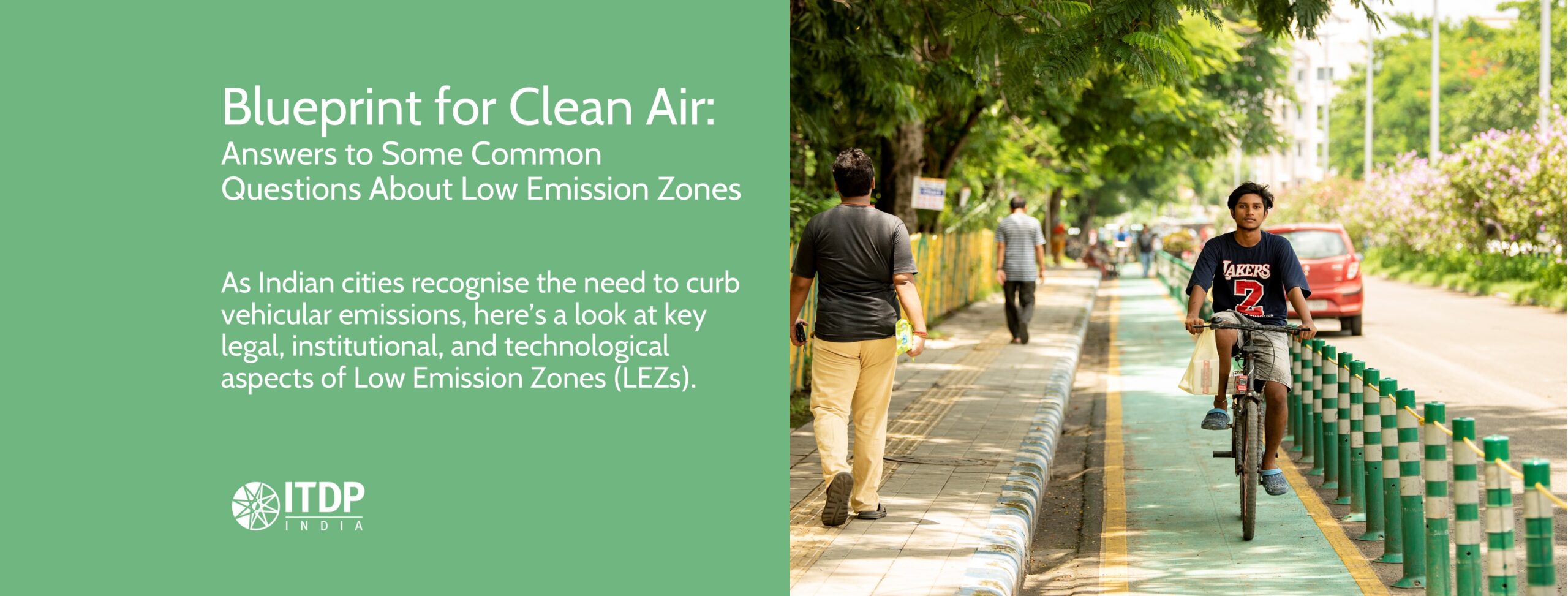
With the idea of Low Emission Zones (LEZs) gaining steam in India, here are a few concepts on the Legal, Institutional, and Technological aspects of vehicular emission.


A recap of Urbanlogue 4.0 Episode 2

LEZs are the need of the hour to arrest the invisible yet harmful impact of vehicular pollution. However, the entire subject can be challenging to grasp. Alongside figuring out the enforcement technology and monitoring, in India, data quality and impacts on marginalised communities add to the complexity. 

On September 18, ITDP India and ICCT hosted a webinar featuring six experts, moderated by Amit Bhatt, India Managing Director, ICCT, wherein they unwrapped these concepts by sharing their journeys from managing air/vehicular pollution in cities like Delhi, Pimpri Chinchwad, and Surat, alongside insights from Brussels and Seoul. You can watch the full webinar here. 

Here are seven frequently asked questions around Low Emission Zones, which were answered during  the webinar. 

1. What are the technologies available to enforce Low Emission Zones and which is best suited for Indian context? 

Parin Visariya, Deputy Manager at ITDP India, highlighted two key enforcement methods for India: Automatic Number Plate Recognition (ANPR) and Global Navigation Satellite System (GNSS). 

“What’s currently feasible in India is ANPR, which uses cameras to read vehicle number plates and deduct fees for entering Low Emission Zones,” Visariya explained. GNSS, an alternative, connects to an on-board unit inside the vehicle via a cellular network to charge fees, though the unit costs INR 8,000-10,000. 

Srinivas Ganji, Solution Delivery Director (Urban Transport), Arcadis, discussed the challenges of both. ANPR faces issues like low visibility due to weather, traffic congestion, and low-light conditions. However, due to improved algorithms and infrared cameras, the efficacy of ANPR system is close to 90%.  

Regarding GNSS, Ganji pointed out a few concerns. “A lot of incentives will have to be given to maintain the onboard unit. Privacy is also a concern as all movements can be tracked and it’s still a question on who will bear the charges of transmission of the data.”  

2. Are our vehicle emissions measuring methods robust enough? 

Vaibhav Kush, Researcher at ICCT, highlighted the importance of accurately monitoring emissions for implementing LEZs. Currently, India measures pollution at two stages: during vehicle prototype testing before the production and through Pollution Under Control (PUC) checks. However, these methods only reflect emissions under controlled conditions, either in labs or when vehicles are stationary. Neither show actual pollution levels emitted. Factors like load, maintenance, driving habits, road surface, traffic congestion impact emissions. 

ICCT’s 2022 study in Delhi using the roadside sensors revealed a significant gap between tested and real-world emissions.   

3. What are the various legal routes to implement LEZs  

Vaibhav Kush, further elaborated on the legal routes to establish LEZs. He explained that LEZs require legal backing for notifying the LEZ area, restricting polluting vehicle type, imposing fines and more. There are legal provisions available at national, state and city level. It depends on which government is initiating it. Vaibhav highlighted the cases of vehicle restrictions implemented in Delhi, Taj Trapezium Zone in Agra, Kevadia in Gujarat. He also highlighted a case where judiciary (Supreme Court) ordered the Delhi government to levy the environment compensation charge. 

He highlighted that the Air Act of 1981, Central Motor Vehicle Act of 1988 and state laws like Maharashtra Municipal Corporation Act 1949, can enable LEZ implementation. 

4. How robust should the city’s pollution monitoring network be? 

Ronak Sutaria, Founder and CEO, and Kevin Joshi, Product Engineer and Researcher, from Respirer Living Sciences, emphasised the need for robust and dense pollution monitoring networks to implement LEZs. For Surat Municipal Corporation (SMC), they deployed low-cost monitoring machines to measure PM 2.5 and 10 across 20 locations, focusing on densely populated areas. The data was shared with SMC and revealed nuanced results—PM 2.5 levels spiked during morning rush hours at certain junctions, while industrial areas peaked in the evening, and commercial zones showed higher levels during weekends. Regular analysis enabled tailored decisions and actions. 

“We need data analytics specialists, to help city corporations make informed decisions,” Joshi stated. 

On data accuracy, Ronak also highlighted that it is important to understand the purpose of using the data. Based on technologies and their cost, data accuracy can vary between 70%-90%.  

5. Is crowdsourcing of pollution data the way ahead for monitoring and predicting pollution levels in micro levels? 

Dr Suraj Ghosh, Associate Counsellor from CII- ITC Centre of Excellence for Sustainable Development, shared that their pollution monitoring and forecasting model was built on crowdsourced data. Their new model integrates emission inventories, meteorological data, live traffic, ambient air quality, and sensor data. By applying the Chemical Transport Model, they can predict pollutant levels for the next 72 hours, which aids measures like the Graded Response Action Plans. 

Their model achieves a resolution of 1 km x 1 km down to zone and ward levels, with the potential to enhance accuracy to 200 meters, though data quality remains a concern. “To improve accuracy of forecasts, we need good data,” he shared. 

6. What can cities in India learn from international cities like Brussels, Seoul, and London? 

Anindita Ghosh, Senior Researcher, UITP, shared several insights from different cities’ LEZ experiences. In Brussels, citizens were proactive in pushing the government to implement LEZs. In Seoul, LEZs were introduced only in the Business Zone, a model that could work in India as well. 

In all these cities, including London, effective communication played a vital role. “Engaging citizens consistently is key. Making them part of the process is essential,” Ghosh said. Various tools such as leaflets, videos, and advertisements were used extensively, with communication beginning 2-3 years before implementation. Efforts were also made to include marginalised communities, a practice that should be adopted in India. 

7. How can we address equity issues on marginalised communities while implementing LEZ? 

Globally, cities have provided incentives to encourage the transition to cleaner vehicles. Cities have provided free public transport passes for two years. Financial incentives are priortised for e-cycles and small freight vehicles for businesses, subject to polluting vehicles being scrapped. Incentives for personal cars are avoided to reduce congestion. All cities invest heavily in improving public transport, walking and cycling infrastructure. Indian cities, similarly, must priortise to improve public transport (especially bus transport) and offer target incentives after analysing the budget. 

Watch this space for more on Low Emission Zones! Join our Whatsapp group now for more webinars and talks!


Team Urbanlogue 


Written by Donita Jose, Senior Associate, Communications and Development, ITDP India

With technical inputs from Parin Visariya, Deputy Manager at ITDP India
Filed Under: Low Emission Zones Tagged With: Air Pollution, ANPR, Delhi, Electric bus, electric mobility, GNSS, Health crisis, India, London, Low Emission Zones, Maharashtra, Pimpri chinchwad, Public Transport, Pune, Sustainable Transport, Sustainable Transport Policy, Vehicular Pollution

Challenges of a Bus-Rapid-Transit System in Indian Cities: The Rainbow case study

9th July 2018 by admin

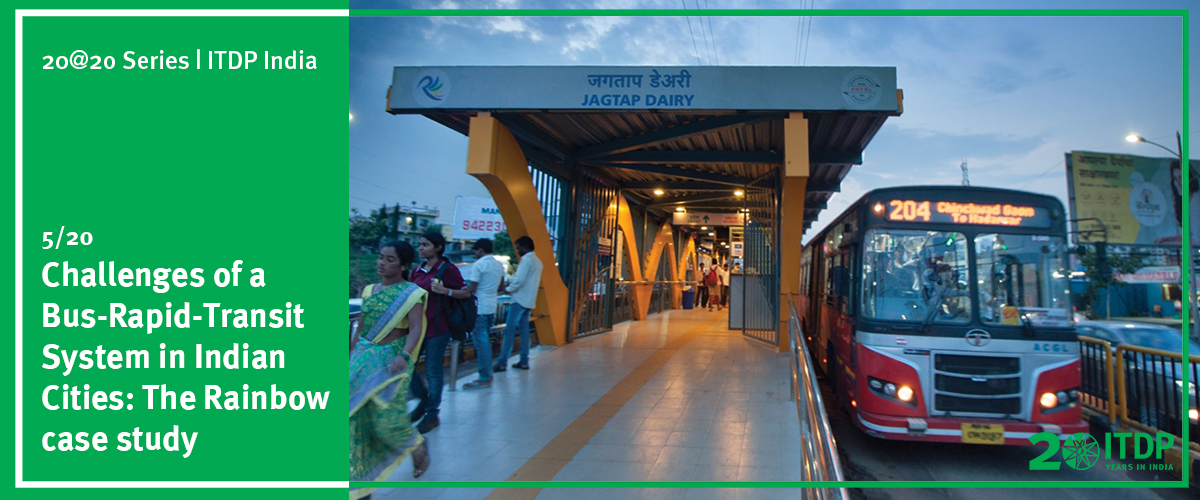
Over the past decade, cities across India have dared to dream of reimagining bus transit, most famously known as the Bus-Rapid-Transit, or the BRT. The concept of having buses ply in the centre of the road, on dedicated bus-only lanes, has gradually mulled into our urban transport systems with a tenacious aim of mobilizing people rather than cars.

India’s first high-quality bus-rapid-transit system was inaugurated in 2009 in Ahmedabad — the Janmarg bus-rapid-transit. Janmarg set a national benchmark and inspired systems across India, including the Rainbow bus-rapid-transit in the twin cities of Pune and Pimpri-Chinchwad that was launched in 2015.

The Rainbow bus-rapid-transit offers convenient commute, as efficient as a metro or a train without the cost of acquiring land, laying tracks, building large scale stations, and the pedestrian foot-over-bridge to get to them. The ITDP India Programme assisted Pune Municipal Corporation, Pimpri-Chinchwad Municipal Corporation, and Pune Mahanagar Parivahan Mahamandal Limited create physical designs and operational plans for the system.

Today, the Rainbow operates along a 43 km network of bus-only lanes, with 58 stations along four corridors. However, this was Pune’s second attempt at perfecting a system that would help address the pressing issue of transport needs for the influx of population. Back in 2006, Pune piloted a 13 km bus-rapid-transit corridor but failed to meet BRT Standards.

A good bus-rapid-transit system requires dedicated bus-only-lanes, high quality bus fleet at regular frequency, a matching height of the station and bus fleet for easy step-less passenger boarding, off-board fare collection, and adequate passenger information for seamless travel. Unfortunately, the pilot bus-rapid-transit was short of meeting these basic standards.

The initial set back was not detrimental to the city regaining momentum to construct a successful bus-rapid-transit. Learning from this experience, and from the systems later commissioned in India and around the world, leaders were determined to get Rainbow right.

The Rainbow bus-rapid-transit was faced with a challenge of retrofitting a high-quality system on an existing bus network. The ITDP India programme assisted with route rationalization to deliver frequent service and ensure efficiency of the system’s fleet.

Soon after it’s launch, Rainbow was awarded the ‘Outstanding Contribution to Sustainable Mobility’ at the Volvo Sustainable Mobility Awards 2015. The award was attributed to it’s efficiency of mobilizing thousands of commuters, and travel time savings. Dedicated bus lanes ensured that commuters reach their destinations 10 to 15 minutes earlier than usual.

Rainbow bus-rapid-transit started off well but has failed to achieve its full potential. Ridership has only increased by 12-17 percent over the three years while the number of personal motor vehicles on the road has been growing unabated due to infrequency of buses. Considered a first for any urban area in India, Pune’s total number of vehicles has surpassed the human population!

Lack of cleanliness of stations areas attributed to the public’s demeaning perception of the system. Walking and cycling access to bus-rapid-transit stations is the dire need of the hour but yet to be developed along most corridors.  

In an era where financial resources are sparse but population growth is inevitable, large-scale public transport systems are difficult to conceive. An expansion of the the Rainbow system is being planned for an additional 45 km network. This is because the twin cities strongly believe that the Rainbow can provide a solid backbone to the urban transit system.

A major limitation to the bus-rapid-transit system is also the stigma that comes with being a ‘bus’. This can be addressed through better system design, well-maintained stations, and most importantly bus-only lanes to make the users feel like it worth leaving the car back at home.

Finally, for the success of any bus-rapid-transit system it is essential to periodically assess the infrastructure and operations of each corridor, and set benchmarks to ensures its longevity. Pune and Pimpri-Chinchwad can aim for a ‘Rainbow’ future, learn from its shortfalls, and get back on the wheel to move its citizens.


Filed Under: news Tagged With: 20@20 Series, BRT, Bus Rapid Transit, Pimpri chinchwad, Public Transport, Pune, Sustainable Transport, Traffic reduction

New High Quality BRT Corridors Planned for Pimpri Chinchwad, India

22nd January 2013 by admin

by Sam Mohamad-Khany

Pimpri Chinchwad is a city of 1.7 million in the state of Maharashtra, India. On January 5, ITDP conducted a full-day workshop on the BRT Standard, which was attended by over 25 officials from the Pimpri Chinchwad Municipal Corporation (PCMC), public transport operator Pune Mahanagar Parivahan Mahamandal Ltd (PMPML), and consultants Creations Pvt Ltd, S. N. Bhobe, and C. V. Kand, who are preparing detailed designs for new bus rapid transit (BRT) corridors.

Pimpri Chinchwad’s BRT network includes four corridors and spans a total length of 40 km. The goal of the workshop was to inform the BRT planning process by identifying gaps and opportunities for improvement in the current plans for new corridors. Commissioner Shrikar Pardeshi of PCMC opened the session, followed by presentations by ITDP staff on the BRT Standard and salient system features of the Janmarg BRT system in Ahmedabad. Mr Ramkrishna from UMTC, who has been appointed as a project management consultant for the region’s BRT, presented the details of the plan and design.  As a warm-up, attendees formed groups and rated the Ahmedabad system using the BRT Standard. In the afternoon, the groups rated the planned BRT lines in their own region. Groups then presented their scores to each other and engaged in lively debate about various opportunities and possible pitfalls of BRT planning and implementation. “We are now aware that what major steps to be taken to upgrade and enhance BRT service in this region,” said Rajan Patil, Joint City Engineer for PCMC.

Workshop participants identified several areas of improvement for the Pimpri Chinchwad BRT corridors, including intersection design, branding and communications, and the provision of adequate pedestrian facilities to enable passengers to reach the future BRT stations. “The workshop conducted by ITDP gave us insight about BRTS element to be incorporated in the design and planning of BRTS for PCMC,” said B. K. Gaikwad, Traffic Engineer, PCMC. “It provided ideas to our engineers, consultants, planners, and operators through discussions in interactive sessions on each of the aspects of the BRTS. Also the importance of pedestrian safety while accessing BRTS has been deliberated during this workshop. Overall, it was very helpful to PCMC.” ITDP will compile recommendations from the groups and follow up with PCMC to facilitate implementation.

The BRT Standard is available for download at www.brtstandard.org.

Filed Under: news, sustainable-transport-magazine Tagged With: BRT, Pimpri chinchwad, Public Transport, Pune-Pimpri Chinchwad

ITDP and Pune Municipal Corporation jointly organize Street Design Workshop

19th September 2012 by admin

Pune, traditionally known as the “city of cyclists,” and having built over 100 kilometers of cycle tracks, presently suffers from poor state of pedestrian and cycling infrastructure. A recent CAI-Asia report in 2011 states, “residential, educational areas and public transport terminals lack proper footpaths and other facilities that leaves pedestrians competing with vehicles for space, making it a one sided contest in Pune.”

To address these concerns, Institute for Transportation & Development Policy and Pune Municipal Corporation (PMC) jointly organized a two-day Street Design Workshop on September 6 and 7, 2012.

The workshop consisted of a discussion of road safety principles for all users and a hands-on-exercise for 49 members of the technical staff from PMC. The workshop was led by street design expert Michael King, Principal at Nelson Nygaard, who outlined a three-pronged strategy for designing pedestrian-friendly streets: first, observation of physical conditions and street user behavior; second, iterative testing of design solutions; and third, setting a direction for policies that are supportive of non-motorized transport.

Throughout the workshop, King emphasized the importance of streets in urban fabric saying, “The most progressive cities of the world are the most walkables ones. The city should make streets for people and not highways for traffic.”

A walking audit of the network of streets connecting Pune Railway Station, Sadhu Vaswani chowk, Sassoon Hospital, and Council hall in Pune was conducted by the participants which comprised of executive engineers, deputy engineers, and junior engineers among others to assess the on-ground state of current pedestrian infrastructure, observe road user movement and capture the safety issues concerning people walking on the street. Participants were divided into five teams and sent to the selected site to observe pedestrian infrastructure, cycling facilities, public transport uses, land use changes and motor vehicle movement among others. The site was selected because of the heavy pedestrian movement in large numbers between the bus terminal, railway station and neighboring commercial and institutional land uses all throughout the day.

SDW-Pune-02

Sabnis Madam, executive engineer with PMC giving a presentation on walking audit

Participants reacted to the conditions of the site saying, “There is a good chunk of cyclists on the road, and sadly for them there is no provision in the existing design. Also, there are too many obstructions on the walkway forcing pedestrians to walk on middle of road risking their lives”.

Later on, the teams were assigned the task of redesigning Alankar Talkies Chowk (located adjoining to the Pune Railway Station) based on the theme of pedestrians, cyclists, motor vehicle users, public transport users and public place. Each team visited the site at morning & evening peak hour to conduct traffic counts, observe the user behavior and traffic movement patterns. After the exercise, the team gave a group presentation on their “observation of the site” and “solution for the site” based on the designated theme.

Nitin Warrier, Senior Associate, ITDP India said, “The idea was to enhance participants understanding of road user behavior and to encourage participatory and inclusive planning of streets based on its usages by different road users. The learning from the workshop will help PMC in designing better streets for pedestrians, cyclists and enhancing the walking connectivity to nearest public transport facilities”

A similar one-day long workshop was conducted with 46 of Pimpri Chinchwad Municipal Corporation’s engineering staff on street design taking Chafekar Chowk, located in the heart of Pimpri -Chinchwad as the site for intersection design exercise.

ITDP India team comprising of Anuj Malhotra, Nitin Warrier, Pranjali Deshpande, Kumar Manish and Pratik Dave facilitated the team discussions and site visits in both the workshops.

Filed Under: news Tagged With: Complete Streets, cycle, Pimpri chinchwad, Pune, Walking and Cycling

  • « Previous Page
  • 1
  • 2
  • Who We Are
    • Our Team
    • Contact Us
    • Opportunities
    • Our Approach
  • What We Do
    • Complete Streets and Parking Management
    • Public Transport
    • Transit Oriented Development
    • Inclusive Mobility
  • Where We Work
    • Agra
    • Ahmedabad
    • MAHARASHTRA
    • Pune – Pimpri-Chinchwad
    • Nashik
    • TAMIL NADU
    • Chennai
    • Coimbatore
    • JHARKHAND
    • Ranchi
    • NATIONAL
  • News
  • Resources
  • Get Involved
    • Donate

Copyright © 2026 · ITDP Responsive on Genesis Framework · WordPress · Log in

Loading Comments...