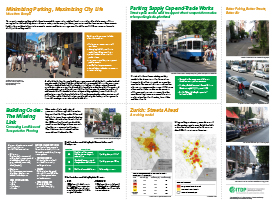
The poster depicts innovative parking policies from Europe, like parking caps and building codes, to have better parking, better streets and better air.
Source: Michael Kodransky

The poster depicts innovative parking policies from Europe, like parking caps and building codes, to have better parking, better streets and better air.
Source: Michael Kodransky
Greenways are managed open spaces that offer improved mobility to pedestrians and cyclists, create new recreational space for city residents, and enhance environmental assets. A greenway project can transform a neglected creek or drainage channel into a high quality public space that becomes part of the city’s open space network. Designed with accessibility and safety features in mind, greenways can become a place of enjoyment for residents of all ages and genders. The planning process for greenways combines analysis of the hydrological features of the waterway with an assessment of the mobility needs of local residents and non-motorised transport (NMT) users in the city as a whole. The design of a greenway must be integrated with a city’s transport network, especially city wide pedestrian and cycle networks. In addition, the design should take into account nearby public transport services to improve accessibility to the greenway.
This document outlines the scope of work for the appointed consultants for the design of Greenways.
Well-designed streets are a critical element of a safe and efficient mobility system. At present, poor design and management of streets in cities are contributing to increased congestion, pollution, road safety risks, and maintenance requirements. Going forward, City corporations may seek to establish a network of streets that offer convenience and safety to all users. They will implement streets with high quality walking and cycling facilities, improved access to public transport, organised parking, and streamlined junctions.
A key aim of the Street Design project is to ensure equitable allocation of road space to walking and cycling—collectively known as “non-motorised transport” (NMT). NMT modes provide basic mobility and affordable transport, and bring significant health and recreation benefits. Improving conditions for NMT reduces the demand for travel by motorised vehicles and associated issues such as pollution and safety. NMT also provides crucial first- and-last mile connectivity to public transport.
This document outlines the scope of work for empaneled Consultants along with details about the empanelment process.

Well-designed streets are a critical element of a safe and efficient mobility system. At present, poor design and management of streets in cities are contributing to increased congestion, pollution, road safety risks, and maintenance requirements. Going forward, City corporations may seek to establish a network of streets that offer convenience and safety to all users.
This document outlines the scope of work for the appointed consultants for the design of Pedestrian Zones.
Cycle Sharing Systems provide a low-cost, environmentally friendly mobility option to city residents of any city. Cycle sharing is a flexible system of personalised public transport, which forms a key element in a city’s strategy to expand the use of sustainable transport modes. Cycles will be available in a closely spaced network of fully automated stations. Users can check out cycles at one station and return them to any other station in the network.
This Request for Proposals (RFP) has been prepared to install and operate the Cycle Sharing System. The RFP has been prepared with an intention to invite prospective bidders and to assist them in making their decision of whether or not to submit a proposal.
Cycle sharing is a public transport system in which people have access to cycles that can be used across a network of closely spaced stations. With a smart card or other form of identification, a user can check out a cycle from a station and return it to any other station. The Corporation of Chennai (COC) is planning a public cycle sharing system with approximately 3,000 cycles and an initial coverage area of about 19 square kilometres. Chennai, the capital of Tamil Nadu state, has a population of 4.6 million, with nearly 9 million inhabitants in the larger metropolitan area.
Cycle sharing is considered a key element in Chennai’s strategy to expand the use of sustainable transport modes. The system will help COC achieve the goals laid out in the city’s Non-Motorised Transport Policy, namely an increase in the mode share of non-motorised modes from 34 to 40 per cent of all trips by 2018, and an increase of public transport use from 41 to 60 per cent of motorised trips over the same time period. Cycle sharing is expected to boost the use of public transport by providing crucial last-mile connectivity, thereby expanding the catchment areas for the region’s rapid transit systems.
By encouraging a shift to sustainable modes, the cycle sharing system will reduce dependency on automobiles, reduce traffic congestion, vehicle emissions, and demand for motor vehicle parking while also improving health and wellness of cyclists. A cycle sharing system will offer the convenience of cycling without the burden of ownership and the flexibility to accommodate one-way trips. The report outlines in details the features of cycle sharing systems and its feasibility for implementation in Chennai.
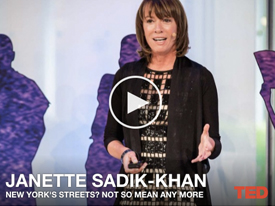
Watch ITDP Board Member Janette Sadik-Khan’s 2013 TED Talk on changes to New York’s streets that made the city more walkable, bikeable, and livable:
From TED.com: In this funny and thought-provoking talk, Janette Sadik-Khan, transportation commissioner of New York City, shares projects that have reshaped street life in the 5 boroughs, including pedestrian zones in Times Square, high-performance buses and a 6,000-cycle-strong bike share. Her mantra: Do bold experiments that are cheap to try out.