ITDP India

Promoting sustainable and equitable transportation worldwide

  • Contact
  • ITDP India’s 2025
  • Who We Are
    • Our Approach
    • Contact Us
    • Career Opportunities
  • What We Do
    • Healthy Streets
    • Public Transport
    • Electric Mobility
    • Transit Oriented Development
    • Low Emission Zones
    • Inclusive Mobility
    • Traffic Reduction
  • Where We Work
    • NATIONAL
    • MAHARASHTRA
      • Pune
      • Pimpri Chinchwad
      • Nashik
    • TAMIL NADU
      • Chennai
      • Coimbatore
    • JHARKHAND
      • Ranchi
    • Agra
    • Ahmedabad
  • Blogs
  • Resources
    • Press
  • National Challenges
    • India Cycles4Change Challenge
    • Streets for People Challenge
    • Transport4All Challenge
  • Urbanlogue
    • Urbanlogue Webinars – Series One
    • Urbanlogue Webinars – Series Two
    • Urbanlogue Webinars – Series Three
    • Urbanlogue Webinars – Series Four

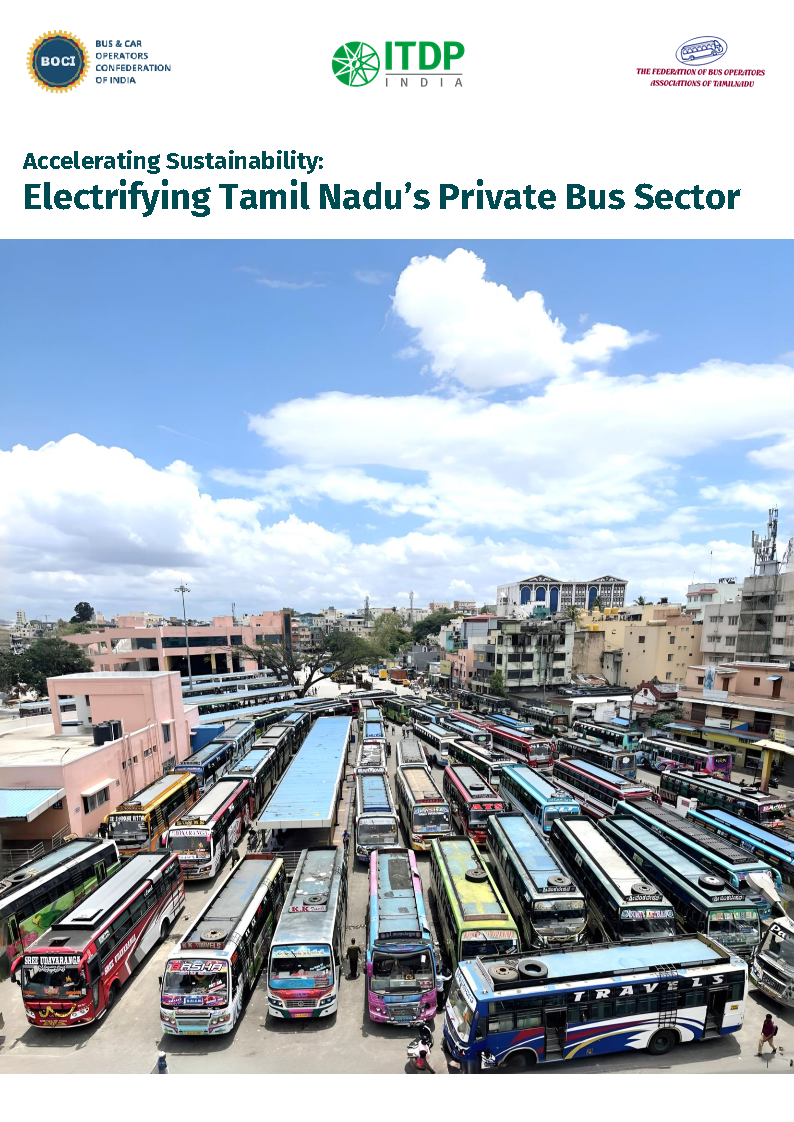
Accelerating Sustainability: Electrifying Tamil Nadu’s Private Bus Sector

1st August 2025 by

This publication explores the electrification potential of Tamil Nadu’s private bus sector, which operates over 8,500 buses on stage carriage permits, serving nearly 48 lakh passengers daily across urban and rural areas. Despite playing a vital role alongside State Transport Undertakings, the sector faces severe challenges—post-COVID ridership declines, high diesel costs, and ageing fleets—all while lacking government financial support.

The report highlights how electrifying these buses can curb 87.83 lakh tonnes of CO₂ emissions, save ₹24,000 crore in fuel costs over 12 years, and reduce operational costs by 30–50%. Based on a survey of 153 private operators, it also captures their readiness to adopt electric buses if supported by leasing models, improved charging infrastructure, and regulatory reforms. With practical recommendations to overcome key barriers, the publication lays out a roadmap for Tamil Nadu to lead India’s clean mobility transition.

Click to download the full report here: Accelerating Sustainability: Electrifying Tamil Nadu’s Private Bus Sector


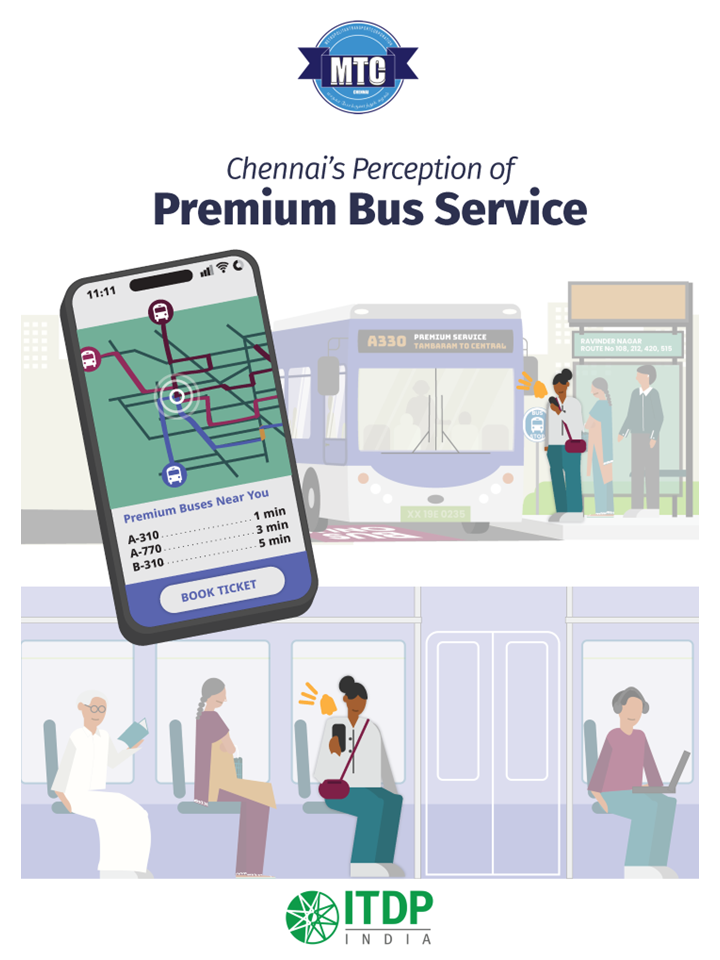
Chennai’s Perception of Premium Bus Service

9th May 2025 by Leave a Comment

State Transport Undertakings (STUs) across India face declining ridership due to overcrowding, limited amenities, and competition from private vehicles and ride-hailing services. To address this, ITDP India conducted a survey on Premium Bus Services in Chennai, aiming to understand commuter preferences for comfort, reliability, and convenience.
The survey focused on private vehicle users—car and two-wheeler owners—to identify factors that could encourage a shift back to public transport.
The findings were compiled in the report Chennai’s Perspective of Premium Bus Service.

Download the full analysis here: Chennai’s Perception of Premium Bus Service

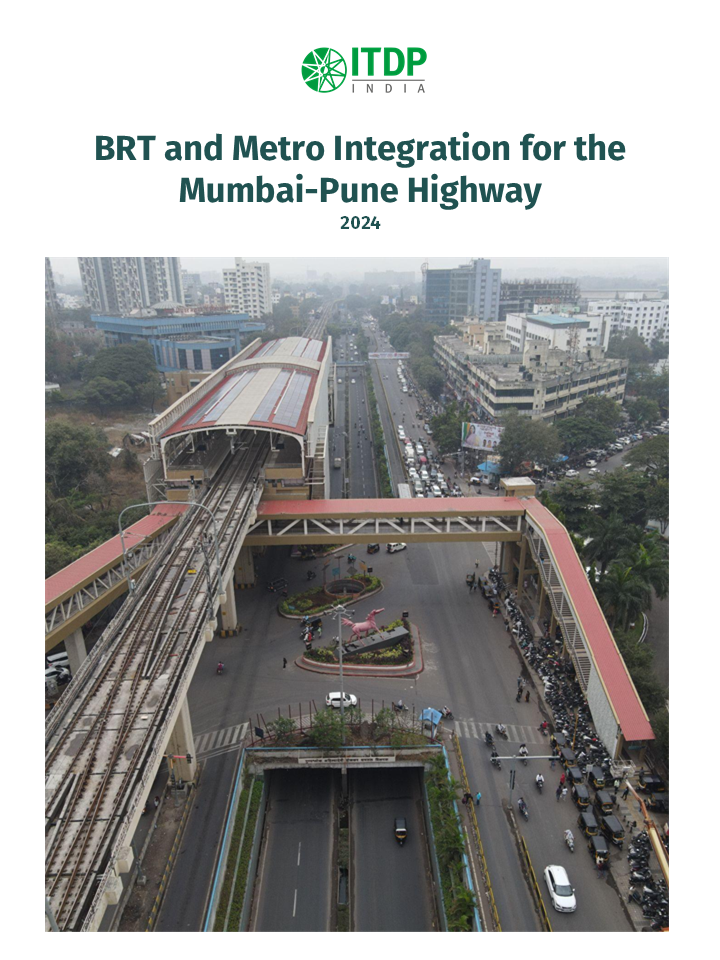
BRT and Metro Integration for the Mumbai-Pune Highway

1st April 2025 by Leave a Comment

ITDP India conducted an analysis on how the Nigdi-Dapodi BRTS corridor and Pune Metro services, currently serve the city of Pune. Both these lines run parallel to each other and are complementing each other to ensure maximizing of the overall public transport usage. Key highlights of the study:

  1. The Nigdi-Dapodi BRTS corridor serves 1.5 lakh passengers daily, with 37 buses per hour during peak times,
  2. One bus every 1.6 minutes
  3. About 47% of users were students (18-25 years)
  4. Frequent users had a household income below ₹20,000/month

Download the full analysis here: BRT and Metro Integration for the Mumbai-Pune Highway


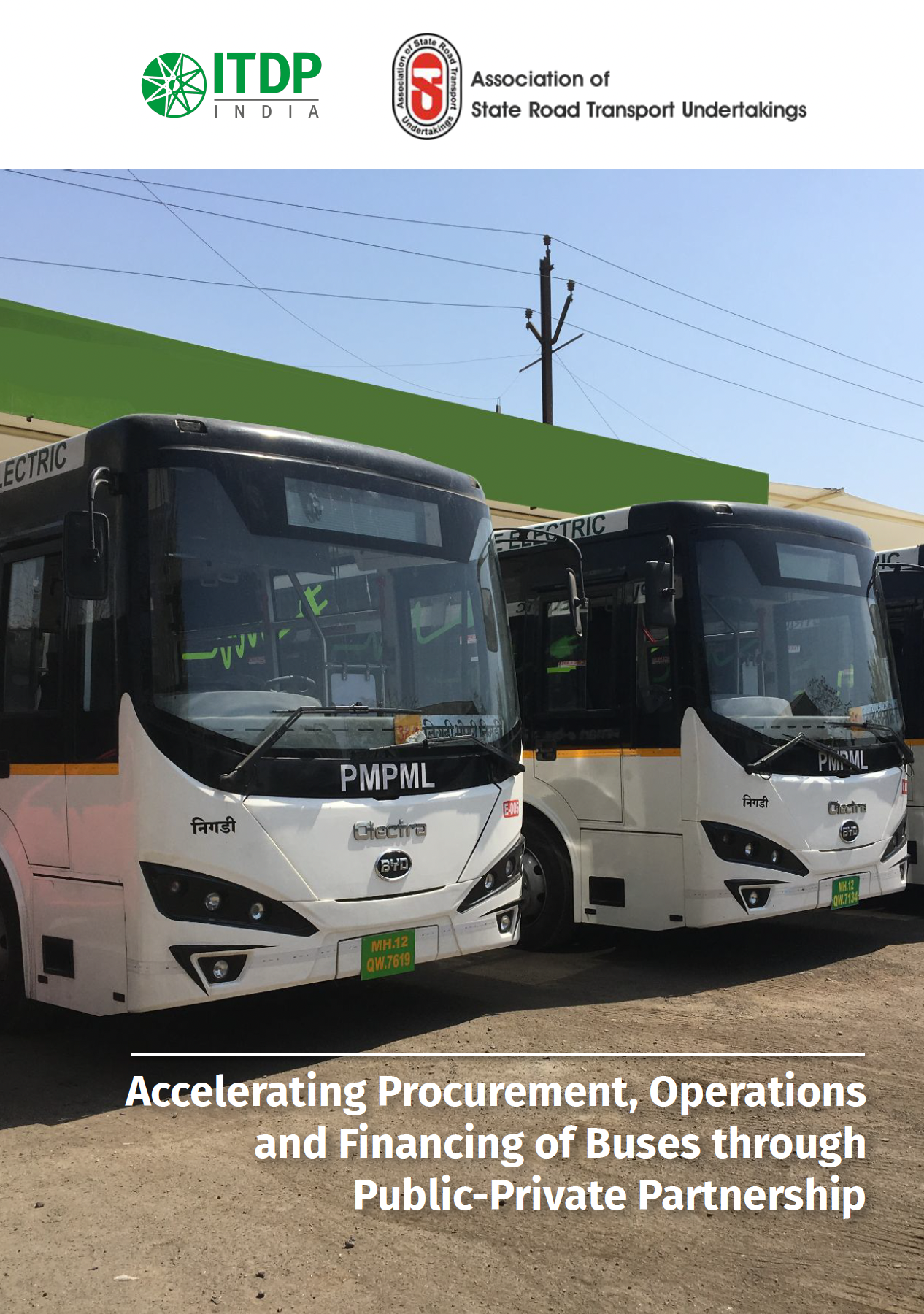
Accelerating Procurement, Operations and Financing of Buses through Public-Private Partnership

27th September 2023 by

‘Accelerating Procurement, Operations, and Financing of Buses through Public Private Partnerships’ resulted from our collaborative workshop with the Association of State Road Transport Undertakings (ASRTU) in New Delhi in April 2023. 🇮🇳

This report delves into how Public-Private Partnerships (PPP) can be the driving force behind transforming State Transport Undertakings (STUs) and lead to
🌟 Improved service quality
🌟 Enhanced financial viability
🌟 Increased operational efficiency
while expanding our bus fleets and transforming the entire transport system.


Read the report here.

Pune’s Walk & Cycle Analysis

13th December 2022 by

This report consists of an analysis of findings from Design, Observation & Perception surveys carried out across 11 selected streets in Pune.

Download the document 

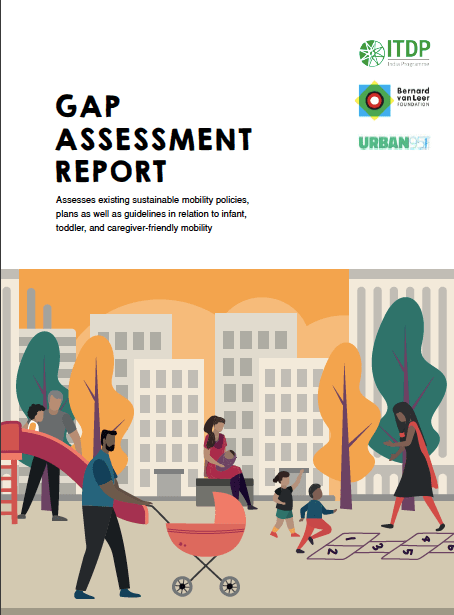
Gap Assessment Report

5th March 2021 by

The report assesses existing sustainable mobility policies, plans, and guidelines in relation to infant, toddler, and caregiver-friendly mobility.

The ITDP India Programme prepared the gap assessment report as part of the project, ‘Transforming Urban Mobility to nurture Early Childhood Development in India’, supported by the Bernard van Leer Foundation under the Urban95 programme. This report explores the various governance tools/documents—policies, plans, and guidelines—that directly and/or indirectly impact the mobility of young children and their caregivers in Indian cities. This report aims to understand whether these policies, plans, and guidelines address the mobility needs of infants, toddlers, and their caregivers comprehensively and will be useful for city officials who wish to improve these documents. It will also be useful for anyone interested in understanding how these different documents impact the mobility of young children and caregivers in Indian cities.

Publication Team: Aswathy Dilip | Aila Bandagi | A V Venugopal | Parin Visariya | Pranjal Kulkarni | Vaishali Singh | Avishek Jha | Keshav Suryanarayanan | Aishwarya Soni | Bala Nagendran M

Download


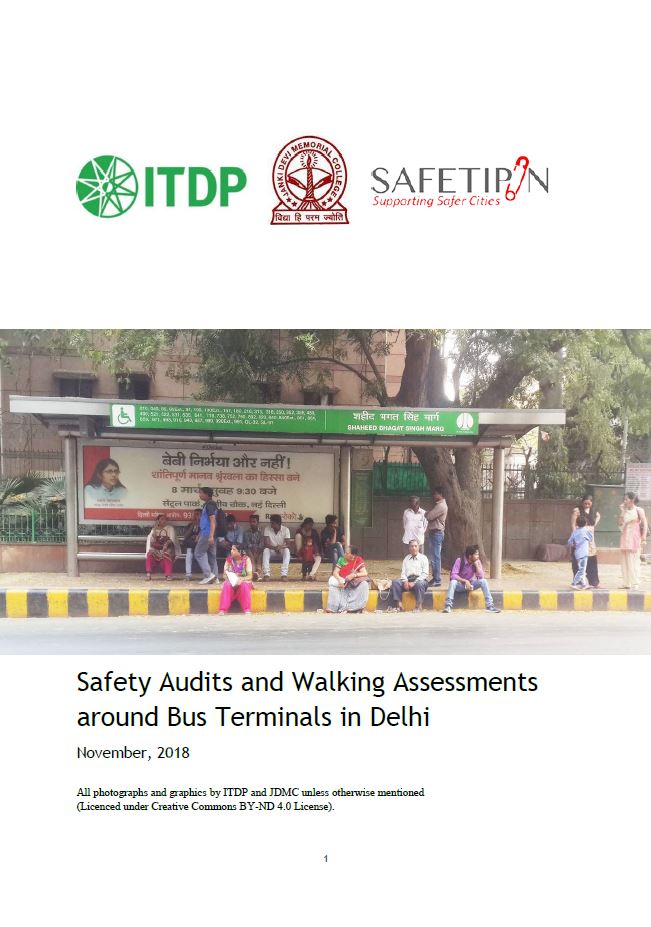
Safety Audits and Walking Assessments around Bus Terminals in Delhi

24th September 2019 by

The report scores the bus terminals of Delhi on a scale of 0 to 3 in terms of women’s safety and also provides policy recommendations on ways to improve safety.


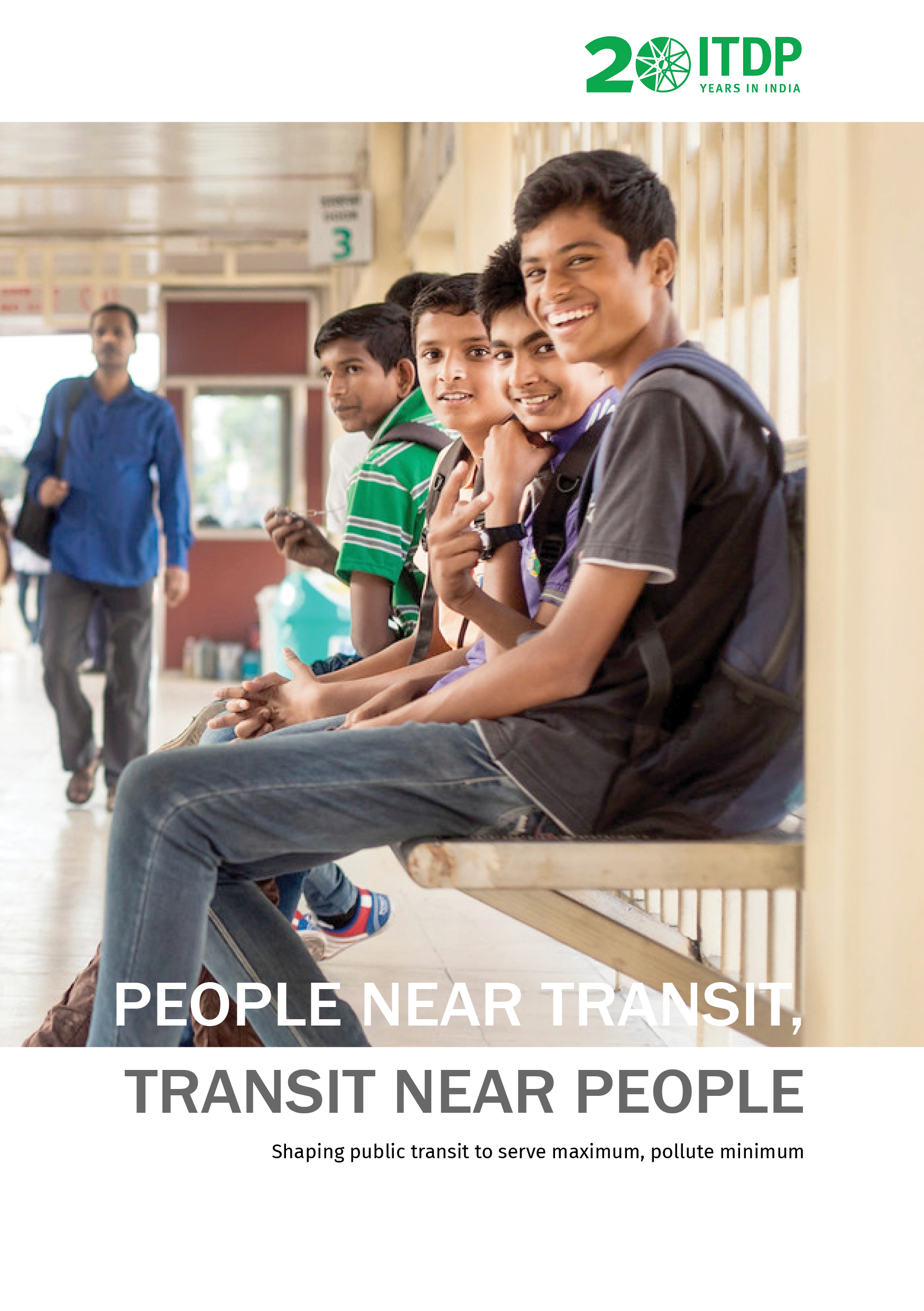
People Near Transit, Transit Near People

17th May 2019 by

The People Near Transit (PNT) report establishes the levels of urban transit services in Pune Metropolitan Region and the accessibility gaps that affects its residents.


Pedestrianisation in India and Across the Globe

4th January 2018 by Leave a Comment

Cities across the globe are acknowledging the importance of the pedestrian. The activity of walking, either as part of one’s transit, fitness regime or for leisure, is being increasingly associated with a city’s social life. The measures a city takes for the safety of its pedestrians is now becoming a deciding factor in its popularity. Some cities have gone on to completely cut off access to vehicles from some of their streets, converting them to pedestrianised areas.

Although the idea of creating pedestrian-only streets seems modern, it has been tested and tried out in various cities several times in the past and continues to work well. Despite initial resistances, many of these projects have proven to be great successes.

Pedestrianisation in India and Across the Globe aims to learn from the best practices in pedestrianisation across the world.

Download the report here.

Related News

  • InFocus: Reclaiming streets for people

    April 17, 2015

  • People's day out: Shoppers welcome T. Nagar Pedestrian Plaza

    March 3, 2017

  • Reclaiming streets: Pedestrian-only test run marks new beginning in Pune!

    October 11, 2016

More News >

A Global High Shift Cycling Scenario

24th April 2016 by Leave a Comment

The Potential for Dramatically Increasing Bicycle and E-bike Use in Cities Around the World, with Estimated Energy, CO2, and Cost Impacts

Cycling plays a major role in personal mobility around the world, but it could play a much bigger role. Given the convenience, health benefits, and affordability of bicycles, they could provide a far greater proportion of urban passenger transportation, helping reduce energy use and CO2 emissions worldwide.

This report presents a new look at the future of cycling for urban transportation (rather than recreation), and the potential contribution it could make to mobility as well as sustainability. The results show that a world with a dramatic increase in cycling could save society US$24 trillion cumulatively between 2015 and 2050, and cut CO2 emissions from urban passenger transport by nearly 11 percent in 2050 compared to a High Shift scenario without a strong cycling emphasis.

The report builds on the 2014 study A Global High Shift Scenario: Impacts and Potential for More Public Transport, Walking, and Cycling with Lower Car Use. That report provided a global assessment of the potential for increasing travel on sustainable, efficient modes while concurrently developing cities that are far less car-dependent. However, the role of cycling in the previous study could be considered relatively minor, with the global average urban mode share increasing by three percentage points in 2030 (from 3 to 6 percent of total travel). This report explores just how much is possible if we study cycling in more detail using the same approach. The result is the most comprehensive picture ever of global urban cycling activity.

Download report

Related Resources

  • Chennai Non-Motorised Transport Policy

  • Public cycle sharing systems: A planning toolkit for Indian cities

  • Riding the Bike-Share Boom

More Resources >
  • « Previous Page
  • 1
  • 2
  • 3
  • 4
  • Next Page »
  • Who We Are
    • Our Team
    • Contact Us
    • Opportunities
    • Our Approach
  • What We Do
    • Complete Streets and Parking Management
    • Public Transport
    • Transit Oriented Development
    • Inclusive Mobility
  • Where We Work
    • Agra
    • Ahmedabad
    • MAHARASHTRA
    • Pune – Pimpri-Chinchwad
    • Nashik
    • TAMIL NADU
    • Chennai
    • Coimbatore
    • JHARKHAND
    • Ranchi
    • NATIONAL
  • News
  • Resources
  • Get Involved
    • Donate

Copyright © 2026 · ITDP Responsive on Genesis Framework · WordPress · Log in

Loading Comments...