ITDP India

Promoting sustainable and equitable transportation worldwide

  • Contact
  • ITDP India’s 2025
  • Who We Are
    • Our Approach
    • Contact Us
    • Career Opportunities
  • What We Do
    • Healthy Streets
    • Public Transport
    • Electric Mobility
    • Transit Oriented Development
    • Low Emission Zones
    • Inclusive Mobility
    • Traffic Reduction
  • Where We Work
    • NATIONAL
    • MAHARASHTRA
      • Pune
      • Pimpri Chinchwad
      • Nashik
    • TAMIL NADU
      • Chennai
      • Coimbatore
    • JHARKHAND
      • Ranchi
    • Agra
    • Ahmedabad
  • Blogs
  • Resources
    • Press
  • National Challenges
    • India Cycles4Change Challenge
    • Streets for People Challenge
    • Transport4All Challenge
  • Urbanlogue
    • Urbanlogue Webinars – Series One
    • Urbanlogue Webinars – Series Two
    • Urbanlogue Webinars – Series Three
    • Urbanlogue Webinars – Series Four

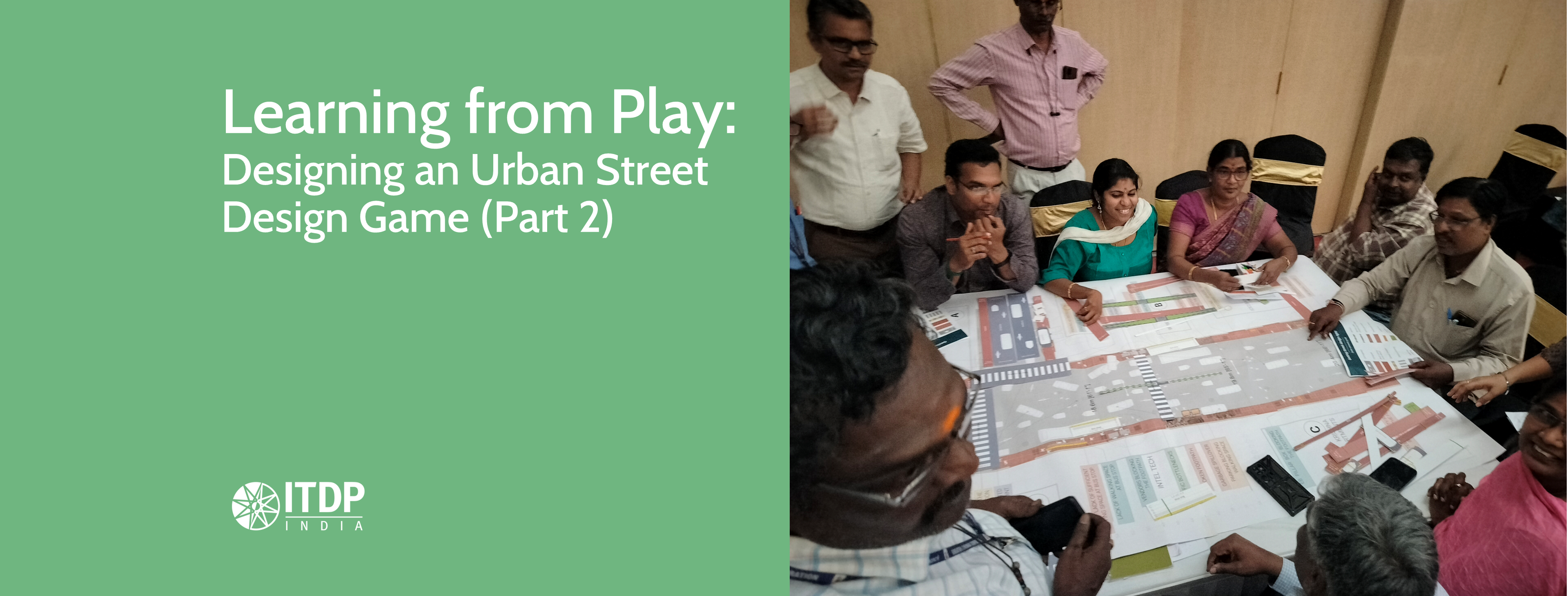
Learning from Play: Designing an Urban Street Design Game (Part 2) 

7th November 2024 by admin

For everyone who thinks managing urban transport is serious business, and not fun and games, we are back to say it can be both! 

A few months ago, we wrote a blog on how to design an urban transport game. In the blog, we captured our learnings of gamifying the process of developing long-term plans for Healthy Streets. We did this so others can learn from the process and build on it. Well, this is our way of giving back, having learned from and built upon the expertise and experience of many other organisations in this field.  

This is another such attempt to document our journey with a new game – Getting Your Street Design Right. In this blog, we elaborate on how we gamified the process of developing good street designs. 

This game was played on 31st May, 2024, with 70 engineers of Greater Chennai Corporation at an inter-departmental workshop. Here’s how it was developed.

Engineers from the Greater Chennai Corporation playing the game during the Inter-departmental workshop

Drawing Inspiration from Experts

In our quest to strategise the next game on getting street design right, we came across Global Designing Cities Initiative’s (GDCI) work. In 2023, GDCI hosted an interactive workshop with nearly 40 participants from Renca and Cerrillos (municipalities in Chile). During this workshop, city officials redesigned an intersection using puzzle pieces that represented key street sections such as bus lanes, cycle tracks, curb extensions for play, commerce, and pedestrian crossings. What a great idea! Inspired by their approach and drawing from our own experience, we started out designing our next game.


Crafting a Clear Intent

Having designed multiple games and hands-on exercises in the past, we knew that getting our intent right was key to designing this game. Street design is a vast subject, and with limited time, we had to focus on specific areas and key takeaways for the participants—the city engineers. Here’s what we wanted them to take away from the game:

  1. Grasp the basics of street design – Our participants were city engineers who were familiar with street design. However, they needed guidance on the right principles that would make their projects more impactful and long-lasting. Hence, we decided to focus on the basics, which could then be incorporated even in their ongoing projects for better impact.  
  2. Understand the reasoning behind the standards – Simply sharing information was not enough. Without understanding why certain street design standards are recommended, there’s always resistance to change. Hence it was necessary to establish the reasoning through the game, making it easier to grasp.
  3. Foster collaboration across departments – Different departments involved in street design have their own perspectives and processes. It was important to bring them together and get them to collaborate.  

In short, we designed the game to simplify street design while making it fun, insightful, and collaborative.  


Establishing Gaming Principles 

To understand the design of street elements—footpaths, carriageway, landscaping, bus stops, street furniture, utilities, etc.—better, we wanted participants to explore redesigning a street. With this as the base, we structured the game on the following principles: 

  • Allow for mistakes and fixes – We wanted the participants to see how their current approach to street design wasn’t effectively addressing on-ground challenges. Hence, the game was structured in two rounds—one, where they design the street as usual, and two where they rectify their design based on the best practices. 
  • Evaluate the design and learn – To get participants to fix their designs, we needed them to understand the design gaps and why it was considered so. For this, we introduced a design evaluation round for them to understand the reasoning behind the street design standards.  
  • Reward players – It was established up-front that this game would have no winners. But where’s the fun in that? To keep the excitement going and to celebrate the teams for getting some aspects of street design right, we introduced badges! Each badge represented a key element to street design and winning that badge meant they designed that element well. Each team needed to win all six badges to unlock a “Healthy Streets Badge”.
The different kind of badges awarded to the participants after each round of play

Detailing the Game

From our past experience, playing the game in groups, especially smaller ones, is most effective to hear different ideas. We decided to play this game in groups of 6-8 participants, creating an interactive approach for participants to learn by doing. Here’s how the game played out:

1. The Playing Board

We started by creating a fictional street, Malgudi Salai (Malgudi Street, in Tamil) and developed a plan view of an 80m stretch of this street, on the playing board. To keep it as realistic as possible, we depicted broken footpaths, varying carriageway widths, parking encroachments, large intersections, etc. on the playing board. Common pedestrian issues were also identified on the board to make it easier for the participants to understand the context and resolve them through design. 

2. Context Sheets

To help participants visualise the street , we developed additional information for Malgudi Salai. We included street photographs (of streets with similar character), land-use, and it’s location in the city.  

A sample of the context sheets provided to the participants
A sample of the context sheets provided in the form of photos

3. The Game Pieces

The elements of street design were our game pieces. Since we wanted players to learn from their mistakes, we developed the street elements of varying dimensions, including some that did not meet standards. This way the players had a variety of pieces of the same street element to choose from. We were also curious to know which ones they would pick in an ideal design scenario.

A list of street-element cutouts handed over to the participants as game pieces

4. The evaluation matrix and characters

To make the game more engaging, we introduced two fictional pedestrian characters—Thangavel, a person with disability, and Kamala, a caregiver—who frequently used Malgudi Salai. Through their journey, we highlighted specific street issues, such as Thangavel struggling to navigate a broken footpath with his wheelchair. These scenarios helped participants understand the street issues from the characters’ perspectives. We shared an evaluation matrix which helped the teams evaluate their designs, keeping in mind the needs of Thangavel and Kamala. The evaluation matrix was a set of questions to check if a particular street design element was designed correctly. 

The two game characters and a sample of the evaluation sheet

5. The right process

After the players designed the street and evaluated their designs, it was time to fix it. For this, they needed guidance on best practice of street design. So, before the teams modified their designs, we provided a step-by-step guide on how to redesign their streets. This was followed by another round of evaluation, and then the awarding of the Healthy Streets Badges.  


Rolling out the Game 

The capacity-building workshop had representatives from departments including the Bus Route Roads, Stormwater Drains, and Special Projects, along with Zonal engineers. We split them into groups of 10, making sure each group had representatives from different departments.  
 
And then, game on! The team dived right into Round 1, working together to come up with a design solution for Malgudi Salai. We witnessed participants engage in healthy debates over minimum standards of the street elements.  
 
After 15 minutes of play, the designs were complete and then came the moment of truth—the evaluation and handing over of badges. All groups got a minimum of two aspects of street design right, qualifying for atleast two badges. However, since they did not incorporate all elements of street design, they did not qualify for the Healthy Streets badge. This quickly made them realise that just fixing one or two aspects of the street doesn’t yield the impact they expect.  We eventually informed them that they had an opportunity to win the Healthy Streets badge in Round 2 by following a secret recipe! The energy in the room shifted—they were now pumped to pay attention to the guidance (the secret recipe) we provided on the right street design practices.  

As the participants worked on Round 2, following the guidance provided, they even remembered to add access ramps for Thangavel’s wheelchair, without our nudges! They also realised that by making small modifications to their approach, like starting off with identifying the centreline of the street and fixing uniform carriageway widths, they were able to accommodate wider pedestrian infrastructure. They could do all this without compromising on other elements.  

As a result, all teams qualified for a Healthy Streets badge by following the not-so-secret-anymore recipe! The players actively referred to the evaluation matrix and the guidance to ensure they got their designs right. This went on to show us that even a simple game like this can be so impactful.  

Glimpses from the game play at the workshop

Conclusion 

Just like our game play in 2023, we once again saw how powerful and transformative games can be. The process of developing the game and especially the positive response of city officials to the game makes us hopeful about the future of streets in our cities. Through such continued engagements, we hope to make Healthy Streets a reality and enable our cities to create impactful transformations on the ground. 

We leave you with this – there is hope for the streets in our cities. The game is far from over. 


Written by Smritika Srinivasan, Senior Associate – Urban Development

Edited by Donita Jose, Senior Associate – Communications
Filed Under: Chennai, Walking and cycling Tagged With: Chennai, Complete Streets, Parking, Sustainable Transport, Walking and Cycling

Rethinking decision making through collaborative community planning

1st July 2019 by admin

The French philosopher and sociologist Henri Lefebvre interpreted space as an entity that is not static, but one that is alive and dynamically shaped through the interaction of people with it. He stressed on the importance of the production of space through these social relations over merely treating space as an object. We, however, live in a world which largely follows the technocratic planning principles for managing these spaces, rather than  embracing the relations that form them. 

Through understanding the relationship between people and their surrounding environment inherent to every space, the cities can ensure a demand-driven approach to solution making, where decisions are largely tailor-made than mass produced to the context. This will ensure a multidisciplinary approach to solution making, where there is open knowledge sharing and a collaborative work of different stakeholders. An intervention will thus have more credibility when it is shaped through a participatory approach involving all participants who have a stake in it. 

The case of transformation along Sringeri Mutt Road

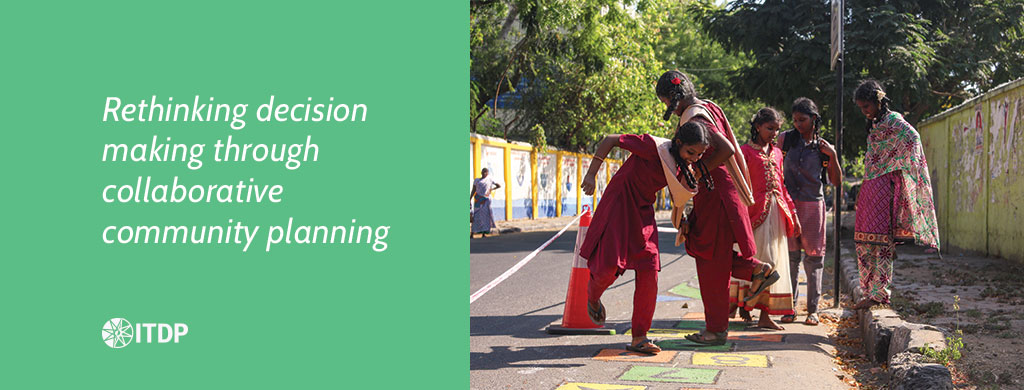
An interesting example of how the participatory deliberation of the people can shape spaces they live in was observed in the case of the tactical urbanism intervention along the Sringeri Mutt Road, facilitated  by ITDP India Programme in Chennai. The quick and cost-effective initiative that was largely community driven, was aimed at enhancing the road and personal safety of the neighborhood, primarily women and children.

[baslider name=”CollectiveCommunity”]

Deepening Democracy: Innovations in Empowered Participatory Governance by A. Fung and O. Wright  highlights three key principles of Empowered Deliberative Democracy which seem to be strongly embraced in this case.

The first principle speaks of ‘practical orientation’ of having a specific focus on tangible problems, which helps solve it through the next two principles. With abandoned vehicles and unauthorized parking lining the stretch along the canal, the dead spaces had become a breeding hub for anti-social activities.   The tangible problems in this case were identified as the need to enhance road and personal safety for the street users in the neighborhood.

The second principle is about ‘bottom up participation’ which calls for including people directly affected by the problems, to serve as a channel for experts and citizens to work together. The direct involvement helps in increasing efficiency, trust, and accountability. The ITDP India Programme was able to measure the root cause of the concerns through initiating dialogues with the different stakeholders in the neighborhood. Those who faced the brunt were frequent users of the street, which were the local residents and the students and teachers of the neighboring school. The different layers of the problem were gradually unwrapped through site visits and discussions with these users

The third principle on ‘deliberative solution generation’ involves joint planning and problem solving through a process of deliberation. The participants hear out each other’s concerns and work together towards developing a solution through discussions than heated arguments.The fresh lease of life that the space witnessed was due to the efforts of the Chennai Traffic Police, Greater Chennai Corporation, civic action groups like Thiruveedhi Amman Koil Street Residents Association (TAKSRA) and Karam Korpom, Chennai High School (Mandaveli) and the ITDP India Programme.


Sketch by the author on the case of Sringeri Mutt Road based on the principles of Empowered Deliberative Democracy

This case showed alternate approaches to transformations that a city can witness, where deciphering the needs and solutions is a joint process with the people involved, than a top-down approach.

Moving towards a systemic change

The intervention on the ground, its success and the interest it has lit amongst the city officials to scale- up, draws parallels to stage model of social innovation discussed by Robin Murray, Geoff Mulgan and Julie Grice.

Source: Stages of Social Innovation from ‘Social Innovation Regimes An Exploratory Framework to measure Social Innovation’ Castro Spila, Javier & Luna, Álvaro & Unceta, Alfonso (2016)

The tactical urbanism solution as a prototype addressed the poor social conditions that prevailed. The smiles that it achieved in bringing to the faces of the children and other users have reflected the triumph of the approach and the city is pushing towards scaling up these quick, low cost and community driven interventions to other areas. 

Pugalis and Giddings in their work on ‘The renewed right to urban life’ extends on the Lefebvrian philosophy which values the coproduction of space. They bring up the concept and importance of ‘little victories’, small wins that add up to create strong ripples capable of bringing a systemic change.  A systemic change involves the gradual reshaping of mindsets that have been accustomed to a set machinery and distribution of power. These steps to scale up the interventions, however reflect the possibility of bringing a systemic change that values the collaborative approach to decision making, by prioritizing the needs of the most vulnerable users. The interest of the city to facilitate this decentralized approach, indirectly shapes this into a coordinated decentralized system, taking the best of both systems.

As a country that has shaped through over seventy years of democratic politics, there is an inherent need to see citizenship as something that is as dynamic as a space itself. Urbanist Luigi Maza speaks of the dual nature of citizenship, one that is not just a bundle of rights and obligations, but a dynamic social process of the citizens contributing to the production of spaces, redesigning its rules and obligations. As the city  adopts new ways of decision making, the citizens also have to start thinking outside the walls of the homes they have built and see the entire city as their home and contribute towards improving it. After all, as Jane Jacobs rightly put it, ‘Cities have the capability of providing something for everybody, only because, and only when, they are created by everybody’.

Written by AV Venugopal

Edited by Kashmira Dubash


Filed Under: Chennai, featured, Featured News #1, Uncategorised, Walking and cycling Tagged With: Chennai, Community engagement, Complete Streets, sringeri mutt, Tactical Urbanism, tami, Tamil Nadu

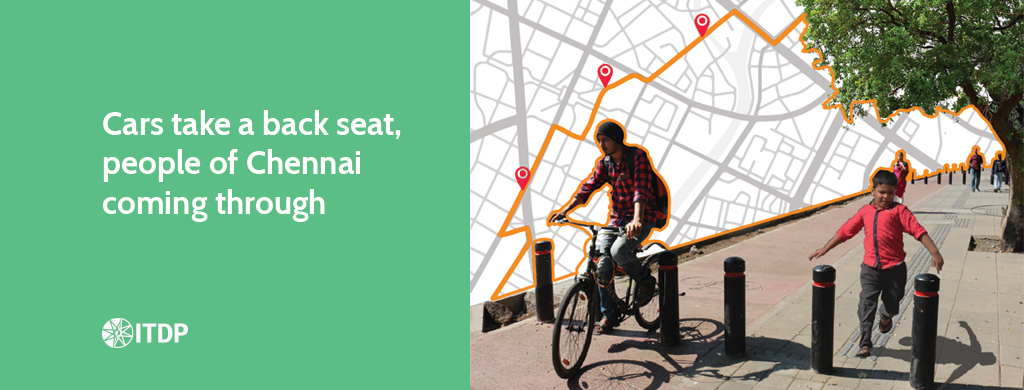
Cars take a back seat, People of Chennai coming through

31st May 2019 by admin

Designed By: Aishwarya Soni
Conceptualized By: Nashwa Naushad, A V Venugopal, Aishwarya Soni

Filed Under: Chennai, featured, Walking and cycling Tagged With: Chennai, Complete Streets, ITDP India, MasterPlan, NMT, Walking and Cycling

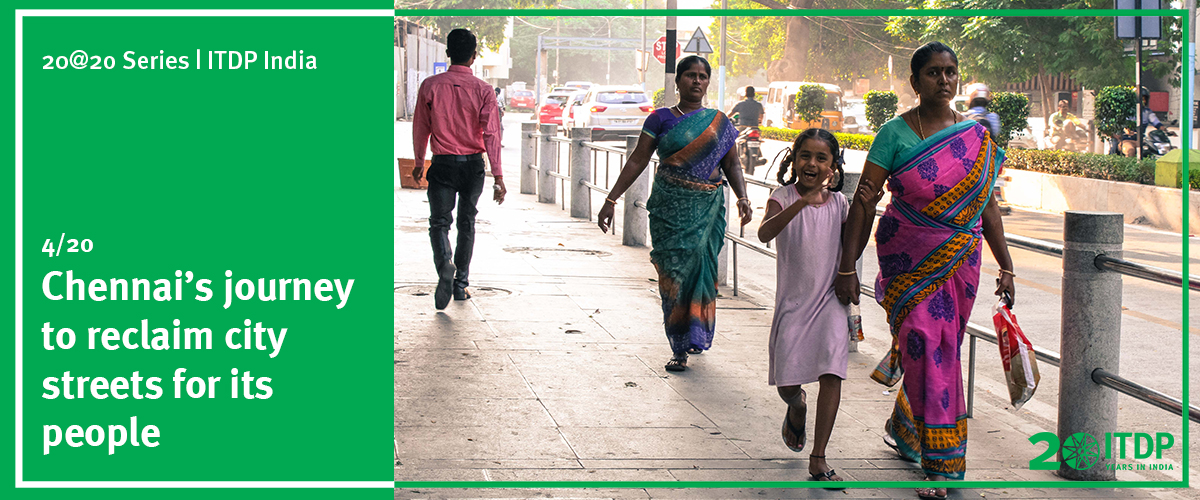
Chennai’s journey to reclaim city streets for its people

8th June 2018 by admin

Chennai, a thriving South Indian metropolis and the capital of the state of Tamil Nadu, is at the cusp of turning into one of the world’s megacities. While it historically had the image of being somewhat insular, the Chennai of today is a cosmopolitan hub where the old meets the new.

Transportation is the focus of many pressing issues facing Chennai today—decisions about whether to build highways or bus corridors have a great impact on our health and our environment.

ITDP India Programme initiated collaboration with Chennai City Connect in 2009 to improve cycling and walking conditions across the city. Change isn’t easy in cities where the car is a symbol for status.

But within five years of ITDP’s engagement with the city, Chennai took the bold move of adopting the Non Motorised Transport (NMT) Policy—first in India. The policy mandates that a minimum of 60 percent of of transport funding to create and maintain walking and cycling infrastructure in the city.

Having retrofitted over 50 km of walkable streets over the years, Chennai has initiated the next phase of redesigning an additional 50 km of street network. Chennai’s policy has inspired many national and international cities—from Chandigarh to Nairobi—to adopt similar policies. The comprehensive approach undertaken by Chennai, was awarded the Sustainia Award in 2015.

Watch how ITDP India has supported, and continues to support Chennai transform its streets for a better city, and better lives.


Filed Under: Chennai, news Tagged With: 20@20 Series, Chennai, Complete Streets, Sustainable Transport, Walking and Cycling

On-Street Parking Management: Pune and Chennai to join the bandwagon

3rd June 2017 by admin

“I bought an AC, now the government has to give me a free house to install it in!” If this is an absurd demand, so is free parking – “I bought a car, now the government has to give me a free place to park it!” Cities across the world including India, are gradually beginning to realise that parking is not a right; it is a commodity and should come at a price. In keeping with this revelation, Indian cities such as Ranchi have started implementing on-street parking management, with a parking fee.

Pune and Chennai are the latest cities striving to join the bandwagon. Pune will soon adopt a parking policy to guide parking management in the city. Pune and Chennai both aim to put a smart parking management system in place. There is now an urgent need to learn more about global best practices, especially challenges faced during implementation and solutions. In order to initiate this learning process, Pune and Chennai will host discussions and workshops internally and for the public in the following weeks, led by internationally acclaimed parking expert Dr.Paul Barter.

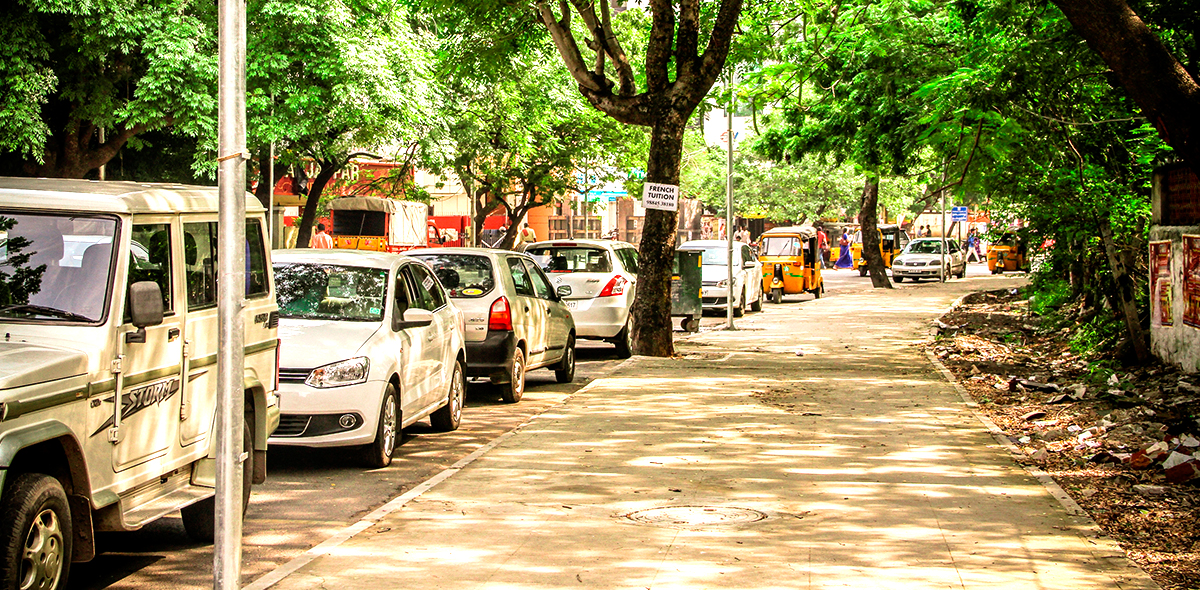
Today, unorganised on-street parking and invasion of pedestrian footpaths by parked cars is common of most Indian cities. On-street parking is mostly free, and even when charged, the rates are too low and fee collection is carried out by private operators with little monitoring or oversight by the government.

In Pune, open spaces have been converted into parking lots – including a mechanised structure – to meet the ‘demand’. However, prior to providing off-street solutions, on-street parking has to be addressed as it comes free of cost and is more easily accessible, hence is more sought after.

Realising this, Pune has tried to employ certain strategies to ensure that rampant parking doesn’t hinder movement of vehicles as well as people. The age-old “P1/P2” scheme has been incorporated in several streets where parking is allowed only on one side of the road depending on odd/even dates. Traffic cops have tried to ban parking on mobility corridors during peak hours.

A manually-operated “Pay and Park” system in Pune charges 4-wheelers Rs.5-10 for 2-4 hours

Pune has also implemented a manually-operated “Pay and Park” system on some streets with parking charges of the order Rs 5-10 for four-wheelers for 2-4 hours. While this is the on-street scenario, many private establishments like hospitals and cinema halls charge upto Rs 50 for 4 hours of car-parking. All these measures have had mixed successes.

In Chennai on the other hand, parking rules and fees are administered on an ad-hoc basis, leading to a lack of clarity for users, inconsistent enforcement, and significant revenue leakage. The city experiences localised shortages despite overall availability of parking space.

The two cities are thus trying to solve the parking problem by better on-street parking management. The Pune Municipal Corporation has proposed a policy to manage parking in the city. The policy suggests slabs of parking charges, using the fundamental economic principle of supply and demand to determine the cost. It prioritises road space for other users – especially pedestrians, by dissuading the usage of any available public space (both off- and on-street) for parking.

The revenue from parking management only on bus-route roads in Chennai could itself be over half a crore rupees per year.

Chennai has initiated the process of implementing a smart parking management system. Key features of the proposed system are parking guidance for users and real-time information of parking slot availability on mobile platform, an online digital payment portal to improve revenue collection and enhance transparency and an electronic enforcement system, among other things.

For parking charges, a zone-based system will be followed wherein streets are categorised into paid parking (medium to high demand), free parking (low demand) and no parking (since parking restricts movement) zones. Parking fee and fine will be determined by the Greater Chennai Corporation and Chennai Smart City Ltd. It is estimated that the revenue from the system only from bus-route roads could itself be well over half a crore rupees per year.*

Dr. Paul Barter at a parking management workshop in Kathmandu. Image Courtesy: Clean Energy Nepal

In order to assist the two cities’ commendable efforts to deal with parking, Dr.Paul Barter will be visiting and leading discussions in both Pune and Chennai. Dr. Barter has offered his expertise along with necessary training in several parking-management projects across the world including Beijing, Kathmandu, Jakarta, Singapore, Mumbai, etc. He has published an on-street parking management toolkit as a guide for government staff in low-income and middle-income countries. His expert opinion and knowledge will add greatly to the parking management plan of the two cities.

Through their actions to tackle parking, Pune and Chennai are surely setting a great example for other cities that intend to create an urban environment focused on people rather than vehicles!

*This estimate is based on a parking fee rate of Rs. 40 per ECS per hour for bus-route roads.


Read the draft of Pune’s parking policy here: Suruvath: Public Parking Policy 2016.

Discover the basics of parking management and regulation in ITDP’s publication, Parking Basics.

Filed Under: Chennai, Parking Management, Pune Tagged With: Chennai, Parking, Pune, Pune-Pimpri Chinchwad, Traffic reduction

  • « Previous Page
  • 1
  • 2
  • Who We Are
    • Our Team
    • Contact Us
    • Opportunities
    • Our Approach
  • What We Do
    • Complete Streets and Parking Management
    • Public Transport
    • Transit Oriented Development
    • Inclusive Mobility
  • Where We Work
    • Agra
    • Ahmedabad
    • MAHARASHTRA
    • Pune – Pimpri-Chinchwad
    • Nashik
    • TAMIL NADU
    • Chennai
    • Coimbatore
    • JHARKHAND
    • Ranchi
    • NATIONAL
  • News
  • Resources
  • Get Involved
    • Donate

Copyright © 2026 · ITDP Responsive on Genesis Framework · WordPress · Log in

Loading Comments...