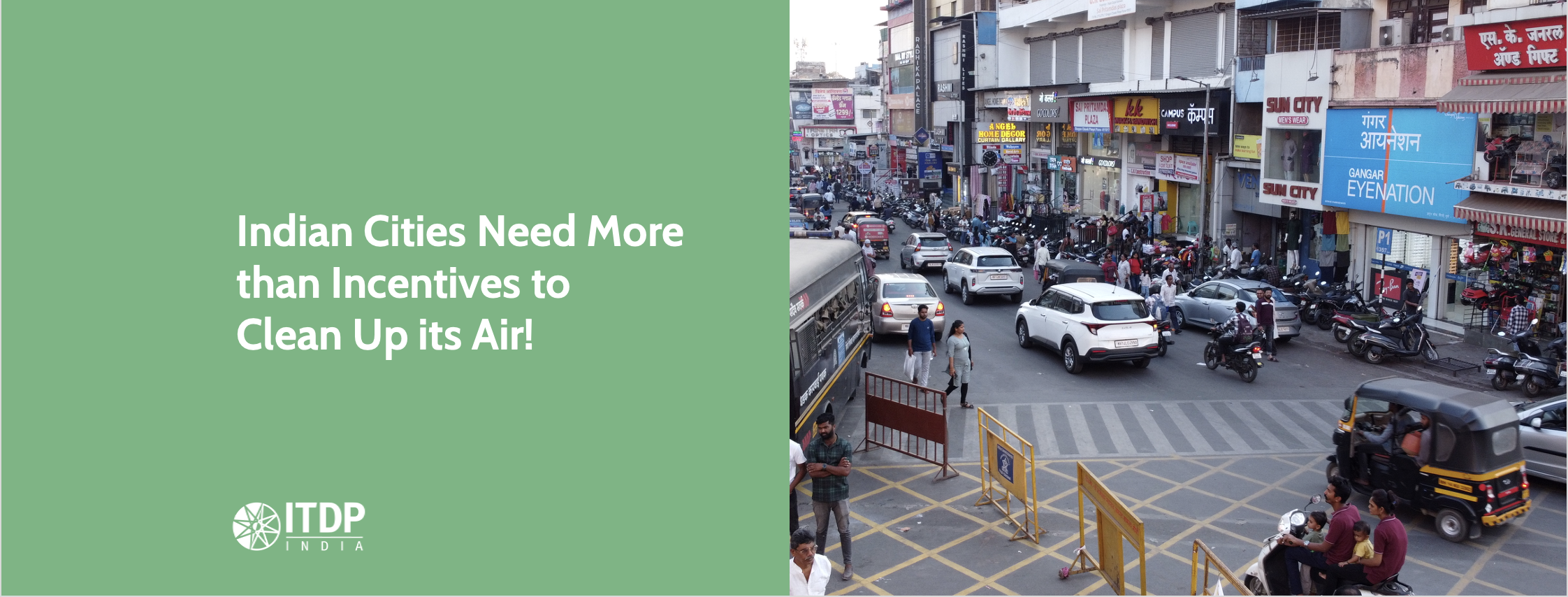
This blog explores how Indian cities can address vehicular air pollution by moving beyond incentives for cleaner vehicles and strengthening measures that discourage the continued use of highly polluting vehicles. It examines pollution pricing through Low Emission Zones as a gradual alternative to outright bans, outlining how such a system could work, the conditions needed for effective implementation, and how it could encourage a shift towards cleaner and more sustainable modes of transport.
Across India’s cities, conversations about air pollution have become almost routine, however, there is ambiguity around the source of pollution depending on the city in concern. Of the multiple sources, road transport currently contributes to 20-30% of the urban air pollution. Unlike seasonal sources like crop burning or localised and temporary causes like construction, vehicle pollution persists throughout the year and across the city. So, how should we tackle vehicular emissions?
Acknowledging the issue, many governments have introduced air quality improvement plans that follow the ‘Improve, Shift, Avoid’ approach to phase out polluting vehicles. Improve encourages use of cleaner technology vehicles like EVs; Shift nudges people to use more public transport, walking and cycling; Avoid discourages the use of polluting vehicles. While the first two approaches have seen growing policy attention, “avoid” remains largely underexplored.
While there are measures such as vehicle scrappage schemes, higher re-registration charges, and green taxes to support phase out of polluting vehicles, they don’t tackle the problem directly. That leaves cities with the question: how do we make the shift away from polluting vehicles happen on the ground?

If Indian cities are serious about cleaner air, they will need to move beyond incentives for cleaner alternative alone. Cities cannot rely only on subsidising electric vehicles, improving public transport, or promoting walking and cycling while the whole system makes the use of polluting vehicles easy. The next step lies in strengthening the “avoid” strategy through policy tools that actively discourage the continued use of polluting vehicles.
What is a better alternative to reduce the use of high polluting vehicles – Ban or Pricing?
When it comes to phasing out high polluting vehicles, a complete ban may seem like the most obvious solution. A ban is also easier to implement. However, obvious or easy does not mean it is effective. For many people, shifting to a cleaner, compliant vehicle is not an overnight decision—it requires upfront capital, planning, and the ability to absorb a sudden change. For those with limited purchasing power, an immediate ban can quickly become a harsh and difficult transition.
This is where a daily pricing approach on high polluting vehicles offers a more practical way forward to actively discourage vehicular emissions. Instead of abruptly forcing vehicles off the road, this approach begins by making their continued use more expensive. Eventually, when the cost of continuing as usual becomes difficult to justify, it results in a change of behaviour.
A pricing approach creates space for transition. It gives people time to adapt, whether by upgrading to cleaner vehicles, shifting to public transport, or choosing walking and cycling. It allows limited use of older vehicles during occasional or emergency situations, while steadily discouraging routine dependence on them. Cities such London and Antwerp have already introduced similar pricing measures through low-emission zones, helping reduce the use of highly polluting vehicles and nudging commuters towards cleaner travel choices.
But pricing will only work if the right conditions are in place!
Before introducing pricing, four important points must be kept in mind.
- Pricing is not designed as a revenue-generating mechanism:
The primary intention of pricing is to discourage continued use of high polluting vehicles and gradually phase them out. This measure is designed to solve a problem, not sustain a system. Therefore, as the number of polluting vehicles reduces, the need for pricing will phase out as well.
- Pricing high polluting vehicles is not the same as congestion pricing:
Congestion pricing aims to reduce traffic congestion, by discouraging the use of personally owned vehicles or privately hired taxis or autorickshaws, irrespective of whether the vehicles are polluting or clean. Whereas pricing polluting vehicles specifically focuses on only reducing the use of high polluting vehicles. The pricing strategy and the zone where it applies will vary for both. For instance, London has implemented congestion pricing in Central London, whereas pricing on high polluting vehicles applies city-wide.
- Revenue collected must be reinvested in sustainable mobility:
Collected charges should only be used on initiatives that directly reduce air pollution such as investing in procuring electric buses, improving walking and cycling infrastructure. This amount should not be seen as a source of income for the city, and should not be used for recurring operations costs.
- Pricing on high polluting vehicles must be set carefully:
The charge should be high enough to discourage the continued use of high polluting vehicles. At the same time, the charge should be calibrated in a way that clearly nudges behaviour change, rather than functioning as a fee that people simply absorb and continue to pay.
How would pricing work?
In practice, pricing highly polluting vehicles is implemented through the creation of Low Emission Zones (LEZs)—designated areas where high polluting vehicles entering or inside the zone will have to pay the charge. Such zones could be a part area of the city, the whole city, or extend to the metropolitan area, depending on the pollution levels of the city. The zone area can also expand gradually.

It is important that the zones are sizeable enough to discourage the use of high polluting vehicles. Small areas would not yield desired results. A pilot area should also look at a minimum size of 5 square kilometers.
These zones are enforced digitally. Automatic Number Plate Recognition (ANPR) cameras are installed across entry points and key locations inside the area to identify non-compliant vehicles. By combining digital monitoring with clear emission criteria, cities can implement pricing in a transparent and enforceable manner.
What impact could pricing have on people’s travel choice?
Insights from a perception study, Public Opinion on Low Emission Zone Strategies, conducted in 2025 with 2,000 private vehicle users in Pimpri-Chinchwad and Pune offer an interesting perspective. The study combined citizen surveys, data analysis, and focus group discussions to understand how residents might respond to the idea of introducing daily pollution pricing for entering low-emission zones.
The findings reveal that only about 4% were willing to pay charges to use their high polluting vehicles. This shows that pricing could potentially discourage a big percentage of high polluting vehicles. While this may appear to signal public opposition, it actually highlights the potential effectiveness of the measure.
Most respondents were unwilling to pay the charge, and many indicated they would instead adapt their travel behaviour—by switching to cleaner vehicles such as electric vehicles or newer emission-compliant models, or by shifting to public transport, walking or cycling. From a policy perspective, this response reflects exactly what pollution pricing is designed to achieve: a behavioural nudge that discourages the use of highly polluting vehicles and encourages a transition toward cleaner mobility choices.
A new way of thinking about urban air quality
Improving urban air quality demands a broader shift in how cities manage mobility and emissions. Pollution pricing should be seen as one part of a holistic sustainable mobility strategy that encourages people to reconsider how they travel. By placing a cost on highly polluting vehicles, cities can nudge commuters toward cleaner vehicles while also strengthening the case for public transport, walking and cycling.

For Indian cities grappling with worsening air pollution and rapidly growing vehicle ownership, exploring such policy tools could open up new pathways for action. Pollution pricing may not be an easy conversation to start, but it offers a practical way to gradually shift behaviour while supporting investments in cleaner mobility systems. As cities search for solutions that move beyond short-term fixes, experimenting with approaches like pollution pricing could help reshape the way urban transport contributes to cleaner, healthier air.
Written by Shreesha Arondekar, Senior Associate, Development and Communications | With inputs from Parin Visariya, Programme Manager, Inclusive Compact Cities
Edited by Donita Jose, Deputy Manager, Communications
Frequently Asked Questions
- How will cities decide which vehicles are considered highly polluting?
In India, vehicle emissions are regulated through national standards, with vehicle age and Bharat Stage (BS) emission norms providing key criteria for identifying older, more polluting vehicles. Cities can use these standards to define which vehicles are subject to pollution pricing, while adopting stricter criteria where local air-quality conditions warrant stronger action.
- Will pollution pricing actually reduce air pollution?
Pollution pricing is intended to reduce the use of high-polluting vehicles, thereby reducing their contribution to urban air pollution. Its effectiveness will depend on how strongly the charge influences travel and vehicle-use decisions, as well as the availability of cleaner alternatives such as public transport, walking, cycling, and cleaner vehicles.
- What is a Low Emission Zone and how can it be enforced?
A Low Emission Zone (LEZ) is a designated area where high-polluting vehicles are either charged for entering or travelling within the zone, or they completely banned. Cities can enforce LEZs using Automatic Number Plate Recognition (ANPR) cameras to identify vehicles and determine whether they meet the required emission criteria. Non-compliant vehicles can then be charged digitally.