ITDP India

Promoting sustainable and equitable transportation worldwide

  • Contact
  • ITDP India’s 2025
  • Who We Are
    • Our Approach
    • Contact Us
    • Career Opportunities
  • What We Do
    • Healthy Streets
    • Public Transport
    • Electric Mobility
    • Transit Oriented Development
    • Low Emission Zones
    • Inclusive Mobility
    • Traffic Reduction
  • Where We Work
    • NATIONAL
    • MAHARASHTRA
      • Pune
      • Pimpri Chinchwad
      • Nashik
    • TAMIL NADU
      • Chennai
      • Coimbatore
    • JHARKHAND
      • Ranchi
    • Agra
    • Ahmedabad
  • Blogs
  • Resources
    • Press
  • National Challenges
    • India Cycles4Change Challenge
    • Streets for People Challenge
    • Transport4All Challenge
  • Urbanlogue
    • Urbanlogue Webinars – Series One
    • Urbanlogue Webinars – Series Two
    • Urbanlogue Webinars – Series Three
    • Urbanlogue Webinars – Series Four

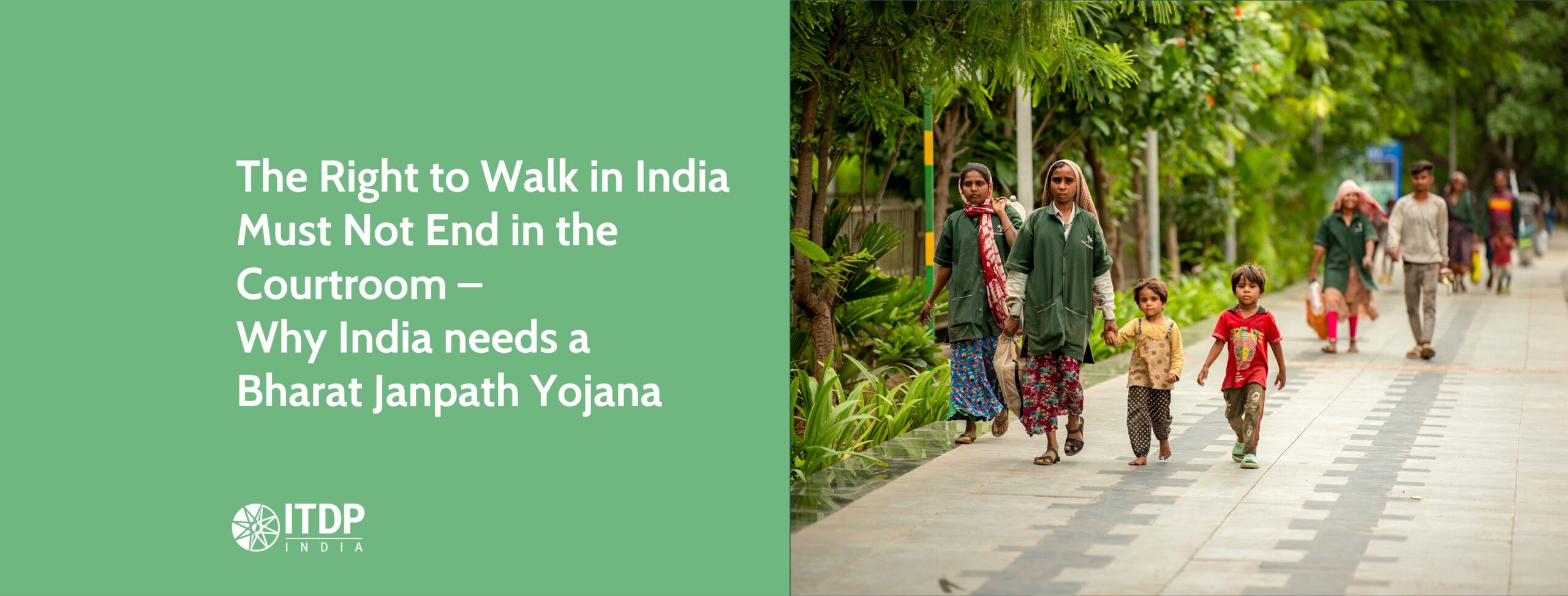
The Right to Walk in India Must Not End in the Courtroom – Why India needs a Bharat Janpath Yojana

22nd July 2026 by admin


Every day, millions of Indians begin and end their journeys on foot. Yet our cities continue to treat walking as an afterthought. The consequences are measured not just in inconvenience, but also in the lives lost.   

The Supreme Courts’s landmark judgement in Maniyar Iliyaz v. P. Ayyappan in June 2026 marks a clear break from this reality. By recognising the right to walk on safe, well demarcated footpaths as a fundamental right under Article 19(1)(d) and 21 of the Constitution, the Court has fundamentally changed the way India’s streets must be planned and governed.   

More importantly, the Court has established a new hierarchy for urban mobility: the movement of people on foot takes priority over the movement of vehicles. The judgement has made clear that footpaths are no longer optional urban amenities, but essential public infrastructure. Wherever a road exists, municipal authorities have an enforceable duty to provide and maintain a safe footpath.   

While the judgement settles an important constitutional question, the answer to a practical question remains: how do we ensure that every Indian can exercise the right to walk?   

Because rights alone do not build safe footpaths.

What is Missing in the System to Deliver Better Streets?  

Across India, cities have demonstrated that people-first streets are possible. The challenge is that these remain isolated successes because the systems needed to plan, fund, and sustain them at scale are still missing.

  1. No long-term vision: Firstly, cities continue to operate without a long-term vision for connected pedestrian networks, resulting in isolated projects rather than continuous walking infrastructure. This is compounded by the absence of a strong legislative framework that makes safe footpaths and pedestrian infrastructure a mandatory part of every road project. Existing policies and guidelines encourage better streets, but they are largely advisory and often ignored.  
  2. Lack of funding and misallocation of resources: Even where the intent exists, cities struggle to implement Healthy Streets because the problem is not just one of limited funding, but of how funding is prioritised. Transport budgets continue to favour infrastructure for vehicles, while walking infrastructure receives only a fraction of the investment it needs.  
  3. Frequent changes in administrative leadership and lack of technical capacity: This imbalance of funding is compounded by frequent changes in political and administrative leadership, weak technical capacity, and poor coordination between multiple road-owning agencies. Tier II and III cities face even greater constraints, with limited municipal finances and little access to specialised expertise for planning and delivering high-quality streets.  
  4. Public perception tilted in favour of vehicles: Finally, transforming streets also requires changing public perception. For decades, road space has been designed almost exclusively around vehicles. When projects seek to rebalance streets in favour of pedestrians and cyclists, they are often met with resistance because the vehicle owners see this as taking road space away from vehicles. Without sustained public engagement to communicate the wider benefits—for safety, mobility, health, and local economies—cities will continue to face pushback that slows or derails meaningful street transformation.  

What’s Needed to Make the Constitutional Right a Public Reality?

The next task for decision-makers is to redefine how Indian streets are planned and delivered. The Supreme Court has recognised the right to walk; translating that right into everyday reality requires pedestrian infrastructure to be treated with the same priority as every other mode of transport. The proposed Bharat Janpath Yojana, as elaborated in the recent report: The Healthy Street Dividend, offers a framework to achieve this through three interconnected actions.

  1. Legislative Framework: The first is a legislative framework that formally recognises and protects the right to walk while making safe, continuous, and universally accessible pedestrian infrastructure a mandatory part of every road project. While a comprehensive national framework is the long-term aspiration, states are well placed to lead this reform in the near term by enacting legislation that reflects the Supreme Court’s principles. Just as the Motor Vehicles Act provides a statutory framework for improvement of vehicular movement, India now needs a legislation that makes safe, continuous, and universally accessible footpaths mandatory in every road. Karnataka’s proposed Active Mobility Bill offers one such pathway.   
  2. National Streets Programme: India also needs a dedicated national programme to support implementation at scale. The second action is a National Streets Programme to help cities move beyond isolated street improvement projects and build connected walking networks at scale. Beginning with a target of 10,000 kilometres of Healthy Streets across 100 cities, the programme would prioritise continuous footpaths, safe at-grade crossings, traffic-calmed streets, protected cycling infrastructure, shade, lighting, and universal accessibility. More importantly, it would create complete networks that connect homes with schools, healthcare, markets, workplaces, and public transport hubs, closing the critical first- and last-mile gap while making streets safer and more inclusive for everyone.    
  3. Creating an enabling ecosystem: The third action is to build the institutional and financialecosystem needed to sustain this transformation. Delivering better streets cannot depend on individual champions or one-time funding. States should establish dedicated Urban Transport Cells, while cities create Active Mobility Cells to coordinate agencies, build technical expertise, and oversee implementation. This must be backed by dedicated funding for Healthy Streets, regular monitoring of outcomes, and sustained public engagement to build support for people-first streets. Together, these reforms can ensure that India’s walking networks are not only built, but maintained, expanded, and continuously improved. 

The Case for Investing in Better Streets  

The proposed Bharat Janpath Yojana is more than a roadmap for implementing the Supreme Court’s Judgement. It is a compelling public investment. The strongest argument for better footpaths and well-designed streets will always be that they save lives; this alone is reason enough to act. However, the benefits don’t end there. Streets designed for people determine who can access the city, how healthy neighbourhoods become, how resilient cities are to extreme weathers, and even how local economies grow.  

This is the central finding of The Healthy Street Dividend, a multi-city, multi-indicator assessment launched by the Ministry of Housing and Urban Affairs (MoHUA) and GIZ India, prepared by ITDP India. The study examined Healthy Streets across 10 cities and compared it with streets in the same city where basic pedestrian infrastructure is lacking. The findings make a compelling case.  

The most immediate dividend is social. A well-designed street gives people confidence to step out, especially those who have historically been excluded from public spaces. Women are 1.5 times more likely to walk on Healthy Streets, and nearly nine in ten women report feeling safe after dark. Older adults and children also use these streets significantly more. Healthy Streets allow for independence, dignity, and equal access.  

The benefits extend to the environment we live in. Healthy Streets improve air quality by 27%, reducing people’s exposure to harmful pollutants such as PM1, PM2.5, and PM10 by 23%. They also help cities cope with rising heat street through shaded trees. As Indian cities grapple with extreme heat and worsening air pollution, pedestrian infrastructure must be recognised as climate and public health infrastructure too.  

The economic dividend is equally compelling. Streets that are safer and easier to walk on attract more customers and increase spending at local shops. Shopkeepers on Healthy Streets reported a 20% increase in annual turnover, while street vendors saw 50.6% higher daily sales. The benefits extend beyond individual businesses. Walkable, people-friendly streets make neighbourhoods more desirable, contributing to 10–60% higher real estate values across cities, strengthening the local tax base. They also unlock the value of India’s massive investments in public transport by making the first and last leg of every journey safer and more convenient. In other words, the same investment that protects lives also supports businesses, strengthens city finances, and makes existing transport systems work better.  

The Stars Have Aligned. We Must Act Now!

In May 2026, the Prime Minister of India, called on Indians to rely more on public transport and reduce dependence on private vehicles, recognising the strategic importance of reducing fuel consumption in an uncertain geopolitical landscape. The Supreme Court has affirmed safe footpaths as a fundamental right. With political intent and constitutional backing moving in the same direction, what remains is decisive implementation. The time to redesign India’s streets is not sometime in the future, it is now. 

Written by Shreesha Arondekar, Senior Associate, Development and Communications | With inputs from Venugopal AV, Programme Manager, Healthy Streets and Partnerships, ITDP India 


Frequently Asked Questions

  1. What does the Supreme Court judgement on walkability say? 

The Supreme Court’s judgment recognises the right to walk safely on a footpath as a fundamental right under the Constitution of India. The Court held that the right to walk is an essential part of a person’s right to life, dignity, and freedom of movement. 

The judgment makes five important points: 

  • People walking on footpaths should be given priority over motor vehicles. 
  • Footpaths are a legal responsibility. Wherever there is a road, local authorities such as municipal corporations, municipalities, development authorities, and panchayats have a duty to provide and maintain safe, well-demarcated footpaths. 
  • Current laws are not enough, such as the Motor Vehicles Act, which focuses on vehicles, and does not protect the rights of pedestrians. 
  • India needs a dedicated legal framework that clearly protects the right to walk, defines the responsibilities of governments, and creates systems to ensure this right is implemented. 
  • Citizens can seek legal remedy, if authorities fail to provide safe walking infrastructure, and a person’s right to walk is violated. 
  1. What is the proposed Bharat Janpath Yojana? 

The Prime Minister’s Bharat Janpath Yojana is a proposed national mission, recommended by ITDP India, to help cities build safe, accessible, and people-friendly streets across India. Its vision is to reclaim India’s streets as vibrant, equitable, and sustainable public spaces that prioritise people over vehicles, recognising that the right to walk safely is an integral part of the Right to Life under Article 21. 

To make this vision a reality, the proposed Yojana brings together three key elements: 

  • A legislative framework to protect the right to walk and make safe pedestrian infrastructure a mandatory part of every road project. 
  • A National Streets Programme to create 10,000 kilometres of Healthy Streets across 100 cities, building connected walking and cycling networks instead of isolated pilot projects. 
  • An enabling ecosystem that provides dedicated funding, strengthens state and city institutions, builds technical capacity, and establishes monitoring and accountability mechanisms to support long-term implementation. 
  1. What is Healthy Street? 

A Healthy Street is defined as a thoroughfare designed with pedestrian-oriented infrastructure that prioritises people and social activity over the movement of motorised vehicles. Unlike conventional “Unwalkable Streets” which lack dedicated pedestrian space, Healthy Streets are reimagined as equitable public spaces that support economic growth, social interaction, and environmental health. 

The key characteristics and design components of a Healthy Street include: 

  • Wide, continuous footpaths 
  • Traffic-calming measures 
  • Universal accessibility 
  • Green buffers and shade to improve thermal comfort and manage stormwater 
  • Street amenities 
  • Integrated underground utility corridors 

Filed Under: Walking and cycling Tagged With: Active Mobility India, Article 21 Right to Walk, Bharat Janpath Yojana, Complete Streets India, Footpath Development, healthy streets India, Pedestrian Infrastructure India, People-First Streets, Right to Walk in India, Road Safety India, Safe Footpaths, Supreme Court Right to Walk Judgment, sustainable transport India, urban mobility India, Walkability India

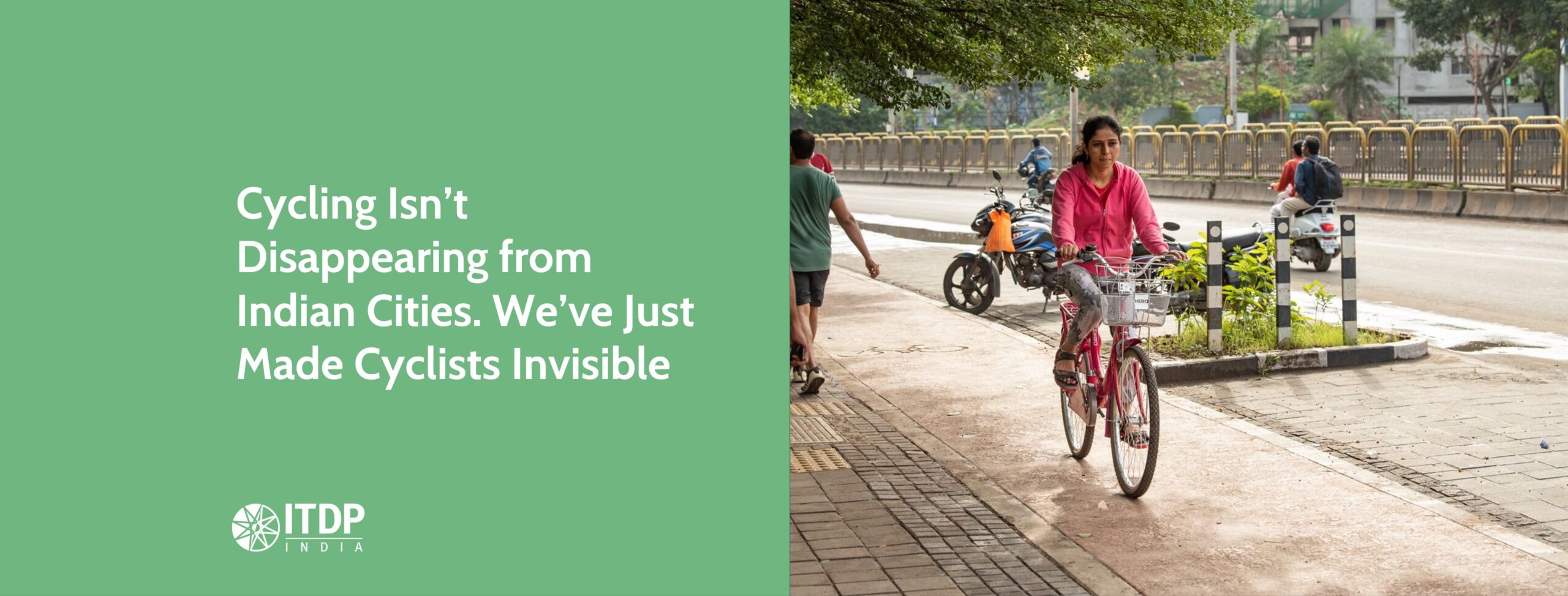
Cycling Isn’t Disappearing from Indian Cities. We’ve Just Made Cyclists Invisible

14th April 2026 by admin

Walk down a busy arterial road in an Indian city and you might conclude that cycling is a thing of the past. But look closer, especially during peak hours, and a different story emerges. On wide streets in Pune, industrial corridors in Pimpri-Chinchwad, and arterial streets in Nagpur, cyclists are very much present. They are just easier to miss because our streets are no longer designed to see them. 

A recent study conducted by ITDP India across these three Maharashtra cities (Pune, Pimpri Chinchwad, and Nagpur) found visibly high cycle volumes at peak hours, even on streets where cycling infrastructure is incomplete or poorly enforced. The data challenges a popular myth: cycling hasn’t disappeared. It has simply been pushed to the margins. 

Who Are India’s Cyclists Today?

India’s cyclists are not a homogenous group. Some ride to work, some to school, some to save money, and some for health or the environment. According to the survey of over 600 residents in three cities, nearly half of all cyclists use their cycles for daily, non-recreational trips—to jobs, colleges, markets, and homes. 

58% of responses from male cyclists said they cycle for recreation and fitness, but women, in particular, seem to rely on cycling as a mode of necessity. Nearly 60% of women cyclists reported using cycles for commuting, education, or errands. This distinction matters because it reframes cycling not as a lifestyle choice, but as essential urban mobility—especially for those with limited access to private vehicles or public transport. 

Children, too, are a critical yet overlooked group. Among cyclists under 18, two-thirds cycle primarily to reach schools and colleges, and 84% said they prefer dedicated cycle tracks over mixed traffic conditions. Their message is clear: safety, not speed, determines whether young people cycle. As one student cyclist put it, “Sometimes it gets too hot when I cycle back from school. I wish there were more trees or shade on the way.” Infrastructure, for them, is not just concrete—it is comfort, dignity, and protection. Some also said that their parent didn’t allow them to cycle to school as it was perceived to be unsafe.  

Infrastructure Exists. But Is It Working?

Over the past decade, Indian cities have invested in cycling infrastructure. Pune alone has built over 90 km of cycle tracks, Pimpri-Chinchwad more than 50 km, and Nagpur has begun developing an early-stage network.  

On paper, the city is making progress—cycle tracks have been built, and space has been allocated. But the reality on the ground tells a different story. 

Nearly 60% of cyclists rate segregated cycle tracks as ‘bad’ for comfort, pointing to fundamental design and maintenance issues. More than 60% report that these tracks are frequently obstructed by parked vehicles and vendor encroachments, while 44% highlight discontinuity—tracks that simply disappear mid-route. 

Faced with these challenges, cyclists are making a pragmatic choice. Instead of using unreliable and blocked infrastructure, many prefer riding in regular traffic lanes, even if it feels less safe. Ironically, shared streets with traffic calming measures receive better feedback, with 53% rating them as ‘good’ for comfort. 

The takeaway is clear: infrastructure alone is not enough. If cycle tracks are not continuous, unobstructed, and comfortable, they fail to serve their purpose—leaving cyclists to navigate the very traffic they were meant to be protected from. 

The single biggest complaint across all three cities? Obstructions.

Over 56% of cyclists cited parked vehicles and vendors blocking cycle tracks, while 54% pointed to weak enforcement as a key deterrent. One respondent asked bluntly: “What’s the use of a cycle track if it’s always full of parked vehicles?” 

 For women, the stakes are even higher. Half reported speeding vehicles and lack of enforcement as major deterrents, and more than 60% flagged poor road conditions and potholes as serious safety concerns. It is no surprise, then, that 87% of women cyclists said they prefer physically segregated cycle tracks.  

Regarding surface materials, 52% of respondents preferred asphalt(blacktop) as the ideal material for cycle tracks. Paver clocks are strict no-no as surface materials. 

The Silent Majority Waiting to Cycle 

Perhaps the most striking finding is not about those who already cycle, but those who don’t. 

Among non-cyclists and infrequent cyclists, 72% said they would consider cycling if safe, continuous cycle tracks were available, and 61% said strict enforcement of traffic rules would make a difference. These are not ideological opponents of cycling; they are pragmatic urban residents responding to risk.  

With Comprehensive Mobility Plans in these cities ambitiously targeting ~35% of trips by walking and cycling by 2030, there is a clear need for reliable, safe, and high-quality cycling infrastructure—not just to support existing cyclists, but to encourage new users and a broader section of citizens to adopt cycling. 

A Way Forward: From Token Lanes to People-Centred Streets

If we really want to see the cyclist back on the streets, we will need to provide dignity, safety and convenience to the users through nuanced design and strict enforcement.  

  1. First, continuity matters more than length. Fragmented cycle tracks that disappear at junctions or merge into traffic are worse than none at all.  
  1. Second, enforcement is infrastructure. Without managing parking, vending, and vehicle speeds, even well-designed tracks fail.  
  1. Third, cities must prioritise vulnerable users—women, children, and older adults—by providing shaded routes, smooth surfaces like asphalt, and traffic calming near schools and neighbourhood streets. 
  1. Finally, shared streets deserve renewed attention. When designed with narrow carriageways, speed tables, and pedestrian priority, they offer inclusive mobility without excessive segregation—an approach that many European cities have embraced and Indian cities can adapt. 

Cycling in India is not dying. It is waiting. Waiting for streets that acknowledge its users, protect their journeys, and recognise that a cycle is not a symbol of the past—but a vehicle for a more equitable urban future. 

Written by Pranjal Kulkarni, Programme Manager, Healthy Streets, ITDP India 

Edited by Kashmira Dubash, Deputy Director, ITDP India 

Filed Under: Pune, Walking and cycling Tagged With: bicycle commuting India, cycling in India, cycling infrastructure India, Nagpur cycling infrastructure, non motorized transport, Pimpri Chinchwad cycling, Pune cycling tracks, road safety cyclists India, shared streets design, sustainable transport India, traffic enforcement India, urban mobility India, women cyclists India

  • Who We Are
    • Our Team
    • Contact Us
    • Opportunities
    • Our Approach
  • What We Do
    • Complete Streets and Parking Management
    • Public Transport
    • Transit Oriented Development
    • Inclusive Mobility
  • Where We Work
    • Agra
    • Ahmedabad
    • MAHARASHTRA
    • Pune – Pimpri-Chinchwad
    • Nashik
    • TAMIL NADU
    • Chennai
    • Coimbatore
    • JHARKHAND
    • Ranchi
    • NATIONAL
  • News
  • Resources
  • Get Involved
    • Donate

Copyright © 2026 · ITDP Responsive on Genesis Framework · WordPress · Log in

Loading Comments...