The Tamil Nadu Chief Minister, C. Joseph Vijay, announced the state’s latest budget on August 05 and has unravelled what’s being called a new chapter for urban mobility taking shape in Tamil Nadu.
The 2026–27 budget is being called a pioneering one for sustainable mobility, for not one, but two of its significant announcements. Firstly, the Chief Minister’s Integrated Urban Development Mission (CMIUD), has 11 sub-missions, includes the City Roads, Mobility and Transport as a dedicated sub-mission within a five-year framework. With ₹2,117 crore allocated this year and recurring funding envisioned, mobility gets a more focused place in the state’s urban development agenda. Municipal Administration and Water Supply (MAWS) also ranked as the third highest-funded department of this year’s budget with a ₹29863 Crore allocation – a 12% increase compared to last year’s ₹26678 Crores, following School Education and Rural Development departments.
The shift is also clear in the state’s approach to electric mobility. For the first time, the budget has committed dedicated funding for public EV charging, with ₹50 crore allocated this year with a target of having 20,000 charging stations over five years.
Alongside this, the investments in 1,000 AC e-buses for Chennai and charging infrastructure at MTC depots, the message is clear: Tamil Nadu is putting money behind a cleaner, more people-centred urban mobility future.
Interestingly, it is not just the budget, this shift towards a sustainable mobility future is being reflected even in the MAWS policy note, which mentions concepts like complete streets, further reiterating that the state is walking the talk. The Vetri Tamizhagam Vision 2031, which is similar to a state-wide vision document, reinforces this direction, calling for citizen-friendly roads with footpaths, cycle tracks and storm water drains, alongside urban greening, climate resilience, and improved public transport infrastructure.
Here are some of the key highlights from the budget that reiterate this
Healthy Streets
Key highlights:
- The Chief Minister’s Integrated Urban Development Mission – A 5-year umbrella mission with a current financial year outlay of ₹2,117 crore. The 11 sub-missions are:
- City Infrastructure Development Plan.
- Urban Water Supply.
- Urban Underground Sewerage.
- Integrated Solid Waste Management.
- City Roads, Mobility and Transport.
- Urban Greening, Recreation and Open Spaces.
- Urban Water Bodies Development.
- Social Infrastructure.
- Safety and Security Mission.
- Digital Urban Governance.
- Public Health Mission.
Why we are glad: Unlike traditional budgets in which urban investments are fragmented across departments and schemes, this year’s mission recognises that cities function as interconnected systems. Integrating transport, water, public spaces, and governance under a single programme creates opportunities for more coordinated planning and implementation. If operationalised well, this mission could improve project delivery while reducing duplication across agencies.
2. a. People-friendly streets – The Chief Minister’s special announcement highlighted a dedicated budget of ₹165 Crores for this financial year to implement People-friendly streets initiatives across all municipal corporations excluding Chennai. This will include, transforming streets into modern urban thoroughfares with proper road connectivity, dedicated pedestrian pathways, separate cycling lanes, well-connected cross-streets, junction improvements, safe school access networks, and modern LED street lighting.
b. What’s in it for Chennai: This year, two special announcements were additionally made by the hon. Chief Minister,
- Safe Routes to Schools: Piloting safer, child-friendly streets across Tondiarpet, Royapuram, Washermenpet and K.K. Nagar.
- Improvement of Traffic Islands/Junctions: 105 junctions to be transformed in Chennai under this initiative.
These will be executed with a dedicated budget of ₹110 Crores for this financial year.
It may be noted, under the overarching theme of “People-Friendly Modern Streets” the Greater Chennai Corporation is already pioneering the following initiatives,
- 200 km of footpaths: Expanding the pedestrian network to strengthen intra- and inter-neighbourhood connectivity, alongside parking management and transit integration.
Complete Streets: Transforming streets across six key neighbourhoods with World Bank support under the Chennai City Partnership.
Why we are glad: Last year, we noted that walking and cycling infrastructure have always received short shrift, but this year’s budget changes that, not only for metropolitan cities in Tamil Nadu but for all municipal corporations. This is a truly encouraging shift that prioritises the silent majority of street users who walk or use public transport for their daily commute.
What we recommend: Measurable targets and best-practice standards at the State level for planning, design, and implementation of these initiatives will be important to ensure that these commitments translate into high-quality streets across cities.
3. Performance-based Maintenance Contracts and Namma Salai app: A dedicated allocation of ₹250 crores have been earmarked for Operations and Maintenance of roads. Encouraging user ownership, this announcement comes along with the ‘Namma Salai’ mobile application, where citizens can report any road repairs to enable prompt rectification.
Why we are glad: Operations and Maintenance, which is often a second thought, has become a priority line item in the State budget. Pre-defined Key Performance Indicators (KPIs) ensures greater accountability, quality implementation/restoration standards thereby lowering lifecycle costs of road assets.
What we recommend: Roads often mean only carriageways. What we would like to see is regular maintenance of walking and cycling infrastructure (footpaths and cycle tracks), above-ground utilities (pillar boxes, streetlights, uneven manhole levels, hanging cables, street furniture etc.), which form an integral part of our Right of Way (RoW). Standardised KPIs shall be created specifically for these street elements to track maintenance measures and ensure that they are also timely repaired and well- maintained.
- Climate resilience becomes urban and public infrastructure in this budget:
- Greening and Beautification as a part of CM’s Integrated Urban Development Mission: To expand Chennai’s green canopy and create people-centric public spaces, footpaths along major routes, and residential zones will also undergo greening and beautification.
- Blue-green infrastructure: Projects around Chennai’s water bodies to mitigate urban flooding, protecting environmental resources while creating sustainable spaces for community use.
- Cooum and Adyar river restoration: Global tenders and DPR for river rejuvenation, with boating facilities, riverfront promenades, and recreational spaces.
Why we are glad: The budget recognises that climate resilience is increasingly inseparable from urban development. By integrating it into mainstream urban investments like streets and public space improvements, Tamil Nadu moves beyond conventional engineering approaches towards more nature-based solutions that can improve flood resilience, public health, and urban liveability.
What we recommend: While these are significant policy commitments thought through a climate resilience intersectionality lens, mobility and street design should also be integrated. We’d like to see these translate into street-level specifics: minimum tree canopy cover along footpaths and cycle tracks as a heat-mitigation standard, and stormwater drainage channels built into every road/access created for the blue-green infrastructure. Attaching dedicated, published allocations to each of these announcements will also be key to timely, accountable delivery.
EV Charging
- EV Charging Infrastructure Rollout: ₹50 crore has been allocated in 2026-27 towards developing public EV charging stations, with a target of establishing 20,000 public EV Charging Stations across Tamil Nadu over the next five years.
Why we are glad: Charging availability is one of the biggest factors shaping EV adoption, and a clear five-year target signals a strong, sustained commitment to building out that network at scale. A wider public charging network also goes a long way in easing range anxiety – the hesitation many potential EV buyers feel about running out of charge with nowhere nearby to top up – making EVs a more confident, practical choice for everyday use. Setting a public, numeric goal like 20,000 stations gives citizens, industry, and charge point operators a concrete benchmark to plan around, rather than incremental, unclear expansion.
What we recommend: As the rollout progresses, publishing a phased plan will make the five-year journey easy to follow. This plan could cover districts and corridors which are to be prioritised first, explore how urban versus highway placement is sequenced, and what charger types (based on the interoperability standards and charging rate) are deployed where.
- Residential EV Charging Incentive: ₹5 crore has been earmarked to incentivise the installation of EV charging stations. This supports Resident Welfare Associations (RWAs) in setting up charging infrastructure within housing societies and apartment complexes.
Why we are glad: This initiative recognises that public charging infrastructure alone isn’t enough, a lot of EV charging naturally happens at home, overnight. By supporting RWAs directly, the government is making it easier for EV owners living in apartments and gated communities to access convenient charging where they live.
What we recommend: Creating a simple, standardised process and platform for RWAs to apply for and access this incentive would help more housing societies take it up smoothly. Sharing a few early success stories or model implementations from participating RWAs could also help other communities see how straightforward the process can be, encouraging wider adoption across the state.
Public Transport
- State Transport Undertaking (STU) subsidies and performance-linked funding: The budget provides a total allocation of ₹13,561 crore for the Transport Department. Within this, ₹7,675 crore in allocated for operating subsidy to STUs statewide, along with ₹2,650 crore in performance gap funding, and ₹1,005 crore as share capital assistance.
Why we are glad: What stands out here is the structure of the funding, not just the total. Separating an operating subsidy (₹7,675 crore) from the performance gap funding pool (₹2,650 crore) points toward outcome-linked support. This kind of disaggregation is useful because it makes it possible to track whether STUs are meeting service targets and to direct funding, accordingly, adding a layer of accountability alongside the base subsidy.
What we recommend: For performance gap funding, publishing the specific metrics used to define the “gap” – such as occupancy, route coverage, or fleet efficiency – would help make the outcome-linked intent of this funding fully visible and give each STU clarity on what improvements are being recognised and supported.
For share capital assistance, structuring allocations around each STU’s actual capital needs such as fleet age, planned route expansion, or procurement targets would help the funding go further. Pairing both funding streams with a simple, public utilisation update showing funds released and used over the year would help showcase the impact of this investment as it reaches STUs across the state.
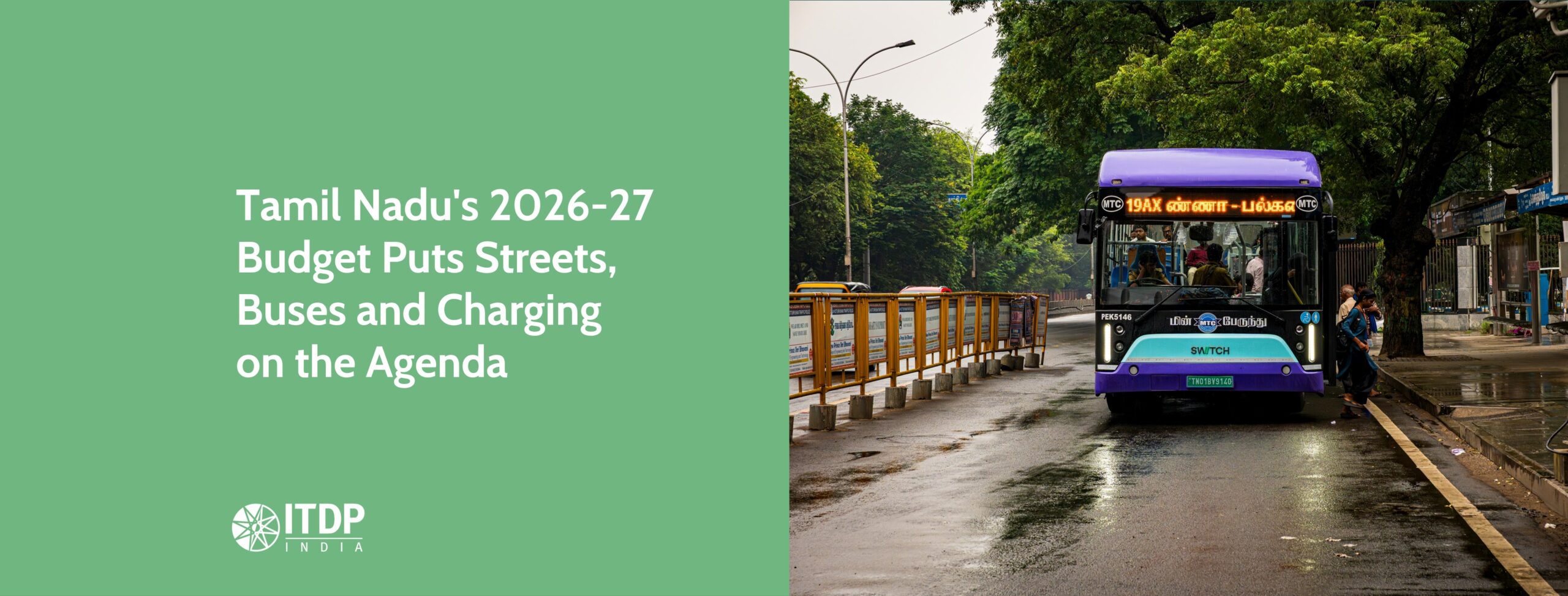
- MTC Chennai: 1,000 electric buses for Chennai and a Gross Cost Contract ( GCC) model: The Budget commits to 1,000 new air-conditioned electric buses for Chennai’s Metropolitan Transport Corporation (MTC), procured and operated under GCC model, where private operators are paid per kilometre operated. Furthermore, a dedicated ₹500 crore has been earmarked for depot infrastructure to support this expanded electric fleet.
Why we are glad: A fleet order of this scale, 1,000 buses in a single commitment, is a meaningful step toward decarbonising Chennai’s public transport and improving air quality across the city. Pairing the vehicle order with an upfront, dedicated depot infrastructure allocation is especially welcome: charging bays, grid connections, and maintenance yards are what determine whether an electric fleet runs reliably day to day, and developing this requires large investments. Funding them alongside the buses sets the rollout up to work in practice.
What we recommend: Depot selection could weigh proximity to high-frequency routes, grid capacity near substations and available land for charging and parking requirements. A mix of greenfield and brownfield depots would help – greenfield sites accommodate future network expansion, while upgrading brownfield depots lets the rollout prioritise existing high-demand routes early on.
Strict service-level KPIs are best written directly into the GCC tenders. On route selection, underserved corridors depend on opportunity-charging infrastructure at layover points, not just the depot, so full coverage may need to be phased – starting with routes ready today while charging infrastructure is extended to underserved areas over time.
- Diesel to Electric Bus Conversion: Around 100 diesel buses belonging to MTC Chennai, approximately 7 years old and in good condition, will be converted into electric buses and operated under the GCC Model. The necessary charging facilities and electrical infrastructure will be established at the depot, at an estimated cost of ₹13.6 crore.
Why we are glad: Retrofitting existing, well-maintained buses into electric ones is an efficient way to go electric faster, it makes use of buses already in good shape while still delivering the emissions and air quality benefits of going electric. Alongside the depot-level charging and electrical infrastructure investment, this shows a practical, infrastructure-ready approach to expanding the electric fleet.
What we recommend: Once these buses are running, sharing how they perform in terms of range, charging time and maintenance needs comparing to newly manufactured electric buses would be valuable in assessing conversion as a scalable model for the rest of the fleet. If it does, a clear plan for scaling up conversions across other ageing-but-serviceable buses in MTC’s fleet could offer a cost-effective complement to new electric bus procurement.
- Special Buses for School Students: Special buses will operate during peak morning and evening hours for school students in rural, hilly, and interior areas where public transport service is currently inadequate. These buses will serve 140 schools, benefiting approximately 19,000 students.
Why we are glad: This targets some of the hard-to-reach areas for public transport – rural, hilly, and interior regions, where students often face the biggest gaps in safe, reliable commuting options. Addressing this at the student level also has a ripple effect on families, easing the burden on parents who might otherwise need to arrange or accompany daily commutes themselves.
What we recommend: Ensuring safe, walkable access to bus stops – especially in hilly terrain where road conditions can be challenging – would help students reach these buses safely on both ends of their commute. Reliability will also be key, since these buses need to align closely with school start and end times; clear, consistent scheduling would help both students and parents plan their day with confidence.
Authors: Varsha V, Janani V
With inputs from: Vedavalli Vedantham, Bezylal Praysingh, Sooraj EM, Venugopal AV
Edited by Donita Jose