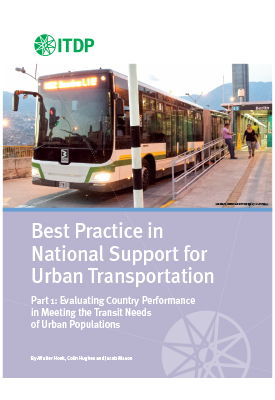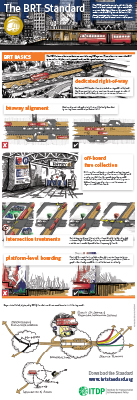
This infographic highlights the key features of BRT essential to any BRT system. These elements ensure that BRT systems have high operating speeds and provide a good customer experience.
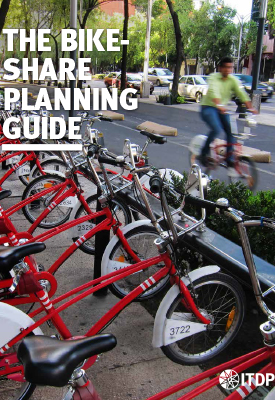
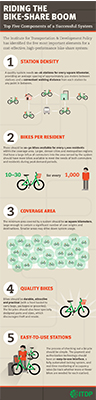
The Bike-Share Planning Guide establishes many important metrics and principles for evaluating bike-share systems around the world. Although each city makes bike-share its own, adapting it to the local context, many of the most successful systems share certain common features.
The Guide provides important standards and insights into best practices for building bike-shares, and this infographic highlights five of the most important metrics and performance indicators for achieving a successful system.
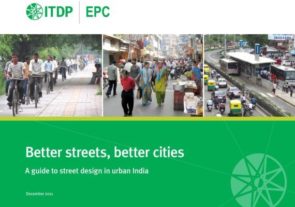
Current street design practice in India is often based on a vision of high-speed motorized mobility that does not take into account the variety and types of activities that actually take place in Indian streets. While streets are often designed from the centerline outward, Better Streets, Better Cities urges planners to explore an alternate approach that prioritizes the needs of pedestrians and cyclists.
The Chennai Corporation’s Council adopted a progressive non-motorised policy in October 2014 to make walking and cycling its priority. The policy aims to arrest the current decline in walking and cycling in the city by creating safe and pleasant network of footpaths, cycle tracks, greenways and other NMT facilities. Walking and cycling infrastructure—that until recently was at best an afterthought—will now take centrestage. The policy mandates that a minimum of 60 percent of the Corporation’s transport budget is allocated to construct and maintain NMT infrastructure—a clear demonstration of the Corporation’s commitment to creating safe streets that consider the needs of all users.
The city has set for itself ambitious goals: by 2018, build safe and continuous footpaths on at least 80% of all streets, increase the share of walking and cycling trips to over 40%, and, most significantly, eliminate pedestrian and cyclist deaths. The Corporation aims to achieve these goals by mandating various measures through this policy.
Download the policy here.

The cities of Tamil Nadu are witnessing rapid motorisation, along with increased congestion and pollution. Public transport service is often unreliable, infrequent, and inadequate to meet demand, resulting peak-hour overcrowding and a shift toward informal paratransit services. Walking and cycling are critical modes for many urban residents in Tamil Nadu, providing essential low-cost mobility. However, dedicated pedestrian and cycle facilities are almost non-existent in most cities.
To address these mobility challenges, the Commissionerate of Municipal Administration (CMA) launched Sustainable Cities through Transport, a planning process to develop municipal transport budgets for five of the largest city corporations in Tamil Nadu after Chennai including Coimbatore, Madurai, Tiruchirappalli, Tiruppur, and Salem.
The process was organised in partnership with the Institute for Transportation and Development Policy (ITDP) and with support from ICLEI–SA South Asia, adequately facilitated by inputs from municipal teams in the cities involved. The process sought to identify ways to provide safe, affordable, quick, comfortable, and reliable access for the growing number of city residents. In harmony with the 2006 National Urban Transport Policy, the process seeks out to achieve a more equitable allocation of road space by incorporating a focus on sustainable transport in the planning and budgeting stages.

Coimbatore is a prominent industrial hub and second largest city in the state of Tamil Nadu. The city has been witnessing rapid growth of vehicles especially cars and two wheelers. Due to the high vehicle volumes, there is significant traffic congestion in the inner city. Though walking and cycling account for a quarter of trips in Coimbatore, most streets lack dedicated pedestrian and cycling facilities. Even where footpaths are available, they are either narrow or encroached by utilities and parked vehicles.
The existing public transport system served by TNSTC does not have adequate good quality buses and is characterised by poor frequency, longer waiting times, and poor quality bus shelters. To actively promote safe and accessible sustainable transport with focus on reducing vehicular increase and pollution, the Commissionerate of Municipal Administration, Tamil Nadu, in partnership with ITDP has initiated the “Sustainable Cities through Transport” process.
In partnership with the Transport Department, ITDP has worked with Coimbatore to study the city’s public transport needs in more detail. The outcome is this feasibility study, which identifies a 74 km network for rapid transit. This document discusses the existing transportation system challenges, and identifies four corridors to implement an affordable, accessible, flexible, and cost effective mass rapid transit system.
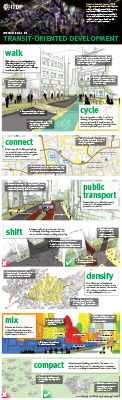
With the increased growth of cities and levels of urbanism in India comes challenges in the form of traffic, pollution, the need for equitable access to infrastructure & resources etc. all of which contribute in determining the quality of life. In the current situation where policy frameworks like JNNURM & SUTP are in place to address some of these issues, there is also a need for a framework for guiding development alongside these new & proposed transport infrastructure.
This framework is needed not only to maximize the impact of investments made under various policy heads, but also to contain urban sprawl by focusing development and densification of existing urban fabric, resulting in the creation of compact cities. There is also a need to identify financial mechanisms that would allow recapture of some of the increased value of properties around these transportation nodes.
Thus, this guide is meant to provide the said framework for planners, decision makers in the government, policy makers, developers as well as the general public to transform transit oriented development into reality.

In most Indian cities, parked vehicles dominate the public realm by consuming more and more of our cherished parks, plazas, streets and common spaces. Each parking space consumes from 15m2 to 30m2 and the average motorist uses two to five different parking spaces every day. Hence, many cities are questioning the current parking policy which dedicates scarce public space to car parking.
Parking management is a critical tool for achieving a variety of social goals. This booklet ‘Park it Right’ is a brief illustrated guide to principles of on-street parking management.

Gandhinagar is the capital of Gujarat state and has a population of 2,08,299.2 The city’s density is
approximately 7,900 persons per sq km. Much of the city is organized on a 1.0 km by 0.7 km grid. A
typical sector layout consists of convenience shops and community park in the centre surrounded by
residences, including both government and private housing.
The Gandhinagar Urban Development Authority (GUDA) is planning a public cycle sharing system with approximately 1,430 cycles and an initial coverage area of 21.8 square kilometres. Gandhinagar is a planned city, characterized by separated land uses with government facilities comprising the central sectors. Since most of the commercial activities and institutional land uses are concentrated in specific areas and given the lack of connectivity to other uses, the city sees a high level of dependence on personal motor vehicles for short trips. Cycle sharing will help address the connectivity gap, serving as an alternate means of mobility that links the residential, commercial and institutional sectors. It will help users get to work and finish daily errands in a quick and cost effective way.
Cycle sharing also will complement public transport services, including intercity services provided by the Gujarat State Road Transport Corporation (GSRTC), the local the city bus system VTCOS, and the planned Janmarg bus rapid transit link from Ahmedabad.

Delhi, the national capital territory of India, has population of 17.4 million1 and covers an area of 1,483 sq km. Delhi has been at the forefront of investment in transport infrastructure. It has a Metro network of almost 200 km—one of the largest in the world—and an extensive network of roads and flyovers. Yet the city experiences some of the worst congestion in the country.
Cycle sharing is considered a key element among these strategies to serve as an alternate mode of public transport in which people have access to cycles that can be used across a network of closely spaced stations. By encouraging a shift to sustainable modes, the cycle sharing will reduce dependency on automobiles, particularly for short trips in the city centre, thereby reducing traffic congestion, vehicle emissions, and demand for motor vehicle parking.
GNCTD has requested the Institute for Transportation and Development Policy (ITDP) to consolidate the existing cycle sharing plans for Delhi and prepare a detailed report, including the system design, proposed station locations, and a financial plan, for implementation of a first phase cycle sharing system. The proposed GNCTD Phase 1 cycle sharing system will have approximately 3,800 cycles and an initial coverage area of about 52 sq km.