The TOD Standard is a powerful tool to help shape and assess urban development. It focuses on maximizing the benefits of public transit and non-motorized mobility while placing the emphasis firmly back on the users: people. [Read more…]
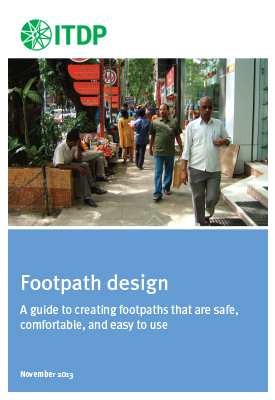
Footpath Design: A guide to creating footpaths
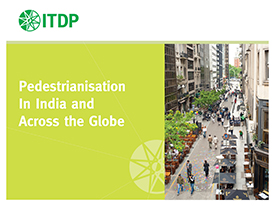
Walking is fundamental to urban life. It is a healthy and pollution-free form of mobility and recreation. Pedestrian trips account for a quarter to a third of all trips in many Indian cities. However, the poor quality of pedestrian infrastructure sends a message that pedestrians are not welcome in the urban environment.
Fortunately, street design practice in India is beginning to recognise the integral role of walking in any sustainable transport system. Increasingly, engineers and planners are emphasising the need to design “complete streets” that make walking safe, comfortable, and convenient. Reflecting this changing outlook, the Indian Road Congress’ (IRC) First Revision of the Guidelines for Pedestrian Facilities represents a significant departure from traditional traffic engineering practice, which focused on maximising personal motor vehicle speeds at the expense of other street users. The Guidelines emphasise the need to design streets for all users and activities, including the social and economic activities that make Indian streets so vibrant.
This quick reference guide highlights key concepts from the IRC Guidelines, including footpath design standards. The guide also draws from local and international best practice for some themes not covered in the IRC publication.
Parking basics
Parking is a mystery. Many public agencies push for more parking in buildings, but, rather than alleviating the parking problem, it leads to massive traffic jams, severe air pollution, and more road deaths. Under the illusion that density creates congestion, public agencies also control building density. However, it is parking, not density, that creates traffic congestion. Excessive parking supply that is cheap or free induces people to use personal motor vehicles—even when good public transport is provided.
Cities across the world are now realizing their past follies. They now follow a simple mantra—Add transit, Build density, Cut parking. Put another way, where there is good connectivity to mass rapid transit, building density is welcome but parking supply is not. Parking fee is pegged to parking demand—when demand increases, fee also increases. Revenue thus generated is used to build complete streets—with better walking and cycling infrastructure—and expand public transport.
Parking Basics outlines these key principles and steps involved in managing on-street parking and regulating off-street parking.
Better streets, better cities: A guide to street design in Urban India

Better Streets, Better Cities: a guide to street design in urban India illustrates ways that good design can help create safer streets and more livable public spaces. Current street design practice in India is often based on a vision of high-speed motorized mobility that does not take into account the variety and types of activities that actually take place in Indian streets. While streets are often designed from the centerline outward, Better Streets, Better Cities urges planners to explore an alternate approach that prioritizes the needs of pedestrians and cyclists.
The guide begins with a discussion of sixteen street elements, such as footpaths, cycle tracks, medians, and spaces for street vending, covering the importance of each element as well as implementation challenges and design criteria. While existing NMT infrastructure in Indian cities is implemented with good intent, design shortcomings resulting from a failure to account for the practical needs of pedestrians and cyclists often mean that these facilities remain unused. The guide indicates how these pitfalls can be avoided.
Next is a library of design templates for various rights-of-way, followed by sample intersections. The final section describes the process of street design—from data collection, surveys, and analysis to the preparation of final plans—using a real-world example of an urban intersection to explain methodological issues.
The guide can serve as a reference manual for municipal governments, practitioners, design consultants, and academic institutions. While the guide was developed considering Indian conditions, applicability in other countries can be explored.
This guide is available in both English & Gujarati.
Public cycle sharing systems: A planning toolkit for Indian cities
Maintaining high quality standards and excellent customer service will be critical to the successful roll-out of cycle sharing in India over the coming years. Public cycle sharing systems: A planning toolkit for Indian cities introduces the key ingredients of best practice cycle sharing systems. The toolkit draws from lessons learned from cycle sharing projects around the world while presenting adaptations to administrative structures and transport system typologies found in the Indian context.
Modern cycle sharing systems employ information technology systems to ensure security, provide real-time customer information, and facilitate the redistribution of cycles. These IT features enable the operator to ensure that cycles are available when and where users need them. IT systems also provide a way for the implementing agency to monitor system status and ensure that the operator meets service level standards. A combination of good engineering and constant oversight on the part of the government will ensure that cycle sharing systems can attract a diverse set of users.
The toolkit was developed on behalf of the Ministry of Urban Development, Government of India, as part of India’s National Public Bicycle Scheme. The toolkit reflects the input of numerous stakeholders during a series of public consultations in 2011 and 2012. ITDP wishes to thank the Chairperson of the working group, B. I. Singal, Director General of the Institute of Urban Transport, and all those who provided input and support for the preparation of the document.
The Bike-Share Planning Guide
More than 600 cities around the globe have bike-share systems, and new systems are starting every year. The largest and most successful systems, in places such as China, Paris, London, and Washington, D.C., have helped to promote cycling as a viable and valued transport option.
This guide evaluates international best practice in bike-share, helps to bridge the divide between developing and developed countries’ experiences to provide guidance on planning and implementing a successful bike-share system regardless of the location, size, or density of your city. For more information on the growth of bike-share systems, watch this Streetfilms video, Riding the Bike Share Boom.
Best Practice in National Support for Urban Transport: Part 2
Large cities of the world require strong coverage of rapid transit networks to ensure they remain competitive, and that local communities have a healthy environment, vibrant urban economy, and an equitable, high quality of life for all residents. Many cities—especially those with growing populations, incomes, and/or large infrastructure deficits—have not, however, built rapid transit at the scale and rate needed to meet mobility needs. This paper is Part 2 in a series of research papers that explores how countries can grow their rapid transit infrastructure.
Growing Rapid Transit Infrastructure: Funding, Financing, and Capacity, analyzes how the funding practices, financing practices, and institutional capacity impact a country’s ability to deliver rapid transit effectively. While the paper draws on the rapid transit database used in Part 1, it also uses an additional database compiled by ITDP with complete funding and financing details for 123 urban rapid transport projects, as well as data on urban transport capacity. To understand which countries are the most successful at growing their rapid transit relative to their urban populations, the paper focuses on the annual change in a country’s RTR, looking specifically at the period from 2000 to 2014. Countries are then evaluated according to this metric.
Best Practice in National Support for Urban Transportation
Part 1: Evaluating Country Performance in Meeting the Transit Needs of Urban Populations
With the world’s urban population projected to increase from 3.4 to 6.4 billion between now and 2050, the sustainability of the earth will depend on these new urban residents living as sustainably as possible. One key element of this will be making sure the majority of these new urban residents can live well without depending on the use of the private automobile. Success in large measure will depend on whether the expansion of urban mass transit systems will be able to keep pace with this rapidly growing urban population. Many innovative cities have, on their own initiative, brought about significant long term shifts away from private car use. Overall, however, cities have not expanded their mass transit infrastructure at a pace sufficient to meet the growing needs of their new urban residents, or to stem the risk of irreversible climate change.
In a few countries, like Colombia and Mexico, national governments have played an important role making sure that cities have the financing and technical assistance they need to meet their growing mobility challenges.This paper explores where, whether, and how cities have obtained sufficient help from their national governments to meet their growing urban mobility challenges. With the growing risk of permanent damage to the earth from climate change, it has become imperative to figure out whether there is a role for national governments, and then what that role is, in scaling up municipal level successes to achieve national level changes in urban mobility patterns.
Transport Oriented Development Poster
Transit-oriented development (TOD) brings compact, mixed-use development within walking distance of high capacity rapid transit.
TOD features vibrant streetscapes, pedestrian-oriented built forms, and land use characteristics that make it convenient and safe to walk, cycle, and use public transport.
This poster demonstrates the principles for good Transit Oriented Development and the essential features required for it.
Mobility for all at Ranchi
Ranchi, the capital city of Jharkand is fast urbanising. Though the state remains largely rural, Ranchi and the other cities have been rapidly growing with the influx of people from the hinterland in search of opportunity. These cities need to be planned and manage to provide a safe, affordable, attractive and inclusive environment for the citizens.
With a good transport system comes better connect between people and also more sustainability- socially, economically and environmentally.
The lack of a formalized public transport system in Ranchi has led to dependence on private vehicles and paratransit for day-to-day travel, congestion and safety issues. While most of the new transport initiatives deal with road widening and flyovers, there have been no concrete efforts to address the people’s need and propose genuine solutions.
The Ranchi Mobility Charter, developed by the Ranchi Mobility Partnership led by ITDP calls for a development model that focuses on a high-quality bus based transport system, parking management and a pedestrian friendly outlook.
- « Previous Page
- 1
- 2
- 3
- 4
- 5
- 6
- …
- 8
- Next Page »