As published in The Hindu(Tamil)
For decades now, the opening of a new flyover has been the ultimate symbol of political progress. These towering structures of concrete and steel were marketed as the ultimate solution to congestion and a promise of modernity and speed.
But ask any commuter on any major artery in our cities, and the answer is clear: the promise has expired. The congestion returns, often worse than before, while the immense investment delivers only fleeting relief for a small segment of commuters.
The larger public sees very little benefit.
The core problem here lies in an old belief in city planning: that we can build our way out of traffic. In reality, new roads encourage more people to use private vehicles. When driving becomes slightly easier, more cars and two-wheelers come onto the road. Soon, congestion returns. This cycle keeps repeating and cities keep spending huge public money on projects that are both environmentally and fiscally unsustainable.
Globally, most forward-thinking cities have begun to question this approach. One famous example is Seoul in South Korea. The city famously dismantled a massive elevated highway through its centre, over the Cheonggyecheon stream. Many feared traffic chaos. Instead, Seoul gained a six-kilometre public park, better air quality, a 15% increase in public transport use, and rising property values. Traffic did not increase. The city became healthier and more liveable.
San Francisco, Portland, and Paris have followed suit, removing urban highways to reclaim space for people, not just vehicles. These cities recognised that the competition for the future isn’t about which city is fastest to drive through, but which is the most desirable to live in.
So, what is the political alternative in Tamil Nadu? It’s a platform that addresses the actual anxieties of the 21st-century voter: the crushing cost of living, the daily drain of the time-tax commute, and the health burden of toxic air.
1. Fiscal Responsibility: Better Use of Public Money
Flyovers are extremely expensive. One kilometre of flyover can cost ₹200 crore or more. This money serves a limited number of private vehicles. In contrast, the same amount can fund solutions that help far more people.
For example, well-planned Bus Rapid Transit (BRT) corridors can move seven to eight times more people per hour than a flyover. The same budget can also buy around 100 electric buses or build over 100 kilometres of safe footpaths and pedestrian-friendly streets.
The real question for governments should be: how can public money help the maximum number of people? Flyovers benefit a minority. Strong public transport systems benefit everyone—office workers, students, elderly citizens, women, and low-income families. From a financial point of view, investing in buses, walking, and cycling gives far better returns for taxpayers.
2. The Daily “Time Tax” on Citizens
For city residents, time has become a hidden tax. Hours are lost every week in traffic jams. This affects work, family life, health, and mental well-being. For professionals, small business owners, and gig workers, time lost is income lost.
A city with frequent, reliable buses and good last-mile connectivity gives people back their time. Shorter and predictable commutes improve productivity and reduce stress. Today, many employees value an easy commute as much as salary hikes. Real estate prices already show this—areas close to good public transport are in high demand.
When governments invest in strong public transport, they are not just improving mobility. They are strengthening the economy. Reduced travel time means more efficient cities and happier citizens.
3. Public Health and Quality of Life
Our cities are struggling with pollution, noise, and unsafe streets. Transport is one of the biggest contributors to air pollution and climate emissions. Every new flyover encourages more vehicle use, which worsens air quality.
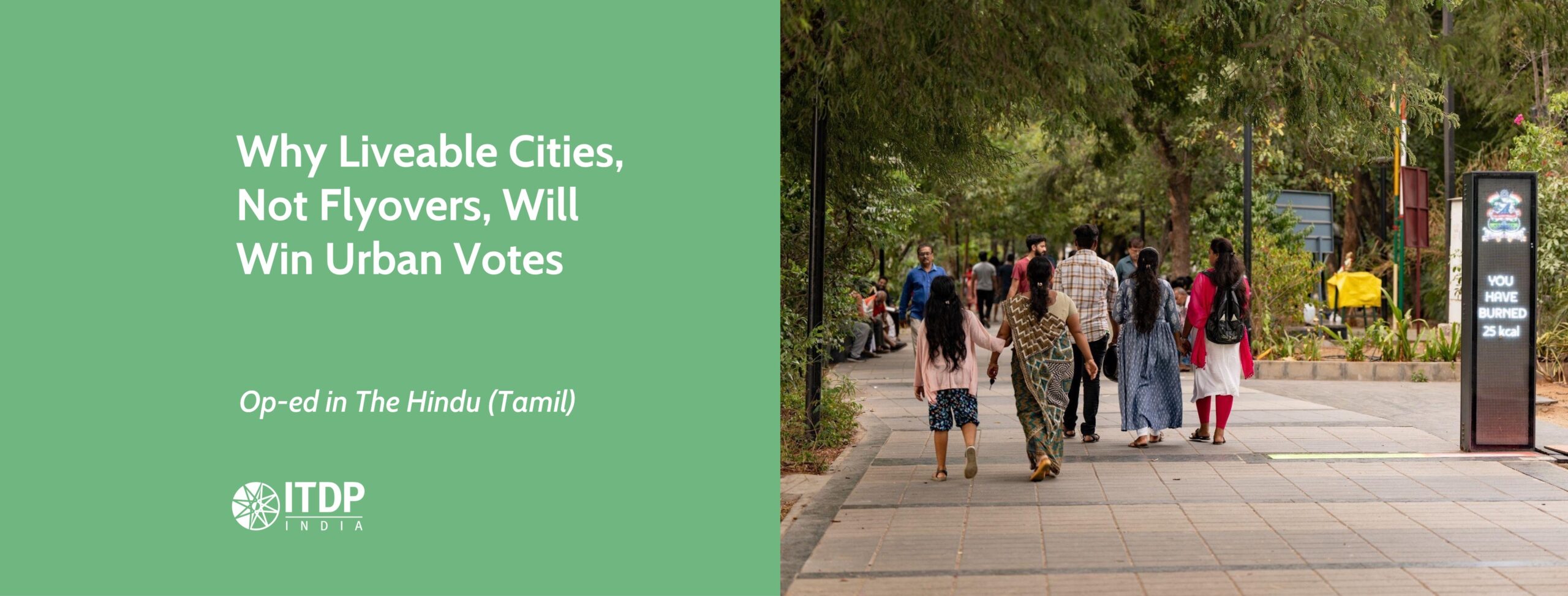
The alternative is cities designed for people. Safe footpaths, cycle tracks, shaded streets, and green spaces make cities healthier. These changes reduce respiratory illness, traffic accidents, and stress. Children can walk safely. Elderly citizens can move around without fear. Neighbourhoods become connected instead of divided by large concrete structures.
This is not a luxury idea. It is about basic health, safety, and dignity in everyday life.
What Voters Want Today
The voter is no longer impressed by a photo-op on an empty flyover. They are counting the hours lost in their week, calculating the fuel burning a hole in their pocket, and worrying about the air their children breathe. They are choosing quality of life.
The winning manifesto will not list flyovers. It will pledge a statewide transit revolution – a commitment to doubling bus fleets, digitizing payments, and integrating schedules and ticketing so that a seamless multi-modal journey is a reality. It will promise to reclaim street space for people, turning dangerous corridors into complete streets. It will frame mobility not as a civic engineering challenge, but as the backbone of a prosperous, healthy, and efficient Tamil Nadu.
The world’s most admired cities have learned that you cannot build your way to prosperity with more concrete. Tamil Nadu has the chance to leapfrog the mistakes of the past and build truly smart, sustainable cities. The question is not whether we can afford to make this shift, but whether we can afford not to. The voter on the crowded bus, the parent worried about polluted air, and the citizen tired of traffic jams are waiting for an answer. And their votes will reflect it.
Authored by A V Venugopal is a Program Manager at ITDP India, based in Chennai, where he leads sustainable mobility projects focused on street transformation and parking management. His work spans Tamil Nadu and extends nationally, in close collaboration with a multidisciplinary team.